Paul Garner’s The New Creationism (2009) is, in its own right, a competent book. Coming to it from within a young-earth creationist framework, I don’t think it’s dishonest or lazy. Garner sets out a defined and modest goal: to demonstrate that plausible scientific models exist which map on to the conclusions entailed by a creationist reading of Genesis. He is not attempting philosophy; there’s no questioning the assumptions of modern science. He is not interrogating his own interpretive assumptions about Scripture; he doesn’t do an explicit run-down justifying his exegetical framework. He takes a run-of-the-mill YEC hermeneutical framework as is and asks, simply, whether science and it can be made to wed. On those terms, he largely succeeds at least for the models available to him in the late nineties and early two-thousands.
And yet the book is, for my purposes, radically unhelpful. This is not entirely Garner’s fault. On one hand, the evidence and models are out-of-date and the rhetorical style is too summary-driven to build genuine conviction in the reader. On the other hand, he is immersed in a cultural environment which takes many things for granted. But the deeper problem is one the book never acknowledges and, in certain ways, actively compounds. Garner operates within an essentially naturalistic and objectivist model of inquiry. He tacitly embraces the notion that knowledge is an enterprise of neutral evidence-gathering and model-fitting. This makes him hardly different from any other creationists doing science. It’s extraordinarily rare to see anyone asking whether their framework is coherent (or whether they’re uncritically taking on their opponents framework).
And within the model he operates, Garner provides data but sidesteps important issues. For example he dismisses radiometric dating on grounds of evidence which could easily be construed as anomalous (at best). He presents plausible stories but gives the reader no tools for weighing them. And finally, his seeming implicit suspicion of those who would question his conclusions, a kind of shy posture of his presentation, makes it very difficult for any genuine skeptic, non-YEC christians included, to engage without feeling pre-judged.
This points to the real problem, which is not the book’s particular arguments but the epistemological framework it silently assumes and shares with many of its critics.
Providing good data or a good alternative story is insufficient if the underlying theory of knowledge is broken. Garner’s models, even the best of them, cannot move a reader whose priors are organized differently and he does nothing to address those priors. This is the Bayesian heart of the matter. If I am a committed naturalist, the prior probability I assign to any divine act in history is, by stipulation, effectively zero. No amount of geological evidence for a global flood will alter my conclusions, because the flood’s supernatural cause is ruled out before the first piece of evidence is evaluated. Conversely, if I accept the flood on theological grounds, the rock record opens up in ways that compress geological time dramatically, and evolutionary timescales collapse accordingly. These are not just disagreements about data. Granted there is data involved, but we are using essentially different models to parse it. If it was just data, we could all go do some field work and resolve it relatively simply.
The trouble is that neither party is typically honest (to themselves) about this. The naturalist often presents their epistemology as though it were simply “ the science.” That is, a neutral view-from-nowhere method that anyone reasonable would adopt. But naturalism is itself a prior, not a conclusion. It is a decision, made before the evidence is examined, about what kinds of causes are admissible. And all our beliefs are this way—they are decisions we commit to prior to evidence or reason. The creationist who dismisses radiometric dating on theological grounds is doing something structurally similar, but at least is usually more explicit about it. They follow “what the Bible says” and filter evidence that way. These are both problematic, of course.
But what’s more pernicious is the skeptical posture that is invisible to itself. You see, if one assumes that one’s own epistemic tools are simply “rational inquiry” while the opponent’s (the rest of the world) are “faith” or “bias.” The skeptic’s lens changes what they see, but the lens itself goes unexamined. This is the foundational error, and it is not unique to any one side of this debate. In fact, we all do this. I am guilty of this too, no question.
This epistemological failure has a name when it becomes habitual: suspicion. And suspicion, when it hardens into a hermeneutic, destroys not just arguments but people.
The suspicious mind does not engage with what its opponent actually says. It looks for what the opponent must really mean. It asks: what’s the hidden motive, the tribal allegiance, the bad faith lurking beneath the surface of the stated position? When someone challenges a cherished belief, the suspicious interpreter does not ask: what is the most charitable reading of this challenge? Instead, they identify the person as either part of their group or not, and use that as a basis for ascribing their reasons and motivations. And having psychoanalyzed the questioner, they feel free to dismiss the question without answering it. This is often called well-poisoning and it comes from the suspicious mind.
This is a type of hermeneutic of suspicion in its most socially destructive form. It does not show up only in academia, where it has a respectable pedigree. It shows up at the dinner table. It shows up in the conversation between a parent and a child who has started to doubt.
The pattern is familiar to anyone who has spent time in strongly evangelical or young-earth creationist communities, though it is by no means limited to them (as I have heard of the direct reverse of this example too). A child raises a question. Perhaps about evolution, or about a passage of Scripture that doesn’t sit right, or about the age of the universe. And the question is not answered. It is adjudicated. The parent decides, often unconsciously, that the question is not a genuine inquiry but a symptom of bad influences, of pride, of the first steps away from faith. The question is treated as a threat rather than an invitation. And the child, sensing that their intellectual honesty is being read as betrayal, learns either to stop asking or to stop sharing. Or worse than that, sometimes the child is ostracized, losing that relationship permanently.
This is a catastrophic failure, and it cannot be fixed by better arguments. The problem is not that the parent lacks a good answer to the question about radiometric dating or archaeological records. The problem is that they have pre-judged the questioner’s intent and, in doing so, have abdicated the most basic responsibility of love: to understand the other person on their own terms before responding.
And yet, and this needs to be said plainly, the skeptical child is not innocent either. Questions can be genuine, or they can be rhetorical. It is entirely possible to ask a question you already believe you know the answer to, not because you seek understanding but because you want to establish your own position without exposing it to scrutiny. It is possible to use doubt as a crutch, i.e., a way of staying comfortable in uncertainty without doing the hard work of actually following the argument wherever it leads. It is possible to use questions as a tool to demonstrate intellectual superiority, because of the same genus of suspicion the parents may have held. Therefore, neither party in these conversations is automatically the victim. Yet, clearly a parent’s role is quite different, based on their natural responsibilities.
Moving to another political question in the US, the Governor Spencer Cox situation is a useful illustration of how quickly this breaks down in public life. In the aftermath of Charlie Kirk’s assassination, Cox made a statement that he had prayed the killer would not be a Utah resident. Several media outlets and commentators interpreted this as an expression of xenophobia. They took it as a wish to scapegoat a foreigner. One framing put it that Cox had “hoped to blame the killing on an immigrant.”
It is perfectly plausible—in fact, considerably more plausible—that Cox simply meant what he said: he had hoped the shooter wasn’t from his own state. No xenophobia or racism needed. But when a person has been categorized as part of an ill-intending elite, suddenly charitable exegesis cannot even be considered. The suspicious reader does not offer the generous interpretation to then reject it. They usually never consider it at all. The conclusion comes first, and the reading is constructed to confirm it.
This is the same error the excommunicating parent makes, and the same error the dismissive skeptic makes. It is a one-and-the-same error of deciding, in advance, that the person you disagree with is not rational enough, or honest enough, or good-faith enough, to be taken at their word.
There is no logic or facts-based fix for this. You cannot reason someone out of a posture they did not reason themselves into. But there is a solution, and it begins with a simple commitment: empathy.
This means resisting the first interpretation that comes to mind when someone challenges your worldview, and asking whether there is a more generous reading. It means treating the person across from you as someone who arrived at their position through some combination of experience, reasoning, and honest conviction—how would you be able to tell otherwise, anyway? It means being willing to say “I don’t know” without treating that admission as a defeat and being willing to accept that some will treat it as victory. It means recognizing that your own epistemic tools are not neutral, that your priors are not simply reason, and that the discomfort of examining them is the price of intellectual honesty.
For Christians and creationists in particular, though again, this applies broadly, there is something theologically incoherent about treating people who ask hard questions as enemies. If you believe that truth is not threatened by honest inquiry, then honest inquiry should not threaten you. If you believe that love is the first obligation, then the person asking the question is the first obligation—not the question.
Ken Ham has no difficulty identifying who is wrong and explaining why. That is easy. What is harder, and what matters infinitely more, is how you treat the person who is wrong (or who you believe is wrong). How you treat people in the moment of their doubt is not a secondary concern, it is the real work. The only work that can actually open a conversation rather than close one.
So how do we have an open conversation? How do we have an empathetic mind? We need to be able to step back and ask: “Why are you asking that question? What’s behind it?” Asking that first protects you from falling into the trap of holding suspicion. The alternative is a world of building walls. We need to step back from the approach to conversation-as-war. It’s not. So many of us act like it is, and the damage matters here. It makes the cost of even asking questions too high a barrier for entry.
Openness is, as it happens, the only epistemic strategy that can actually get you to the truth. Not the indifferent agnostic openness, but active, deliberate, uncomfortable practice of checking your own worst interpretations against the most generous alternative. When you catch yourself saying that someone is lying, stop. When you find yourself assuming that what a person plainly says must really mean something more sinister, stop. These are not signs of rigor or a critical mind. They are signs that you have prioritized the security of your own position and a suspicious mind over the person standing in front of you. Therefore, we should trade our suspicious mind with an empathetic mind which strives for humility, generosity, and grace in interpretation.
Citations:
Balta, Hugo. “Governor Cox’s Prayer Wasn’t Just Misguided—It Was Dangerous.” The Fulcrum, 14 Sept. 2025.
Garner, Paul. The New Creationism. EP BOOKS, 2009.
Dr. Cornelius G. Hunter, a Biophysicist and Computational Biologist at Biola, wrote an excellent paper on the evolutionary predictions made by theorists and the unexpected findings that followed. Unfortunately, Dr. Hunter’s website no longer has this article available for viewing.
Therefore, I have decided to temporarily make the document available here. That is, until either Dr. Hunter requests I take it down, he republishes, or submits a revised version. I assume the former will not happen, since the article was public and free to view.
If you haven’t read it before, I suggest you do so. It is well worth it.
Recently the popular creation skeptic Randal Rauser, who goes by the Youtube moniker of “The Tentative Apologist,” posted a video titled, “Why Young Earth Creationism is Irrational and Harmful.” In it, he laid out his case for why evangelicals should not embrace young earth creation as well as a general methodology for laymen wherein they conform to the expert opinion—specifically the expert majority opinion. While I do believe he is good-hearted and well meaning, the video exemplified the innate depravity of the modern “scientismist” view. He covered the bases so well and so thoroughly that I thought it apt to do an in-depth exegesis and logical analysis of the claims he made. My hope is that this case study can be instructive on how to critically think, this is not meant to be a dunk on Rauser.
Argument #1: Social Contingency
He begins his criticism of the young earth creationist movement by citing the book “The Creationists” by Ronald Numbers. Dr. Numbers is a historian of science who was the son of a fundamentalist Seventh-day Adventist preacher and later left becoming a self-proclaimed agnostic. Numbers’ thesis is that the modern movement of creationism began as an Adventist movement. Rauser notes:
“The modern creationist movement actually comes from Seventh Day Adventism and particularly young earth creationist George McCready Price… As a result, young earth creationism became the mainstream view held by the emerging fundamentalist movement of the 1920-30s which was a reaction to the growth and perceived compromise of mainstream denominations and university-based divinity schools.”
The real beginnings of modern creationism started not by an Adventist in the 20s but by Baptists in the 60s. Although Rauser acknowledges this, he points out that “The Genesis Flood” by Morris and Whitcomb was heavily influenced by Price’s work several decades earlier. While it is true that Price played a large role in the model put forth in the 60s, it is important to note that Price, Morris, and Whitcomb were not writing in a vacuum.
Who was Price influenced by? And if we are to say (rightly) not by Adventists, then you cannot simply argue that modern young earth creationism is an adventist movement.
Price was citing Anglicans, Presbyterians, Congregationalists, Baptists, and Reformed geologists. To name a few non-adventist geologists: Thomas Burnet (Telluris Theoria Sacra, 1681), John Woodward (An Essay Toward a Natural History of the Earth, 1695), William Whiston, Granville Penn, George Fairholme, Sharon Turner, George Young, George Bugg, John Murray, David Lord, and Tayler Lewis.
Seventh-Day Adventism wasn’t alone in holding to young earth creationism at that time, either. Many traditional Christian denominations—including Anglicans, Lutherans, and Eastern Orthodox all held semi-official doctrines or official dogmas on the young age of the earth. Figures like the Anglican Bishop James Ussher, Lutheran doctrines and dogmas such as the Westminster Standards (1643–1649) and the 1967 resolution of the LCMS affirmed the six day creation and young earth, and the Orthodox Anno Mundi calendar (held as the official calendar in most Eastern traditions) dates creation to approximately 5508 BC. Some modern Orthodox theologians argue that a literal reading of Genesis 1–2 remains the historic teaching of the church up until the 19th century.
While it is true, Price definitely filtered the former creationist flood models and understandings through his adventist interpretive framework, yet Morris and Whitcomb filtered Price through their Baptist/Evangelical framework.
This is all very important to bring up because Ronald Numbers’ view of the history of creationism is a very prevalent one in current culture and it is told by people who either fallaciously aim to discredit the movement as a prophetic fad or seek to over emphasize credit to Price, likewise to dismiss the important work of early creationist field geologists. Both of which count as genetic fallacies, of which we will cover shortly.
So, then, why does Rauser, himself, open with this remark (of all remarks)?
His answer:
“It doesn’t make young earth creationism right or wrong—it doesn’t tell you anything per se about the science, but it does show you the social contingent historical origins of the young earth creationist movement. And for people who are taught, then, that young earth creationism just is the standard historical orthodox christian perspective to understand and see through the lenses of a historian just how contingent and limited the origins of this modern movement are, really helps to contextualize it and raise the level of prima facie skepticism that one should have about this movement.”
Rauser is being fair when he points out this cannot be evidence of the truth of young earth creationism. And, for a second, I just want you to pause on that.
He has realized that if he were to do so, it would be a genetic fallacy. That is, it would be a dismissal of the arguments and evidence of creationism, not on the basis of evidence, but on the basis of source or origin.
Unfortunately for Rauser, the point he ends up making is likewise… a genetic fallacy. To argue that a movement, especially and particularly of the movement of scientific inquiry, can be discredited because the scientists who penned it were unorthodox is to deny the entire enterprise of science altogether.
He argues fallaciously to what end?
In order to “raise the level of prima facie skepticism.” Prima facie is latin for “at first sight.” What Rauser is communicating to us is that we should make a prior commitment to the falsity of the creationist movement.
Based on what grounds?
On the fallacious grounds of a socially contingent historical analysis, that is moreover historiographically asymmetric and based on the presuppositions of a former seventh day agnostic critical scholar. This is essentially a non-attempt to engage with any evidence (apart from pseudo history). In the philosophy of science, all movements are socially contingent.
To his credit he mentions Bishop James Ussher, however methinks he doth protest too much.
“And just to be cautious here, I do clarify that this is modern. There have been young earth creationists throughout history. The most famous example is Arch Bishop James Ussher, a British theologian and Bishop who attempted to date the origins of the universe to 4004 BC, writing in the seventeenth century. But his views aren’t the same as the modern young earth creationist movement that really traces to this influx of seventh day adventist prophetic theology into modern fundamentalism.”
Well, I’ve got exciting news, Rauser! Modern creationists don’t hold to Price’s view either. In fact, modern flood geology is based on models of catastrophic plate tectonics (CPT) which were exposited by Dr. John Baumgardner in the 90s. The model has been refined since then, but it is the model of neither Price nor Morris and Whitcomb.
This is what’s often called, in philosophy, a symmetry-breaker. You see, Rauser wanted so badly to articulate that early creationists, that are not Adventists, don’t count because they have different models. But if that rule were applied evenly, the start of the modern creationist movement would be pushed to the late 90s! If Rauser defines a movement by its specific mechanics (e.g., Price’s specific model), then he cannot logically link Morris and Whitcomb to Price while simultaneously distancing Ussher from Morris.
Argument #2: Appeal To Experts
Rauser begins his next line of argument with a question:
“The first thing I want to ask whenever people come up with a minority view is: ‘what do the experts say on a particular issue?’ This is true across the board. We should be very careful about engaging in special pleading where we apply a different standard in one area than another just because that suits our bias.”
The first thing I would like to ask Rauser is: what is an expert?
To evaluate who the experts are and which experts to defer to, you already need independent critical judgment. Yet, to say that we should rely on experts is an explicitly uncritical statement.
Rauser warns against special pleading, yet his own methodology treats historical science as if it were identical to operational science. We defer to “experts” like surgeons or pilots because their expertise is constantly validated by immediate, repeatable results. If a surgeon is “irrational,” the patient dies; if a pilot is “irrational,” the plane crashes.
In contrast, “experts” in historical geology or evolutionary biology are constructing narratives about the unobservable past. There is no immediate “feedback loop” from reality to verify their conclusions. By demanding the same level of uncritical deference for historical narrative as we give to operational technology, Rauser is the one engaging in a form of special pleading.
This is not to say Geologists don’t make predictions about, say, where to find oil, what rock strata will look like in unexplored regions, which fossils should exist in which layers… and those predictions get tested. But these are distinct from the narrative they tell about the data. The framework is what is in question in the origins debate, not the facts on the ground.
To make Rauser’s argument clear, we can formulate it in a syllogism:
Premise 1: Most minority views are wrong.
Premise 2: Creationism is a minority view.
Conclusion: Therefore, it is rational to assume Creationism is wrong.
While, you might suppose premise one to be statistically probable generally, the problem is that it’s an extremely weak inference that does almost no epistemic work, especially when the minority view comes with substantive arguments that need engaging on their merits.
It only takes a few history books to see that in every case, the maverick was right and the credentialed majority was wrong. Wegener had his continental drift theory rejected for decades by the geological establishment despite compelling evidence, Galileo was faced against ecclesiastical and academic authority simultaneously, Fleming was largely ignored for over a decade after discovering penicillin, and J Harlen Bretz proposed a massive catastrophic flood event which was ridiculed by the geological establishment for roughly 40 years. Other examples which we more readily accepted, but still independent thinkers are Copernicus, Bacon, Newton, Einstein, Pasteur, McClintock, Marshall and Warren with H. pylori.
That’s not to mention the founders of the mainstream paradigm: Hutton, Lyell, Darwin, Wallace, and Mendel. Hutton and Lyell had to fight tooth and nail against flood geology in intense philosophical debate. Darwin and Wallace spent decades contesting the theory of natural selection. Mendel was entirely ignored for 35 years and only rediscovered posthumously. Yet, these are their icons. This is literally historical amnesia. How can Rauser seriously be saying that we should just default to the consensus? How could any science be done that way?
This is not to say that creationism is right or that the minority is right. I only claim the epistemically humble position: the experts aren’t always right. However, can we embrace his less abrasive claims?
“Experts are not infallible, but all things being equal, you want to go with the experts… You don’t want to go, all things being equal, with the very significant minority.”
This is a particular and different claim. Notice that in the equation he’s drawn, there are no non-experts. But he argues, the majority of experts will be a better place to hang one’s hat—all things being equal.
All things being equal.
I want to highlight a couple angles on this qualifying phrase that Rauser uses. First, what does it mean for all else to be equal? How is that metric reached?
In order to evaluate equality, we need some metric to evaluate the models in question. This means evaluating their explanatory power, internal consistency, relation to the data, and presuppositions. Yet, by the time you’ve done this, you are no longer relying on the experts, you are doing the work of an expert.
Rauser is asking the layman to exercise a form of meta-expertise. He is suggesting that while a layman isn’t qualified to judge the geology, they are qualified to judge the geologists.
This is a precarious position. If a layman is not equipped to understand the nuances of Catastrophic Plate Tectonics (CPT) vs. Uniformitarianism, how are they equipped to judge the social and institutional pressures that produce a “majority”?
What’s more, in the origins debate, “all else” is never equal because the starting presuppositions are diametrically opposed. You can’t even get any kind of equality when the foundations of either edifice cannot be compared to begin with.
Argument #3: You Have To Teach!
He closes that section off with a criterion for engagement:
“Here’s a basic way to test your expertise: how prepared are you right now to give a one hour introductory lecture to any of these fields… geochemistry, or geochronology, or molecular biology?… The ability to give a one hour lecture is at least a minimal threshold to even have a further conversation.”
Rauser’s “one-hour lecture” rule is an elitist filter that ignores how human knowledge actually functions. You do not need a degree in geochemistry to identify a logical contradiction in a geochemist’s paper, nor do you need to be a molecular biologist to understand the statistical impossibility of certain evolutionary transitions.
Take the example of a court of law. In a court of law, we do not require jurors to be able to give a one-hour lecture on DNA sequencing or ballistics. We expect them to use their independent critical judgment to weigh the testimony of competing experts.
Furthermore, most experts are hyper-specialized. A molecular biologist might not be able to give a one-hour lecture on geochronology, yet Rauser would likely still accept their “expert” opinion on the age of the earth simply because they belong to the same “consensus club.”
Argument #4: You Have To Explain!
“If you are a young earth creationist and you’re dismissing 98-99% of experts, you then have to give an explanation for how 98-99% experts could be wrong about some significant issue like the age of the universe, the age of earth, and the origin of species upon the planet. And this is where we’re going to tend to come into accounts which are boarding in the dangerous area of conspiracy theories.”
Rauser says you “have to give an explanation” for how the experts could be wrong. The explanation is actually quite simple and historically grounded: Science is not a democracy. Truth is not determined by the number of PhDs who agree, but by the correspondence of a model to the physical data.
When the majority holds to a flawed paradigm, they will consistently interpret all new data to fit that paradigm (a process called “epicyclic adjustment”). It takes a maverick to step outside the circle and show that the data actually fits a different, more robust model—like Catastrophic Plate Tectonics.
By labeling this “conspiratorial,” Rauser is effectively saying that the only rational choice is to never challenge a majority. This is the very definition of historical amnesia.
“Maybe you’re influenced by Thomas Kuhn’s historical understanding of the progress of science and you say ‘all these evolutionists are just locked into a naturalistic paradigm and they can’t see all the evidence for young earth creationism.’ But what that effectively does is it’s going to breed skepticism about expertise generally which is probably going to spill into other areas… in favor of various conspiracy theories.”
Please, reader, take a big gulp of the irony here. There is enough to go around.
The skeptic is worried about skepticism. The very people who will argue that Christianity or theism are ridiculous. The very people who can hold much incredulity to the largest consensus belief in the world are now going to explain why skepticism is a bad methodology.
By warning against skepticism, Rauser is effectively discouraging the very “critical thinking” he claims to promote. To be “critically minded” is, by definition, to be skeptical of claims—especially those that demand uncritical deference.
If an expert cannot explain the data to a thinking layman without resorting to “trust me, I’m an expert,” then their expertise has become a form of sophistry.
Argument #5: The Harmful Belief
“All of this means that allowing young earth creationism to proliferate unchallenged among the evangelical and fundamentalist protestant Christian subculture does enormous damage to the integrity and the witness of Christianity in North America.”
This last point is supremely interesting. Does he think, first of all, that creationism has gone unchallenged in Western society? Even among evangelical and fundamentalist movements, there is a clear pressure to conform to the infallible doctrine of scientism.
Does he think the Christians will gain ground in culture, if we give up ground? Will we convert more to the truth, if we tell lies?
Let’s call out this appeal to the harm of young earth creationism for what it is—eurocentric scientific elitism. This argument only carries weight in the West, and it should really carry weight nowhere, because it is simply not an argument.
Final Thoughts:
Rauser’s case study is a masterclass in Scientism—the belief that the methods and conclusions of the natural sciences are the only source of genuine knowledge. His methodology requires the layman to be a passive consumer of institutional output rather than an active, critical thinker.
By deconstructing his arguments, we’ve shown that:
His history is socially contingent and misses the broader tradition and trends.
His “Expert Appeal” is circular and ignores the history of scientific revolutions.
His “Lecture Test” is elitist gatekeeping which ignores how we evaluate data.
His “Harm” argument prioritizes social comfort over consistency and truth.
To summarize, we should evaluate each model based on the evidence, parsimony, predictive success, presuppositions, coherence, consilience, etc—take your pick. We should not be evaluating the models on external factors such as perceived harm, individual comprehension, appeals to consensus, appeals to experts, and appeals to novelty or social contingency. These in the latter list do not help us in the project of “how to think.” And the project of “who to trust” has always been a very dangerous game.
The Created Heterozygosity and Natural Processes (CHNP) model, proposed by Nathaniel Jeanson (Jeanson, 2016), suggests that a significant amount of genetic diversity in originally created organisms was frontloaded rather than accumulating slowly through random mutations. Implicit in Jeanson’s model is the postulate that all diversity in humankind has emerged from two biallelic individuals. Little work has been done to explicate original allelic morphologies in created kinds, therefore this study will address this gap in the CHNP model by identifying functional genes (the frontloaded heterozygosity) and their deleterious variants. This study also aims to give quantified rates of mutations necessary for novel allelic frequencies. Doing so allowed for testing the two primary predictions of the CHNP model: (1) Mutations accumulate at a semi-constant rate, and are sufficient to explain novel diversity beyond the initial biallelic kinds and (2) initial created kinds were highly functional and optimized, containing no non-functional or suboptimal gene variants, therefore only function will be shared across lineages. We analyzed a variety of gene families (including CLLU1, MHC, LCT, ABO, Rh, KIR, NANOG, AMY1, DARC, GULO, and FOXP2) and found that initial functional alleles are highly conserved across species, while loss-of-function alleles are species-specific. Balancing selection reveals conflicting and contradictory hypotheses for the origin of alleles leading to the evolutionary explanations becoming ad hoc. The observed mutation rates for diversification of original biallelic pairs falls in the estimated 6000-year timeframe. These findings dovetail with prior CHNP research for known modern rates of molecular clock data (Jeanson, 2019). The results of this data are best explained by the CHNP model, as these genes produce young, discontinuous phylogenetic trees which begin with two variants and later branch into homozygosity. The data strongly supports genetic drift, founder effects, and weak selective pressure for all gene families.
Introduction
The key tenets of CHNP are frontloaded genetic diversity followed by rapid diversification into more homozygous populations via recombination, genetic drift, and regulatory mechanisms all amplified by major and minor founder effects. In CHNP, mutations are seen as creating new allelic variation by degrading the optimized biallelic state in various ways. CHNP, therefore, follows the principles of genetic entropy (GE) and chemical laws (Sanford, 2008). The selected gene families support this view as well as known chemical and structural mutation hot spots. The assumption of design is taken for granted in this paper, however much research has been done to support this inference and the problem of the insufficiency of naturalistic processes (Axe, 2004; Meyer, 2004; Meyer, 2021; Nelson & Buggs, 2016; Thorvaldsen & Hössjer, 2020). CHNP provides a coherent alternative framework to explain the abundance of genotypic and phenotypic diversity we observe in the biological world by emphasizing a pre-existing, divinely-created potential for variation, which is then expressed and refined through natural processes over a much shorter timeframe than mainstream evolutionary models propose.
Being a relatively new evolutionary framework (a little over a decade old), CHNP has yet to elucidate particular historical details such as the evolution of the diversity of alleles. This has led to some popular-level critiques from well-meaning skeptics of the model making serious errors in their assessments (Duff, 2023; Hancock, 2023). Questions have been raised along the lines of: (1) How does CHNP account for the wide diversity and sheer number of alleles in modern human populations, when Adam and Eve could only account for a maximum of four alleles? (2) How does a human population maintain this initial variation of a biallelic couple over generations and then increase in variation? This paper successfully accounts for both challenges: There is overwhelming evidence that all the diversity at different loci for human alleles can be explained by two original humans with the same bi-allelic autosomes. The disparity (divergence in morphospace) and diversity (increase in morphologies) is then created by both homologous recombination and mutational load/GE, respectively.
Works Cited
Axe, Douglas D. “Estimating the Prevalence of Protein Sequences Adopting Functional Enzyme Folds.” Journal of Molecular Biology, vol. 341, no. 5, Aug. 2004, pp. 1295–1315, https://doi.org/10.1016/j.jmb.2004.06.058.
Meyer, Stephen C. “The Origin of Biological Information and the Higher Taxonomic Categories.” Proceedings of the Biological Society of Washington, vol. 117, no. 2, 4 Aug. 2004, pp. 213–239. https://www.discovery.org/a/2177/.
Meyer, Stephen C. “The Return of the God Hypothesis: Compelling Scientific Evidence for the Existence of God.” HarperOne, 30 Mar. 2021.
Nelson, Paul A., and Richard J. A. Buggs. “Next Generation Apomorphy: The Ubiquity of Taxonomically Restricted Genes.” Next Generation Systematics, by Paul A. Nelson and Richard J. A. Buggs, Cambridge University Press, 5 June 2016, pp. 237–263. 10.1017/CBO9781139236355.013.
Sanford, John C. “Genetic Entropy & the Mystery of the Genome.” FMS Publications, 2008.
Thorvaldsen, Steinar, & Ola Hössjer. “Using Statistical Methods to Model the Fine-Tuning of Molecular Machines and Systems.” Journal of Theoretical Biology, vol. 501, no. 110352, Sept. 2020, https://doi.org/10.1016/j.jtbi.2020.110352.
Part IV: ABO
The ABO blood group, the first human blood group system discovered, remains a cornerstone of evolutionary biology and anthropology. The standard evolutionary model seeks to explain the persistence of the A, B, and O alleles in human and other primate populations through a concept known as “trans-species polymorphism.” This hypothesis posits that certain alleles are maintained by balancing selection for millions of years, predating speciation events. Consequently, the functional A and B alleles are argued to be approximately 20 million years old, having originated in a common ancestor and been preserved through the evolutionary divergence of modern primate branches (Ségurel et al., 2012). This ancient origin is believed to be the reason why humans, chimpanzees, gorillas, and other primates and mammals share the same genetic basis for the A and B antigens. Some mammals, such as cows, dogs, and cats, which are said to have diverged from the primate line over 80-90 million years ago, still maintain functional A and B alleles which are said to have been convergently evolved.
1. The Paradox of the ‘O’ Allele
While the A and B alleles are functional—coding for glycosyltransferase enzymes that attach specific sugars to red blood cells—the O allele is non-functional, or “null.” The O phenotype arises from mutations, typically single nucleotide polymorphisms (SNPs) or insertions/deletions (InDels), that introduce a frameshift, resulting in a non-working enzyme. From a molecular perspective, the mutational pathways to a null allele are numerous and common; it is far easier to break a functional gene than to create one.
This molecular reality is coupled with a powerful selective pressure: the O allele confers significant resistance to severe forms of malaria. Given that malaria is a potent selective force in many regions of the world, and that primates have purportedly been evolving in such environments for millions of years, a paradox emerges. If the functional A and B alleles were maintained for 20 million years, then the highly advantageous and mutationally accessible O allele should have appeared constantly throughout this timeframe. Natural selection should have preserved it just as diligently, if not more so, than A and B. The logical prediction of the evolutionary model is, therefore, that the O allele should also be ancient and shared by descent among primate species.
2. Genetic Evidence Falsifies this Evolutionary Prediction
Contrary to the prediction derived from the deep-time model, genetic data reveals the precise opposite. While the functional A and B alleles show evidence of shared ancestry, the non-functional O alleles are demonstrably recent and species-specific. A key study by Ségurel et al. (2012) states this finding unequivocally:
“Thus, primates not only share their ABO blood group, but also the same genetic basis for the A/B polymorphism. O alleles, in contrast, result from loss-of-function alleles such as frame-shift mutations and appear to be species specific.”
Another paper researching non-primate ABO polymorphisms, from Kermarrec et al. (2017), wrote:
“The sequences of cDNAs corresponding to the chimpanzee and rhesus monkey O alleles were characterized from exon 1 to 7 and from exon 4 to 7, respectively. A comparison of our results with ABO gene sequences already published by others demonstrates that human and non-human primate O alleles are species-specific and result from independent silencing mutations. These observations reinforce the hypothesis that the maintenance of the ABO gene polymorphism in primates reflects convergent evolution more than transpecies inheritance of ancestor alleles.”
This means the specific mutations that create the O allele in humans are different from the mutations that create the O allele in chimpanzees, which are different from those in bonobos, orangutans, gorillas, etc. This is definitive proof that the O allele is not shared from a common ancestor. Instead, its appearance is convergent, having arisen independently in each lineage. The central question remains: if the O allele is so advantageous and easy to make, why did it not appear and become fixed or conserved anciently?
Evolutionary genetics has proposed several auxiliary hypotheses to resolve this paradox, none of which withstand scrutiny:
The Pathogen Trade-Off Hypothesis:
One proposal is that the O allele was constantly eliminated by negative selection because it confers vulnerability to other pathogens, such as gut bacteria like Vibrio cholerae. However, this is empirically falsified by the existence of entire populations, such as Native Americans, who are nearly 100% Type O and thrived for millennia prior to European contact. This demonstrates that any disadvantage cannot be a universal evolutionary law sufficient to prevent the fixation or preservation of the O allele over tens of millions of years.
The Malaria-Smallpox “Tug-of-War” Hypothesis:
A more complex hypothesis has been invoked to explain the balanced allele frequencies in Europeans, where malaria was endemic but did not seem to exert the same selective pressure. This model suggests a selective “tug-of-war,” with malaria selecting against A and B, while smallpox targeting the foundational H-antigen (most exposed in Type O individuals), thereby selecting for A and B. However, the link between smallpox and blood type is based on conflicting and weak evidence. The foundational studies from the 1960s were heavily criticized by peers as likely reflecting methodological artifacts, while other comprehensive studies found no statistically significant link at all (Downie et al., 1965). Furthermore, genetic analysis of ancient European populations shows the O allele was present prior to widespread agriculture and malaria pressure, and its distribution shows no clear correlation with ancient malaria patterns (Gelabert et al., 2017). Given the challenges and apparent ad hoc nature of these explanations, it is valuable to consider an alternative framework that may account for the data more directly.
3. Phylogenetic Structure and Mutation Counts in ABO
The ABO system’s 345 recognized alleles (ISBT v11, January 2026) form a tree-like phylogeny rooted in an ancestral A-like sequence, with major branches forking via defining core events and subtypes adding derivatives. This structure collapses observed diversity into ~150–200 unique nucleotide changes (mostly SNPs and indels), far fewer than independent origins would require. Functional A and B alleles are conserved across species, while loss-of-function O variants are species-specific, supporting CHNP’s frontloaded heterozygosity.
Table 1: Cumulative Missense Mutations by ABO Phenotype
The table below summarizes missense mutations (amino acid-altering changes) across 207 alleles from a detailed dataset, grouped by phenotype. These represent cumulative instances relative to reference A¹ (ABO*A1.01).
Phenotype Group
# of Alleles
Total Missense Mutations
Avg Mutations per Allele
A Subtypes
A1 (Reference)
2
1
0.5
A2
18
32
1.8
A3
7
10
1.4
A (Weak/Other)*
55
83
1.5
B Subtypes
B (Core)
3
14
4.7
B (Weak/Other)**
46
230
5.0
O Subtypes
O (Null)
62
130
2.1
Hybrids
cis-AB / B(A)
12
42
3.5
TOTAL
207
544
2.6
Note: *Includes Aweak, Ael, Afinn, Am, Ax. **Includes B3, Bel, Bweak, Bx. The low average divergence (2.6 mutations) across hundreds of alleles supports the CHNP view of recent diversification from highly functional progenitors, rather than deep-time accumulation.
Table 2: Cumulative Missense Mutations by ABO Phenotype
Analysis of 207 detailed alleles showing the distribution of amino acid-altering changes relative to the reference A1 allele.
Branch / Clade
Allele Count (Est.)
Core Mutation Events (Defining the Branch)
Derivative Diversity (Unique Events)
Representative Subtypes
Evolutionary Mechanism
A (Ancestral)
~60
0 (Reference State)
~40
A¹, A², A³
Original State: Variations arise via single SNPs (e.g., p.Pro156Leu).
Loss of Function: Dominant inactivation event followed by drift/selection (Malaria).
Hybrids
~35
Chimeric Fusions
~10
cis-AB, B(A)
Recombination: Fusion of A/B cores; not de novo creation of new information.
OVERALL
345
~10 Core Events
~100–150
Parsimony: <200 unique events explain all 345 alleles.
The “Bushy” structure of the tree—short branches radiating from specific cores—aligns with the “Pulse-Fragmentation” model below. The high allele count is an illusion caused by counting slight variants of the same few functional themes.
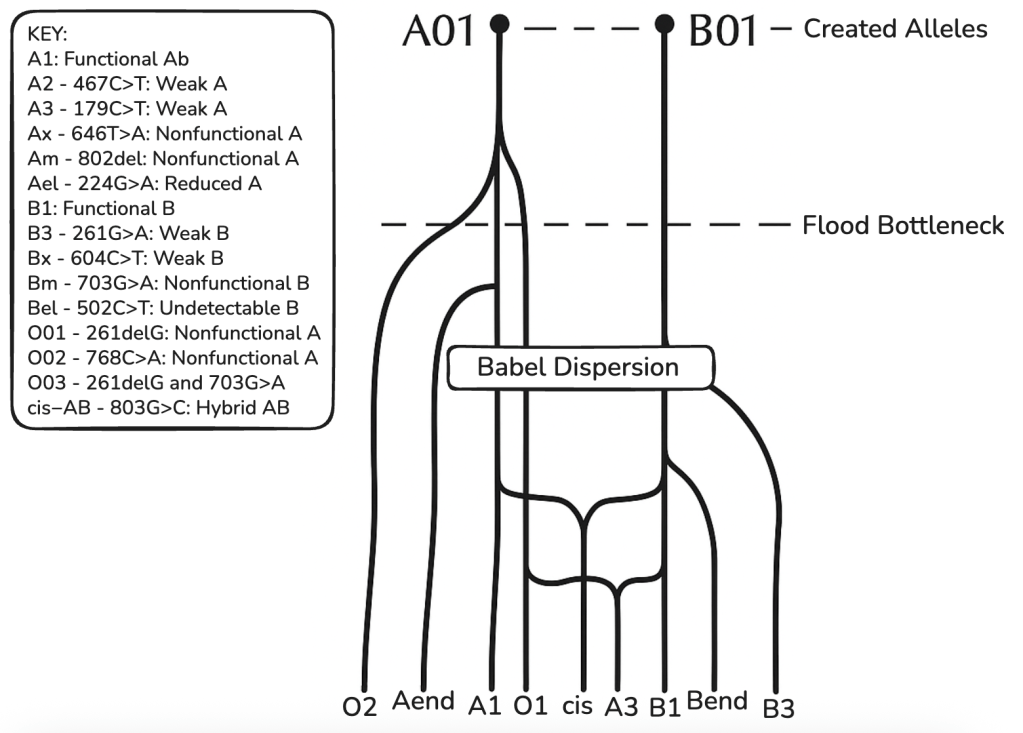
Table 3: ABO Phylogenetic Tree
Above is a phylogenetic tree for the ABO blood group gene based on the CHNP model. Showing several mainline alleles as well as two case bases (cis-AB and A3) which arose from, among other events, intragenic recombination. A-end and B-end represent further variants of weak A or B and O alleles.
This model shows alleles cluster into 6–8 major clades with low divergence (avg. 1.5 nt/allele beyond cores), consistent with young, discontinuous trees.
4. Implications for the CHNP Model
Mutation Budget
To evaluate whether the observed diversity in the ABO gene is consistent with the CHNP model (a ~6,000–10,000 year timeframe), we must calculate the expected number of mutation events using established human mutation rates. The ABO gene spans approximately 24,000 base pairs (24kb). The standard human mutation rate is estimated at 1.1 X 10⁻⁸ per base pair per generation (Roach et al., 2010; Campbell et al., 2012).
Traditionally, we analyze this “budget” like so. The number of mutations separating a modern individual from the original ancestor, Lineage Accumulation. In a single direct lineage from a founder (e.g., Adam) to a modern human, the expected number of de novo mutations in the ABO gene is calculated as:
Mutations = Rate (1.1 x 10⁻⁸) x Gene Size (24,000) x Generations (low 200 to high 333)
(1.1 x 10-8) x 24,000 x 333 (or 200) ≈ 0.087912 mutations (or 0.528)
A modern individual is expected to differ from the ancestral sequence by less than 0.1 mutations on average.
This indicates that the 127–200 unique variants observed today cannot be the result of accumulation along a single line. They must represent a collection of rare variants preserved from a much larger total inventory of events across the population.
While a single lineage accumulates little change, the population as a whole generates massive diversity due to exponential growth. Modeling a population expansion from a bottleneck of 6 individuals to 8 billion over 333 generations, we can estimate the total number of mutation events that have occurred in the ABO gene history. The total human mutations (genome-wide) are ~4.40 x 10¹¹ (440 Billion) events.
The ABO gene represents ~0.0008% of the genome. For ABO specific events, we calculate 4.40 x 1011 x (24,000 / 3.2 x 10⁹) = 3.3 million events. Therefore, the CHNP model faces a “retention” challenge rather than a “production” challenge. The young human population has generated over 3.3 million mutation events in the ABO gene history, far exceeding the ~200 unique alleles observed today. The vast majority of these 3.3 million events were lost to genetic drift or purifying selection (ABO incompatibility). The presence of ~200 unique alleles is mathematically possible within 6,000 years, provided that these specific variants survived drift.
The observation that most alleles are “subtypes” of A or B (differing by only 1 SNP) is consistent with them being recent survivors from this large pool of 3.3 million historical events. The ABO locus’s genetic diversity—345 alleles arising from ~127–200 unique mutations—must be understood in the context of population-wide mutation loads. While a single lineage accumulates negligible change (<1 mutation), the global human population has generated an estimated 3.3 million mutation events in the ABO locus over the last 10 millennia. The observed ~200 unique variants represent a tiny fraction (<0.01%) of this historical inventory that successfully reached detectable frequencies. This supports a model where the core A and B alleles were frontloaded, while the “bushy” diversity of subtypes (including the various O alleles) arose recently from the vast reservoir of population-wide mutations.
Paternal Age Effect
Standard evolutionary calculations assume a constant mutation rate based on a 20-to-30-year generation time. However, the CHNP model posits distinct biological parameters for the early human population, specifically the extreme longevity of the Patriarchs (e.g., Noah, Shem, Arphaxad). Modern genetic research confirms a strong Paternal Age Effect, where the number of de novo mutations passed to offspring increases exponentially with the father’s age due to continuous cell division in the male germline (Kong et al., 2012).
For example, a 30-year-old father transmits ~45 new mutations. Whereas, if the mutation rate doubles every ~16.5 years of paternal age (as observed in modern humans), a father conceiving at age 100, 200, or 500 would transmit hundreds or potentially thousands of de novo mutations in a single generation.
Table 4: Patriarch Exponential Mutation Curve
Father’s Age at Conception
Standard Model (Total Mutations Transmitted In X Years)
Patriarchal Model (Projected Mutations)*
Impact Factor
30 years (Modern Avg)
~45
~45
1x (Baseline)
63 years
~90 (gen 2)
~180
2x
100 years
~135 (gen 3)
~850
~6x
200 years
~270 (gen 6)
~56,000**
~207x
500 years (e.g., Noah)
~720 (gen 16)
Saturation
Explosive
*Projections based on a doubling of the mutation rate every 16.5 years of paternal age (Kong et al., 2012).**Theoretical projection highlighting the exponential potential of long-lived germlines.
This biological reality suggests that the “Input” of mutations in the first millennium of human history was not linear but explosive. The initial mutation inventory was likely frontloaded by these long-lived progenitors, rapidly diversifying the created template far faster than current low-fidelity rates would predict.
Demographic Accelerants: Inbreeding and Fixation
Following the population bottlenecks (Creation and the Flood), high rates of consanguinity (inbreeding) were unavoidable. While modern population genetics views inbreeding primarily as a mechanism for exposing recessive traits, in the CHNP context, it serves as a powerful evolutionary accelerant in two ways:
Rapid Fixation via Drift: In small, inbreeding populations, the coefficient of genetic drift is high. New mutations—whether generated by patriarchs or random errors—can move from 0% to 100% frequency (fixation) in just a few generations. This overcomes the “swamping” effect seen in large populations, allowing unique ABO variants (like specific O alleles) to become characteristic of entire distinct lineages instantly.
Accumulation of Genetic Load: Inbreeding depresses the effectiveness of purifying selection (“Inbreeding Depression”). Slightly deleterious mutations (such as the degradation of the A antigen into O) are less effectively weeded out in small populations (Lynch et al., 1995). This relaxes the selective constraints, allowing loss-of-function alleles to accumulate and persist at rates that would be impossible in a large, randomly mating population.
The Pulse-Fragmentation Model
When these factors are integrated, the CHNP model predicts a specific pattern:
Pulse: A surge of mutational diversity generated by high-age Patriarchs.
Fragmentation: Rapid isolation of this diversity into distinct gene pools via inbreeding and migration.
Degeneration: The inevitable slide from heterozygous function (A/B) to homozygous dysfunction (O) due to entropic forces.
Additional Considerations
Phylogenetic Tree Structure: ABO’s bushy clades (e.g., weak B from B core + 1–2 missense) exemplify recurrent inheritance, reducing independent events.
Parsimonious Evolutionary Model: <200 uniques suffice for all diversity, aligning with CHNP’s recent, bottlenecked history.
Conclusion
The ABO locus’s genetic diversity—345 alleles arising from ~127–200 unique mutations—is within the expected mutation budget under the CHNP model (~330 events over 10 kyr). The phylogenetic tree structure, with subtypes branching from a handful of core ancestral mutations (e.g., A-to-B divergence), supports a parsimonious evolutionary framework where recurrent propagation explains observed variation. Pre-loaded A and B alleles could plausibly have diversified via neutral drift in a young human population, consistent with CHNP claims. The observed genetic diversity at the ABO locus, with 127 to 200 unique mutations, is within the expected range of mutations under the CHNP model. This indicates that the pre-loaded A and B strings could have been accumulating mutations for around 10 kyr, consistent with the CHNP claim for ABO.
Works Cited
Besenbacher, Søren, et al. “Novel Variation and de Novo Mutation Rates in Population-Wide de Novo Assembled Danish Trios.” Nature, vol. 6, no. 1, 19 Jan. 2015, https://doi.org/10.1038/ncomms6969.
Dean, Laura. “Hemolytic Disease of the Newborn.” Nih.gov, National Center for Biotechnology Information (US), 2005, www.ncbi.nlm.nih.gov/books/NBK2266/.
*Dean, Laura. “The ABO Blood Group.” National Library of Medicine, National Center for Biotechnology Information (US), 2005, www.ncbi.nlm.nih.gov/books/NBK2267/.
Downie, A W, et al. “Smallpox Frequency and Severity in Relation to A, B and O Blood Groups.” Bulletin of the World Health Organization, vol. 33, no. 5, 1965, p. 623, pmc.ncbi.nlm.nih.gov/articles/PMC2475872/.
Gelabert, Pere, et al. “Malaria Was a Weak Selective Force in Ancient Europeans.” Scientific Reports, vol. 7, no. 1, 3 May 2017, https://doi.org/10.1038/s41598-017-01534-5.
Kermarrec, Nathalie, et al. “Comparison of Allele O Sequences of the Human and Non-Human Primate ABO System.” Immunogenetics, vol. 49, no. 6, 5 May 1999, pp. 517–526, https://doi.org/10.1007/s002510050529.
Kong, Augustine, et al. “Rate of de novo mutations and the importance of father’s age to disease risk.” Nature, vol. 488, no. 7412, 2012, pp. 471-475.
Kwiatkowski, Dominic P. “How Malaria Has Affected the Human Genome and What Human Genetics Can Teach Us about Malaria.” The American Journal of Human Genetics, vol. 77, no. 2, Aug. 2005, pp. 171–192, https://doi.org/10.1086/432519.
Lynch, M., et al. “Mutation accumulation and the extinction of small populations.” The American Naturalist, vol. 146, no. 4, 1995, pp. 489-518.
Marian, Jakub. “Blood Type Distribution,” Jakubmarian.com, 2018.
Mullaney, J. M., et al. “Small Insertions and Deletions (INDELs) in Human Genomes.” Human Molecular Genetics, vol. 19, no. R2, 21 Sept. 2010, pp. R131–R136, https://doi.org/10.1093/hmg/ddq400.
Nachman, Michael W, and Susan L Crowell. “Estimate of the Mutation Rate per Nucleotide in Humans.” Genetics, vol. 156, no. 1, 1 Sept. 2000, pp. 297–304, https://doi.org/10.1093/genetics/156.1.297.
O’Neil, Dennis. “Modern Human Variation: Distribution of Blood Types.” Kinsta.page, 2012, anthropology-tutorials-nggs7.kinsta.page/vary/vary_3.htm.
As I have been promoting the Kalam cosmological argument, I’ve been thinking deeply about its particular criticisms. To be clear, most criticisms of Craig’s Kalam fail, however some are fascinating and get you thinking about the particulars such as what existence means and whether ex nihilo (out of nothing) is an ontologically distinct kind of creation which we don’t observe.
On one hand, most proponents of the Kalam are perfectly willing to grant that we don’t observe ex nihilo creation and redirect the skeptic to the metaphysical entailments of creation (usually from the principle of sufficient reason), suggesting that the universe, and all things which have ontology in and of themselves, do need efficient causes. Yet, I really don’t think we need to cede ground here. As I’ve meditated on this, I’ve come to the conclusion that we do in fact observe ex nihilo creations—from our minds.
What do I mean by this? Well, take any concept of a “thing”, let’s say a wooden chair (it’s the favorite of philosophers), and ask ourselves how it is that this thing exists in the “real” world. When we examine a chair carefully, we discover something remarkable: the chair as a unified object—as a chair—does not exist in the physical substrate at all. What exists physically are atoms arranged in a particular configuration. The “chairness” of this arrangement, the ontological unity that makes these atoms one thing rather than billions of separate things, is something imposed by mind. In this sense, we observe minds creating genuine ontological categories ex nihilo—not creating the matter itself, but creating the very thingness that makes a collection of particles into a unified object.
This realization leads to a profound philosophical argument that I believe has been insufficiently explored in contemporary philosophy of religion.
The Nature of Composite Objects
We land on a few interesting features when we examine any purported “thing” in the material world. For one, a thing is instantiated in the world separate from its physical parts. This chair, for instance, may be made of wood, but many metals, plastics, and fabrics can be substituted and the identity of a thing within a category (or genus) is not changed. There is something higher than just mere components which brings the composition into a unified whole.
But what is this “something higher”? The materialist wants to say it’s just the arrangement of particles. But this raises immediate problems. Consider: when exactly does a collection of wood atoms become a chair? When the carpenter has assembled 50% of the pieces? 75%? 90%? What if one leg is broken—is it still a chair, or merely chair-shaped atoms? What if the leg is cracked but still functional? The materialist has no principled answer to these questions because “chairness” is not a property that can be reduced to particle arrangements.
The problem becomes even clearer when we consider boundaries. A chair has clear boundaries to us—we know where the chair ends and the floor begins. But at the atomic level, there are no such boundaries. Atoms are constantly exchanging electrons, being shed and replaced. Air molecules intermingle with the chair’s molecules at the surface. There is no physical demarcation that says “here the chair ends.” The boundaries we perceive (form) are imposed by our minds based on function and purpose.
This leads to several different possible conclusions about where a “thing” must be sustained. We are asking where something really exists, ontologically speaking. To be precise, there are three exhaustive options: (1) the thing is sustained in a domain of itself (like Platonic Forms), (2) the thing is sustained in the material domain (by physics and chemistry alone), (3) the thing is sustained in the mental domain (by a mind). I offer the reader to consider alternate hypotheses and notice that these choices really do cover the gamut.
The Trilemma of Ontology
Let us examine each option in turn to see which can bear the weight of explanation.
Option 1: Material Sustenance (Reductionist Materialism)
For the materialist position, we run into the logical contradiction of unified-composite objects. The materialist must assume that composite objects, like a rock, have no inherent boundaries. Physical things are mere indifferentiable clusters of atoms. From here, the materialist has two options. They can either accept a form of object nihilism, where no composite objects actually exist, or they can turn to a nominalistic approach.
In regards to nominalism, we must ask: what is the reason we would call a rock “rock” if separate from its ontology or it actually being a rock? If things, like a rock, exist in name only, then they do not really exist within distinct categories or kinds. This renders their definitions completely meaningless, because a good definition requires classification within the context of genus-species relationships. If things really exist as distinct objects, it is only because we have determined some aspect of their ontology over and above what reductionism or materialism can explain. So in reality, there is no sustainable nominalist approach for the materialist: one is either an object nihilist, or one must accept that real things are established some other way.
It seems to me that something like a rock is a perfect example of what would be impossible to be established as ontologically distinct without a mind. Is a pebble a rock? Is a handful of sand many small pebbles? Why do we call a variant quantity of small rocks a singular category? Why do we delineate between singular grains of sand and groups of pebbles? Is it not an arbitrary size distinction relative to our observational abilities and purposes?
For another example, consider why people groups such as Inuit tribes, who live in snowy environments, have many particular names for snow, whereas those tribes who live near the equator do not. It is because words are conventions within social groups to establish meaningful concepts. To someone who may see snow one day of the year, different textures and variations of snow are not meaningfully distinct. All composite objects that exist—including the very words that I am writing—are things minds have established as meaningful and bounded.
Therefore, a rock is meaningfully different from a pebble and a group of pebbles from sand only insofar as our use or intent dictates. Our experience of snow presupposes our naming conventions of snow. If you learn a language with seven words for snow, but you have always lived in a desert, you will not suddenly understand snow differently—you need to experience snow differently first.
But the materialist might object: “Even if our labels are arbitrary, the physical arrangements are real. When I sit in a chair, something physical holds me up.” This is true, but it misses the point. Yes, atoms arranged in a certain configuration will bear weight. But those atoms bearing weight is not the same as a chair existing. The chair, as a unified object with identity over time, with the capacity to be the same chair even if we replace parts, with clear boundaries—this is not present in the physical substrate. It is a mental construct imposed on that substrate.
Consider the philosophical puzzle of the Ship of Theseus. If we replace every plank of a ship, one by one, is it the same ship? The puzzle has no answer in purely physical terms because the ship’s identity is not a physical property. Identity over time, unity, and boundaries are all features imposed by minds, not discovered in matter.
If you accept Object Nihilism for composite objects and argue for a fundamental realist view where only quarks and leptons (or quantum fields) exist, then you face equally severe problems. What is your evidence that you exist ontologically? An entity which doesn’t exist as a unified object cannot consistently argue that some things do exist as unified objects. Moreover, what is your basis for assuming you know the “stuff” which is fundamental to reality? Even the quantum field is not necessarily the bottom line. Who can say what energy ultimately is? What’s to say that what’s fundamental isn’t also mind-contingent? That it isn’t mathematical in nature—which would itself require mental grounding?
This view has made a distinction where everything composite is nominal except for something that has never been directly observed as a truly fundamental “thing.” How does one justify this distinction in the first place? It seems to me a contradiction in reasoning to deny mind-dependent categories for composite objects while affirming mind-independent categories for fundamental particles. Both require the same kind of ontological boundary-drawing that only minds can provide.
Option 2: Self-Sustaining Forms (Platonism)
From here, a skeptic might say, “Okay, the chair or rock isn’t purely material. But maybe it’s just a Platonic Form. It sustains itself in an abstract realm. Why do we need a Mind?”
This is a more sophisticated response, but it ultimately fails for several reasons.
First, abstract objects have no causal power. A Platonic Form of “chairness” cannot reach down into the physical world and organize atoms into a chair configuration. It cannot explain why this particular collection of atoms instantiates the form rather than some other collection. The relationship between abstract forms and concrete particulars remains deeply mysterious in Platonic metaphysics—so mysterious that even Plato himself struggled with it in dialogues like the Parmenides.
Second, and more fundamentally, it is unintelligible to think of abstract objects like propositions, mathematical truths, or forms existing without a mind to think them. As Alvin Plantinga has argued, propositions are the contents of thoughts. They are the sort of thing that exists in minds. To say they exist “on their own” in some abstract realm is to commit a category error—it’s like saying colors exist independently of anything colored, or that motion exists independently of anything moving.
Consider what a Platonic Form would have to be: a truth, a concept, a logical structure. But these are precisely the kinds of things that exist as thoughts. A thought cannot exist without a thinker any more than a dance can exist without a dancer. The Platonist wants to affirm that 2+2=4 exists eternally and necessarily, and I agree. But this truth exists as an eternal thought in an eternal mind, not as a free-floating abstraction.
Third, many Platonic forms presuppose relationships, which themselves presuppose minds. Take the concept of justice. Justice involves right relations between persons. But “right relations” is an inherently normative concept that makes no sense without minds capable of recognizing and valuing those relations. Or consider mathematical sets. A set is defined by a rule of membership—a mental act of grouping things together according to a criterion. Sets don’t group themselves.
Therefore, if the “Blueprint” of the universe is real—if there truly are eternal structures, categories, and forms that ground the intelligibility of reality—these cannot be free-floating abstract objects. They must be Divine Thoughts, eternally sustained in a Divine Mind.
Option 3: Mental Sustenance (Idealism)
This leaves us with the third option: composite objects exist insofar as they are sustained by minds. This may sound counterintuitive at first, but it’s the only option that avoids the contradictions of the previous two.
When a carpenter builds a chair, he doesn’t merely arrange atoms—he imposes a conceptual unity on those atoms. He creates boundaries where there were none. He establishes identity conditions (this is one chair, not four separate legs plus a seat plus a back). He determines a function and purpose that gives meaning to the configuration. All of these acts are mental, not physical.
But here’s the crucial question: once the carpenter stops thinking about the chair, does it cease to exist? In one sense, yes—the carpenter’s mind is no longer actively sustaining it. But in another sense, no—the chair continues to be recognized as a chair by other minds. As long as someone conceptualizes those atoms as a unified object called “chair,” it exists as such.
This actually goes back to Bishop George Berkeley’s famous argument: “If a tree falls in the woods and no one is there to hear it, does it make a sound?” In a sense, if we stipulate that there is no wildlife and trees lack the ability to register sound frequencies, the fall really does not make a sound. This is because sound is a perception, a mental phenomenon. There are pressure waves in the air, certainly, but “sound” as we experience it requires a mind to interpret those waves.
However, Berkeley went further than this, and so must we. Berkeley argued that material objects continue to exist when no human observes them because God’s mind perpetually perceives them. I want to make a similar but distinct claim: composite objects, categories, and the conceptual structure that makes reality intelligible all require perpetual mental sustenance. Not just observation, but active ontological grounding.
An analogy may help: consider an author writing a novel. The characters in the novel have a kind of existence—they’re not nothing. But their existence is entirely dependent on the author’s creative act and the mind of any reader engaging with them. If every copy of the book were destroyed and everyone forgot the story, the characters would cease to exist in any meaningful sense. They have no “existential inertia” apart from minds sustaining them.
I propose that composite objects in our world are similar. The atoms may have mind-independent existence (though even this is debatable), but the chairness—the unified object with boundaries, identity, and purpose—exists only in minds. And since these objects continue to exist even when finite human minds aren’t thinking about them, they must be sustained by an infinite, omnipresent Mind.
The Formal Argument
All this contemplation leads me to the first formulation of a new kind of contingency argument which I call the Argument from Ontological Sustenance (or Idealist Argument from Contingency):
Premise 1: All composite objects require a mind to sustain their ontology.
Premise 2: The universe is a composite object.
Conclusion: Therefore, the universe requires a mind to sustain its ontology.
This is a logically valid argument, meaning if the premises are true, the conclusion must be as well.
The first premise has been defended at length above. The key insight is that composite objects—things made of parts organized into a unity—have no ontological status in the physical substrate alone. Their unity, boundaries, and identity exist only as mental constructs.
The second premise should be relatively uncontroversial. The universe is composed of parts (galaxies, stars, planets, particles) organized into a whole. It has boundaries (even if those boundaries are the limits of spacetime itself). It has an identity that persists through time. All of these features require the same kind of mental grounding that chairs and rocks require.
Therefore, the universe itself must be sustained in its existence as a unified, bounded entity by a mind. And since the universe contains all finite minds, this sustaining mind must be transcendent—beyond the universe, not part of it.
Why Not Pantheism?
An obvious objection arises: couldn’t the universe itself be the Mind that sustains all these categories? This would be a pantheistic solution—identifying God with the universe itself rather than positing a transcendent deity.
This fails for several reasons:
Step 1: A mind is a container for concepts. It is the sort of thing that has thoughts, holds ideas, and maintains logical relationships between propositions.
Step 2: Necessary truths (logic, mathematics, metaphysics) exist outside our finite minds. We discover them; we don’t invent them. This implies a Greater Mind contains them.
Step 3: Could this Greater Mind be the Universe itself?
Refutation: No. A “Universe Mind” would be composed of parts (galaxies, energy fields, quantum states) and subject to entropy (time, change, decay). But anything composed of parts is contingent—dependent on those parts and their organization. Anything subject to entropy requires external sustenance or an explanation for why it continues to exist through change.
Moreover, the universe is precisely the kind of composite object that needs mental grounding. To say the universe grounds its own categories is circular—it’s like saying a novel writes itself, or a dance choreographs itself.
Conclusion: The Ultimate Sustainer cannot be the Universe. It must be Transcendent (distinct from creation) and Non-Contingent (self-existent, not dependent on anything external to itself).
The Divine Attributes
Once we establish that a Transcendent, Non-Contingent Mind sustains all reality, we can derive further attributes through the classical logic of Act and Potency (pure actuality).
Premise: A Non-Contingent Mind has no external cause, and therefore no external limitations or deficiencies. It is “Pure Act”—fully realized, with no unrealized potential.
Omnipotence
To possess “some” power but not “all” power is to have a limitation—an unrealized potential to do more. But a Non-Contingent Being has no unrealized potentials by definition. Nothing external limits what it can do. Therefore, it possesses all power—omnipotence.
Omniscience
Ignorance is a lack, a privation of knowledge. A Fully Realized Mind has no lacks or privations. Moreover, if this Mind sustains all reality through its thoughts, it must know everything it sustains—otherwise, how could it sustain it? Therefore, it knows all things—omniscience.
Omnibenevolence
Evil, in the classical metaphysical tradition, is a privation—a lack of goodness or being. It is not a positive reality but an absence, like cold is the absence of heat or darkness the absence of light. Since this Mind is Fully Realized Being with no privations, it contains no evil. It is Pure Goodness—omnibenevolence.
Eternity and Immutability
Change implies potentiality—the ability to become something one is not yet. But a Non-Contingent Being has no potentiality. Therefore, it does not change. It exists eternally in a timeless present, not subject to temporal succession.
Personhood
This Mind thinks, knows, and creates categories. These are the activities of a person, not an impersonal force. Moreover, the categories it sustains include moral values, relational properties, and purposes—all of which presuppose personhood. Therefore, this Being is personal.
The Christian Specificity
We have now established the existence of a Transcendent, Omnipotent, Omniscient, Omnibenevolent, Eternal, Personal Mind that sustains all reality. This is recognizably the God of classical theism. But can we go further and identify this God with the specific God of Christianity?
The Argument from Relational Necessity
Premise 1: A God who is Personal, Truthful, and Loving is inherently Relational. Love seeks connection; truth seeks to be known; personhood seeks communion.
Premise 2: To be fully known and to establish a perfect relationship with finite creatures, this Infinite God must bridge the ontological gap. He cannot remain purely transcendent and abstract.
Consider: if God is perfectly loving, His love must be expressed, not merely potential. If God is truth, He must reveal Himself, not remain hidden. If God is personal, He must enter into relationship with persons He has created. But finite creatures cannot reach up to an infinite God—the ontological distance is too vast. Therefore, God must reach down to us.
The Filter
With this criterion, we can evaluate the world’s major religious traditions:
Deism/Pantheism: These fail immediately because they offer no relationship. Deism presents a God who creates and withdraws. Pantheism identifies God with the universe, making genuine relationship impossible.
Unitarian Monotheism (Islam/Judaism): These traditions affirm God’s transcendence and offer prophetic revelation—books and laws sent from on high. But God remains fundamentally separate. He sends messages but does not cross the boundary to unite with creation. The relationship is external, mediated through texts and commandments, never achieving full intimacy or union.
Christianity: This succeeds as the only worldview where the Sustainer becomes the Sustained. In the doctrine of the Incarnation, God doesn’t merely send a message about Himself—He enters history as a human being. The Infinite becomes finite. The Creator becomes a creature. The Mind that sustains all reality subjects Himself to the very categories He created.
This is not merely unique—it’s philosophically necessary. If God is to bridge the ontological gap between infinite and finite, between Creator and creature, He must do so by becoming both. The Incarnation is the only way for perfect relationship to be achieved.
Verification Through Human Experience
The Christian worldview also uniquely and truthfully describes the human condition. We experience ourselves as simultaneously possessing great dignity (made in God’s image, capable of reason and love) and great depravity (prone to selfishness, cruelty, and irrationality). We long for meaning, purpose, and redemption, yet find ourselves unable to achieve these on our own.
Christianity explains this through the doctrine of the Fall and offers a solution through Redemption—not by our own efforts, but by God’s gracious action in Christ. This narrative aligns with both our philosophical conclusions about God’s nature and our existential experience of ourselves.
Conclusion
The Mind that sustains the rock, the chair, and every composite object in reality is the same Mind that entered the world as Jesus of Nazareth. From the seemingly simple question “What makes a chair a chair?” we have traced a path to the central truth of Christianity: God is not distant or abstract, but intimately involved in every aspect of reality, from the smallest pebble to the vast cosmos, from the categories that make thought possible to the incarnate life that makes redemption possible.
This is the Argument from Ontological Sustenance. Like all philosophical arguments, it invites scrutiny, challenges, and further refinement. But I believe it opens a fruitful path for natural theology—one that begins not with cosmological speculation about the universe’s beginning, but with careful attention to the ontological structure of everyday objects and the categories that make them intelligible.
Every time we recognize a chair as a chair, a rock as a rock, or the universe as a cosmos, we are implicitly acknowledging the work of the Divine Mind that makes such recognition possible.