



A common criticism against scientists who espouse a young-age and global flood is that they don’t make testable predictions. However, a closer look reveals that creation science has a robust history of making predictions that challenge mainstream assumptions. To respond to the critic’s claim, we will look at eight predictions of note which are rooted in a biblical perspective of history, have been repeatedly validated, and prompt the need for a re-evaluation of the established paradigm.
1. The Rapid Formation of Opals
Dr. Len Crampton, a creationist geologist from New South Wales, Australia, dared to question the conventional timescale for opal formation. Mainstream geology posits that opals form over millions of years through slow, gradual processes. However, Crampton, drawing upon the catastrophic implications of the global Flood, predicted that opals could form rapidly under conditions of silica-rich solutions and rapid deposition. His experimental work demonstrated the feasibility of this rapid formation, challenging the long-age assumptions of conventional geology. While consensus geology made a story about opals which fit their narrative, creationists found the practical mechanism behind opal creation.
2. Carbon-14 in “Ancient” Samples
One of the most contentious areas of debate is the presence of Carbon-14 (C-14) in samples deemed millions of years old. Conventional radiometric dating assumes that C-14, with its relatively short half-life of 5,730 years, should be undetectable in samples older than 100,000 years. Yet, creation scientists, including those involved with the RATE (Radioisotopes and the Age of The Earth) project, have consistently predicted and found measurable C-14 in fossils, coal, and diamonds (Baumgardner, 2003). This finding directly challenges the long-age interpretations and raises questions about the assumptions underlying radiometric dating, but, significantly, it was predicted by creationists.
3. Mature Galaxies and the Absence of Population III Stars
In the realm of cosmology, Dr. Jason Lisle predicted that the James Webb Space Telescope (JWST) would reveal mature galaxies at great distances and a lack of Population III stars, the hypothetical first stars formed after the Big Bang. This prediction stands in stark contrast to standard cosmological models, which require long periods for galaxy formation and predict the existence of these primordial stars. The early JWST data has aligned with Lisle’s prediction, prompting a re-evaluation of current cosmological timelines. Another prediction in the bag.
4. The Functionality of “Junk” DNA
Evolutionary theory initially proposed that non-coding DNA was “junk,” remnants of evolutionary processes with no function. However, creation scientists, including Dr. Robert Carter, predicted that this “junk” DNA would be found to have important functions (Carter, 2010). The ENCODE project and subsequent research have demonstrated widespread biochemical activity within non-coding DNA, indicating its crucial roles in gene regulation and other cellular processes. This discovery challenges the notion of “junk” DNA and supports the concept of intelligent design.
5. Helium Diffusion in Zircon Crystals
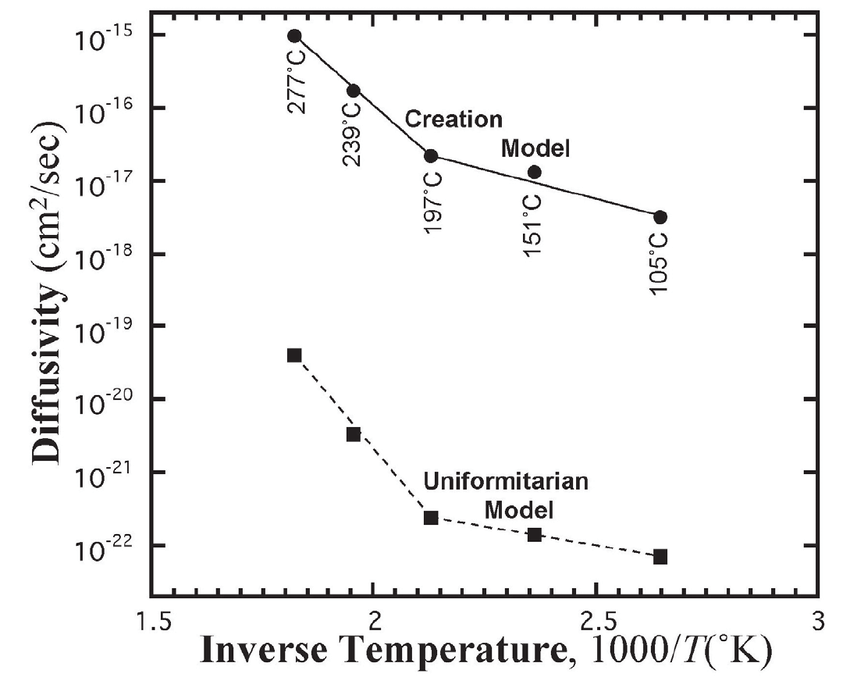
Back to geology. In 1982, Dr. Robert Gentry discovered that the nuclear-decay-generated helium in little crystals in granites called zircons was too high for the rocks to have undergone a constant decay rate (Gentry, 1986). His observation lead to Dr. Russell Humphreys prediction during the early stages of the RATE project (Humphreys, 2000, p. 348, Figure 7), which were verified by an external laboratory, challenged the conventional radiometric dating assumptions. The high retention rates of helium in zircon crystals indicate that they cannot be millions of years old. The data fit his prediction, as shown below, perfectly.
6. Cool Subducted Zones and Rapid Plate Tectonics
Dr. John Baumgardner, a geophysicist, predicted that subducted lithospheric zones in the mantle would be cooler than expected (Baumgardner, 1994), due to rapid plate tectonics during the Flood. Observations have confirmed these cooler zones, supporting the Catastrophic Plate Tectonics (CPT) model.
7. Lack of Metamorphosis in Folded Rock Layers
Geologist Dr. Andrew Snelling predicted that Tapeats sandstone samples in bends would not exhibit metamorphic change to the minerals, despite the folding of the layers. This is because he predicted that all the sedimentary layers were laid down during the flood and that seismic activity below caused the layers to deform over the hardened faults below. Snelling et al. investigated the Tapeats and found no metamorphosing (Snelling, 2021). This evidence supports the prediction that these rocks were bent while still soft and it refutes the mainstream science prediction of ductile deformation (immense pressure and heat over time which should result in metamorphic changes), demonstrating that the folding occurred rapidly, before the rocks had time to metamorphose.
8. Human Genetic Diversity
Creation models predicted a relatively recent origin for humanity, with low genetic diversity. Genetic studies, including those on mitochondrial DNA and the Y chromosome, have supported this prediction, pointing to a relatively recent common ancestry.
These are my top eight examples which highlight the predictive power of the creationist model. These predictions and their verifications dispel the myth that “creationists don’t make predictions” and, hopefully, give you a deeper appreciation for the robustness and explanatory power of the creationist worldview.
Citations:
- John Baumgardner, J. R. (2003). Carbon-14 evidence for a recent global flood and a young age of the Earth. In Proceedings of the Fifth International Conference on Creationism (pp. 129-142). Creation Science Fellowship.
- Carter, R. W. (2010). The non-coding genome. Journal of Creation, 24(3), 116-123.
- Gentry, R. V. (1986). Radiohalos in polonium 218: evidence of a pre-cambrian granite. Science, 234(4776), 561-566.
- Humphreys, D. R. (2000). Accelerated nuclear decay: evidence for young-age radiocarbon dating. In Radioisotopes and the Age of The Earth: Results of a Young-Earth Creationist Research Initiative (pp. 333-379). Institute for Creation Research. p. 348, Figure 7.
- Baumgardner, J. R. (1994). Runaway subduction as the driving mechanism for the Genesis flood. In Proceedings of the Third International Conference on Creationism (pp. 63-75). Creation Science Fellowship.
- Snelling, A. A. (2021). The Petrology of the Tapeats Sandstone, Tonto Group, Grand Canyon, Arizona. Answers Research Journal, 14, 159–254.

