



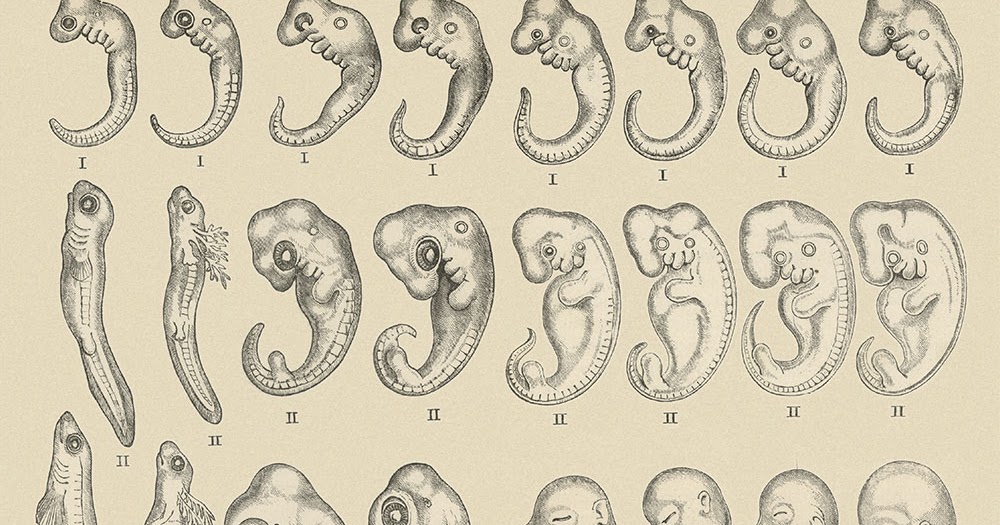
For decades, textbook illustrations of Haeckel’s Embryos have been presented as a compelling visual argument for evolution. These side-by-side comparisons of vertebrate embryos, purportedly showing striking similarities in early developmental stages, have been used to argue for a shared evolutionary ancestry. However, a closer look reveals a story of misrepresentation and manipulation, rather than an accurate depiction of embryological evidence.
Ernst Haeckel, a fervent supporter of Darwin’s theory, produced these drawings in the late 19th century. Yet, his illustrations were not faithful representations of actual embryos. He exaggerated similarities, omitted or altered developmental stages, and even used the same woodcut to represent different species. This deliberate manipulation aimed to bolster the concept of “recapitulation,” the now-discredited idea that embryonic development mirrors evolutionary history.
The reality is that vertebrate embryos are far more distinct in their early stages than Haeckel portrayed. His illustrations were exposed as fraudulent even in his own time, yet they persisted in textbooks for generations, a testament to the power of visual propaganda in shaping scientific narratives.
The argument that similarities in vertebrate embryos indicate a shared evolutionary history is challenged by several points.
Challenging the “Recapitulation” Narrative
One of the central tenets of the evolutionary argument is that embryonic development (“ontogeny”) reflects an organism’s evolutionary history (“phylogeny”). However, this concept, often summarized as “ontogeny recapitulates phylogeny,” is deeply flawed.
- Embryonic Structures vs. Adult Structures: Embryonic features like pharyngeal slits and tails do not simply recapitulate the adult forms of ancestral organisms. Instead, they serve specific functions within the embryonic stage, often disappearing or transforming into entirely different structures in the adult. The embryonic mode of life is distinct from the adult mode.
- “Recapitulation” is a Creationist Concept: The recognition of embryonic similarities predates Darwin. Creationists viewed these similarities as a “God-given ‘pattern of unification’ that reflected the unity of nature,” emphasizing a common Creator’s design rather than evolutionary lineage.
- Unique Development: The unique eye development in lampreys, transitioning from larval eyespots to adult camera eyes, demonstrates that developmental pathways do not always follow a simple, linear evolutionary progression.
- Order of Development: The occasional appearance of later-stage developmental features earlier in the embryonic process further complicates the evolutionary narrative.
Genetic and Developmental Complexity
The genetic and developmental complexity underlying embryonic similarities points to intelligent design:
- Genetic Similarity: The fact that damage to the pax6 gene cascade results in the loss of a functional eye across diverse animal groups highlights a fundamental genetic similarity, but this similarity does not necessitate a shared evolutionary history. It speaks to a common design blueprint.
- Complex Regulatory Systems: The development of complex structures like the eye involves thousands of interacting genes and intricate regulatory systems. Such complexity is more consistent with intelligent design than with random evolutionary processes.
- Common Design: The similarities observed in vertebrate embryos can be readily explained as a reflection of a common design by an intelligent Creator. Just as an engineer might use similar design principles in different models, a Creator might employ common developmental strategies across various organisms.
A Creationist Interpretation
From a creationist perspective, the similarities in vertebrate embryos are not evidence of evolutionary transitions but rather manifestations of a unified design plan. The Creator used common design elements to achieve diverse functions in different organisms. This approach aligns with the concept of baraminology, which studies created kinds and acknowledges variations within those kinds.
The argument that embryonic similarities exclusively support evolution overlooks the possibility of intelligent design. By recognizing the complexity of developmental processes and the historical context of these observations, we can appreciate the power of a creationist explanation.
