

Introduction: Observing Ex Nihilo Creation
As I have been promoting the Kalam cosmological argument, I’ve been thinking deeply about its particular criticisms. To be clear, most criticisms of Craig’s Kalam fail, however some are fascinating and get you thinking about the particulars such as what existence means and whether ex nihilo (out of nothing) is an ontologically distinct kind of creation which we don’t observe.
On one hand, most proponents of the Kalam are perfectly willing to grant that we don’t observe ex nihilo creation and redirect the skeptic to the metaphysical entailments of creation (usually from the principle of sufficient reason), suggesting that the universe, and all things which have ontology in and of themselves, do need efficient causes. Yet, I really don’t think we need to cede ground here. As I’ve meditated on this, I’ve come to the conclusion that we do in fact observe ex nihilo creations—from our minds.
What do I mean by this? Well, take any concept of a “thing”, let’s say a wooden chair (it’s the favorite of philosophers), and ask ourselves how it is that this thing exists in the “real” world. When we examine a chair carefully, we discover something remarkable: the chair as a unified object—as a chair—does not exist in the physical substrate at all. What exists physically are atoms arranged in a particular configuration. The “chairness” of this arrangement, the ontological unity that makes these atoms one thing rather than billions of separate things, is something imposed by mind. In this sense, we observe minds creating genuine ontological categories ex nihilo—not creating the matter itself, but creating the very thingness that makes a collection of particles into a unified object.
This realization leads to a profound philosophical argument that I believe has been insufficiently explored in contemporary philosophy of religion.
The Nature of Composite Objects
We land on a few interesting features when we examine any purported “thing” in the material world. For one, a thing is instantiated in the world separate from its physical parts. This chair, for instance, may be made of wood, but many metals, plastics, and fabrics can be substituted and the identity of a thing within a category (or genus) is not changed. There is something higher than just mere components which brings the composition into a unified whole.
But what is this “something higher”? The materialist wants to say it’s just the arrangement of particles. But this raises immediate problems. Consider: when exactly does a collection of wood atoms become a chair? When the carpenter has assembled 50% of the pieces? 75%? 90%? What if one leg is broken—is it still a chair, or merely chair-shaped atoms? What if the leg is cracked but still functional? The materialist has no principled answer to these questions because “chairness” is not a property that can be reduced to particle arrangements.
The problem becomes even clearer when we consider boundaries. A chair has clear boundaries to us—we know where the chair ends and the floor begins. But at the atomic level, there are no such boundaries. Atoms are constantly exchanging electrons, being shed and replaced. Air molecules intermingle with the chair’s molecules at the surface. There is no physical demarcation that says “here the chair ends.” The boundaries we perceive (form) are imposed by our minds based on function and purpose.
This leads to several different possible conclusions about where a “thing” must be sustained. We are asking where something really exists, ontologically speaking. To be precise, there are three exhaustive options: (1) the thing is sustained in a domain of itself (like Platonic Forms), (2) the thing is sustained in the material domain (by physics and chemistry alone), (3) the thing is sustained in the mental domain (by a mind). I offer the reader to consider alternate hypotheses and notice that these choices really do cover the gamut.
The Trilemma of Ontology
Let us examine each option in turn to see which can bear the weight of explanation.
Option 1: Material Sustenance (Reductionist Materialism)
For the materialist position, we run into the logical contradiction of unified-composite objects. The materialist must assume that composite objects, like a rock, have no inherent boundaries. Physical things are mere indifferentiable clusters of atoms. From here, the materialist has two options. They can either accept a form of object nihilism, where no composite objects actually exist, or they can turn to a nominalistic approach.
In regards to nominalism, we must ask: what is the reason we would call a rock “rock” if separate from its ontology or it actually being a rock? If things, like a rock, exist in name only, then they do not really exist within distinct categories or kinds. This renders their definitions completely meaningless, because a good definition requires classification within the context of genus-species relationships. If things really exist as distinct objects, it is only because we have determined some aspect of their ontology over and above what reductionism or materialism can explain. So in reality, there is no sustainable nominalist approach for the materialist: one is either an object nihilist, or one must accept that real things are established some other way.
It seems to me that something like a rock is a perfect example of what would be impossible to be established as ontologically distinct without a mind. Is a pebble a rock? Is a handful of sand many small pebbles? Why do we call a variant quantity of small rocks a singular category? Why do we delineate between singular grains of sand and groups of pebbles? Is it not an arbitrary size distinction relative to our observational abilities and purposes?
For another example, consider why people groups such as Inuit tribes, who live in snowy environments, have many particular names for snow, whereas those tribes who live near the equator do not. It is because words are conventions within social groups to establish meaningful concepts. To someone who may see snow one day of the year, different textures and variations of snow are not meaningfully distinct. All composite objects that exist—including the very words that I am writing—are things minds have established as meaningful and bounded.
Therefore, a rock is meaningfully different from a pebble and a group of pebbles from sand only insofar as our use or intent dictates. Our experience of snow presupposes our naming conventions of snow. If you learn a language with seven words for snow, but you have always lived in a desert, you will not suddenly understand snow differently—you need to experience snow differently first.
But the materialist might object: “Even if our labels are arbitrary, the physical arrangements are real. When I sit in a chair, something physical holds me up.” This is true, but it misses the point. Yes, atoms arranged in a certain configuration will bear weight. But those atoms bearing weight is not the same as a chair existing. The chair, as a unified object with identity over time, with the capacity to be the same chair even if we replace parts, with clear boundaries—this is not present in the physical substrate. It is a mental construct imposed on that substrate.
Consider the philosophical puzzle of the Ship of Theseus. If we replace every plank of a ship, one by one, is it the same ship? The puzzle has no answer in purely physical terms because the ship’s identity is not a physical property. Identity over time, unity, and boundaries are all features imposed by minds, not discovered in matter.
If you accept Object Nihilism for composite objects and argue for a fundamental realist view where only quarks and leptons (or quantum fields) exist, then you face equally severe problems. What is your evidence that you exist ontologically? An entity which doesn’t exist as a unified object cannot consistently argue that some things do exist as unified objects. Moreover, what is your basis for assuming you know the “stuff” which is fundamental to reality? Even the quantum field is not necessarily the bottom line. Who can say what energy ultimately is? What’s to say that what’s fundamental isn’t also mind-contingent? That it isn’t mathematical in nature—which would itself require mental grounding?
This view has made a distinction where everything composite is nominal except for something that has never been directly observed as a truly fundamental “thing.” How does one justify this distinction in the first place? It seems to me a contradiction in reasoning to deny mind-dependent categories for composite objects while affirming mind-independent categories for fundamental particles. Both require the same kind of ontological boundary-drawing that only minds can provide.
Option 2: Self-Sustaining Forms (Platonism)
From here, a skeptic might say, “Okay, the chair or rock isn’t purely material. But maybe it’s just a Platonic Form. It sustains itself in an abstract realm. Why do we need a Mind?”
This is a more sophisticated response, but it ultimately fails for several reasons.
First, abstract objects have no causal power. A Platonic Form of “chairness” cannot reach down into the physical world and organize atoms into a chair configuration. It cannot explain why this particular collection of atoms instantiates the form rather than some other collection. The relationship between abstract forms and concrete particulars remains deeply mysterious in Platonic metaphysics—so mysterious that even Plato himself struggled with it in dialogues like the Parmenides.
Second, and more fundamentally, it is unintelligible to think of abstract objects like propositions, mathematical truths, or forms existing without a mind to think them. As Alvin Plantinga has argued, propositions are the contents of thoughts. They are the sort of thing that exists in minds. To say they exist “on their own” in some abstract realm is to commit a category error—it’s like saying colors exist independently of anything colored, or that motion exists independently of anything moving.
Consider what a Platonic Form would have to be: a truth, a concept, a logical structure. But these are precisely the kinds of things that exist as thoughts. A thought cannot exist without a thinker any more than a dance can exist without a dancer. The Platonist wants to affirm that 2+2=4 exists eternally and necessarily, and I agree. But this truth exists as an eternal thought in an eternal mind, not as a free-floating abstraction.
Third, many Platonic forms presuppose relationships, which themselves presuppose minds. Take the concept of justice. Justice involves right relations between persons. But “right relations” is an inherently normative concept that makes no sense without minds capable of recognizing and valuing those relations. Or consider mathematical sets. A set is defined by a rule of membership—a mental act of grouping things together according to a criterion. Sets don’t group themselves.
Therefore, if the “Blueprint” of the universe is real—if there truly are eternal structures, categories, and forms that ground the intelligibility of reality—these cannot be free-floating abstract objects. They must be Divine Thoughts, eternally sustained in a Divine Mind.
Option 3: Mental Sustenance (Idealism)
This leaves us with the third option: composite objects exist insofar as they are sustained by minds. This may sound counterintuitive at first, but it’s the only option that avoids the contradictions of the previous two.
When a carpenter builds a chair, he doesn’t merely arrange atoms—he imposes a conceptual unity on those atoms. He creates boundaries where there were none. He establishes identity conditions (this is one chair, not four separate legs plus a seat plus a back). He determines a function and purpose that gives meaning to the configuration. All of these acts are mental, not physical.
But here’s the crucial question: once the carpenter stops thinking about the chair, does it cease to exist? In one sense, yes—the carpenter’s mind is no longer actively sustaining it. But in another sense, no—the chair continues to be recognized as a chair by other minds. As long as someone conceptualizes those atoms as a unified object called “chair,” it exists as such.
This actually goes back to Bishop George Berkeley’s famous argument: “If a tree falls in the woods and no one is there to hear it, does it make a sound?” In a sense, if we stipulate that there is no wildlife and trees lack the ability to register sound frequencies, the fall really does not make a sound. This is because sound is a perception, a mental phenomenon. There are pressure waves in the air, certainly, but “sound” as we experience it requires a mind to interpret those waves.
However, Berkeley went further than this, and so must we. Berkeley argued that material objects continue to exist when no human observes them because God’s mind perpetually perceives them. I want to make a similar but distinct claim: composite objects, categories, and the conceptual structure that makes reality intelligible all require perpetual mental sustenance. Not just observation, but active ontological grounding.
An analogy may help: consider an author writing a novel. The characters in the novel have a kind of existence—they’re not nothing. But their existence is entirely dependent on the author’s creative act and the mind of any reader engaging with them. If every copy of the book were destroyed and everyone forgot the story, the characters would cease to exist in any meaningful sense. They have no “existential inertia” apart from minds sustaining them.
I propose that composite objects in our world are similar. The atoms may have mind-independent existence (though even this is debatable), but the chairness—the unified object with boundaries, identity, and purpose—exists only in minds. And since these objects continue to exist even when finite human minds aren’t thinking about them, they must be sustained by an infinite, omnipresent Mind.
The Formal Argument
All this contemplation leads me to the first formulation of a new kind of contingency argument which I call the Argument from Ontological Sustenance (or Idealist Argument from Contingency):
Premise 1: All composite objects require a mind to sustain their ontology.
Premise 2: The universe is a composite object.
Conclusion: Therefore, the universe requires a mind to sustain its ontology.
This is a logically valid argument, meaning if the premises are true, the conclusion must be as well.
The first premise has been defended at length above. The key insight is that composite objects—things made of parts organized into a unity—have no ontological status in the physical substrate alone. Their unity, boundaries, and identity exist only as mental constructs.
The second premise should be relatively uncontroversial. The universe is composed of parts (galaxies, stars, planets, particles) organized into a whole. It has boundaries (even if those boundaries are the limits of spacetime itself). It has an identity that persists through time. All of these features require the same kind of mental grounding that chairs and rocks require.
Therefore, the universe itself must be sustained in its existence as a unified, bounded entity by a mind. And since the universe contains all finite minds, this sustaining mind must be transcendent—beyond the universe, not part of it.
Why Not Pantheism?
An obvious objection arises: couldn’t the universe itself be the Mind that sustains all these categories? This would be a pantheistic solution—identifying God with the universe itself rather than positing a transcendent deity.
This fails for several reasons:
Step 1: A mind is a container for concepts. It is the sort of thing that has thoughts, holds ideas, and maintains logical relationships between propositions.
Step 2: Necessary truths (logic, mathematics, metaphysics) exist outside our finite minds. We discover them; we don’t invent them. This implies a Greater Mind contains them.
Step 3: Could this Greater Mind be the Universe itself?
Refutation: No. A “Universe Mind” would be composed of parts (galaxies, energy fields, quantum states) and subject to entropy (time, change, decay). But anything composed of parts is contingent—dependent on those parts and their organization. Anything subject to entropy requires external sustenance or an explanation for why it continues to exist through change.
Moreover, the universe is precisely the kind of composite object that needs mental grounding. To say the universe grounds its own categories is circular—it’s like saying a novel writes itself, or a dance choreographs itself.
Conclusion: The Ultimate Sustainer cannot be the Universe. It must be Transcendent (distinct from creation) and Non-Contingent (self-existent, not dependent on anything external to itself).
The Divine Attributes
Once we establish that a Transcendent, Non-Contingent Mind sustains all reality, we can derive further attributes through the classical logic of Act and Potency (pure actuality).
Premise: A Non-Contingent Mind has no external cause, and therefore no external limitations or deficiencies. It is “Pure Act”—fully realized, with no unrealized potential.
Omnipotence
To possess “some” power but not “all” power is to have a limitation—an unrealized potential to do more. But a Non-Contingent Being has no unrealized potentials by definition. Nothing external limits what it can do. Therefore, it possesses all power—omnipotence.
Omniscience
Ignorance is a lack, a privation of knowledge. A Fully Realized Mind has no lacks or privations. Moreover, if this Mind sustains all reality through its thoughts, it must know everything it sustains—otherwise, how could it sustain it? Therefore, it knows all things—omniscience.
Omnibenevolence
Evil, in the classical metaphysical tradition, is a privation—a lack of goodness or being. It is not a positive reality but an absence, like cold is the absence of heat or darkness the absence of light. Since this Mind is Fully Realized Being with no privations, it contains no evil. It is Pure Goodness—omnibenevolence.
Eternity and Immutability
Change implies potentiality—the ability to become something one is not yet. But a Non-Contingent Being has no potentiality. Therefore, it does not change. It exists eternally in a timeless present, not subject to temporal succession.
Personhood
This Mind thinks, knows, and creates categories. These are the activities of a person, not an impersonal force. Moreover, the categories it sustains include moral values, relational properties, and purposes—all of which presuppose personhood. Therefore, this Being is personal.
The Christian Specificity
We have now established the existence of a Transcendent, Omnipotent, Omniscient, Omnibenevolent, Eternal, Personal Mind that sustains all reality. This is recognizably the God of classical theism. But can we go further and identify this God with the specific God of Christianity?
The Argument from Relational Necessity
Premise 1: A God who is Personal, Truthful, and Loving is inherently Relational. Love seeks connection; truth seeks to be known; personhood seeks communion.
Premise 2: To be fully known and to establish a perfect relationship with finite creatures, this Infinite God must bridge the ontological gap. He cannot remain purely transcendent and abstract.
Consider: if God is perfectly loving, His love must be expressed, not merely potential. If God is truth, He must reveal Himself, not remain hidden. If God is personal, He must enter into relationship with persons He has created. But finite creatures cannot reach up to an infinite God—the ontological distance is too vast. Therefore, God must reach down to us.
The Filter
With this criterion, we can evaluate the world’s major religious traditions:
Deism/Pantheism: These fail immediately because they offer no relationship. Deism presents a God who creates and withdraws. Pantheism identifies God with the universe, making genuine relationship impossible.
Unitarian Monotheism (Islam/Judaism): These traditions affirm God’s transcendence and offer prophetic revelation—books and laws sent from on high. But God remains fundamentally separate. He sends messages but does not cross the boundary to unite with creation. The relationship is external, mediated through texts and commandments, never achieving full intimacy or union.
Christianity: This succeeds as the only worldview where the Sustainer becomes the Sustained. In the doctrine of the Incarnation, God doesn’t merely send a message about Himself—He enters history as a human being. The Infinite becomes finite. The Creator becomes a creature. The Mind that sustains all reality subjects Himself to the very categories He created.
This is not merely unique—it’s philosophically necessary. If God is to bridge the ontological gap between infinite and finite, between Creator and creature, He must do so by becoming both. The Incarnation is the only way for perfect relationship to be achieved.
Verification Through Human Experience
The Christian worldview also uniquely and truthfully describes the human condition. We experience ourselves as simultaneously possessing great dignity (made in God’s image, capable of reason and love) and great depravity (prone to selfishness, cruelty, and irrationality). We long for meaning, purpose, and redemption, yet find ourselves unable to achieve these on our own.
Christianity explains this through the doctrine of the Fall and offers a solution through Redemption—not by our own efforts, but by God’s gracious action in Christ. This narrative aligns with both our philosophical conclusions about God’s nature and our existential experience of ourselves.
Conclusion
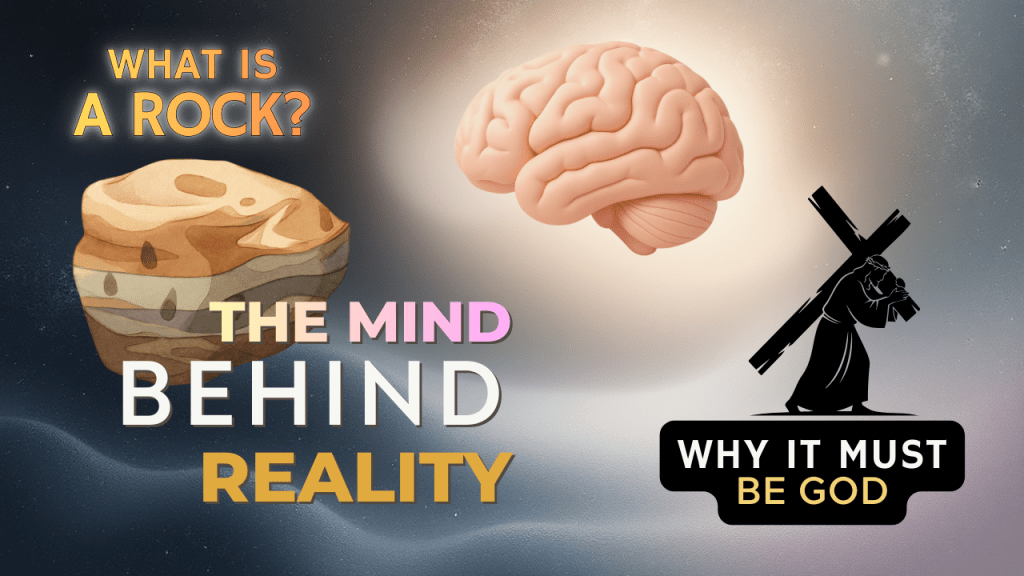
The Mind that sustains the rock, the chair, and every composite object in reality is the same Mind that entered the world as Jesus of Nazareth. From the seemingly simple question “What makes a chair a chair?” we have traced a path to the central truth of Christianity: God is not distant or abstract, but intimately involved in every aspect of reality, from the smallest pebble to the vast cosmos, from the categories that make thought possible to the incarnate life that makes redemption possible.
This is the Argument from Ontological Sustenance. Like all philosophical arguments, it invites scrutiny, challenges, and further refinement. But I believe it opens a fruitful path for natural theology—one that begins not with cosmological speculation about the universe’s beginning, but with careful attention to the ontological structure of everyday objects and the categories that make them intelligible.
Every time we recognize a chair as a chair, a rock as a rock, or the universe as a cosmos, we are implicitly acknowledging the work of the Divine Mind that makes such recognition possible.