



In his paper “Life Transcending Physics and Chemistry,” Michael Polanyi examines biological machines in a way that illuminates the explanatory failures of materialism. The prevailing materialist paradigm that life can be fully explained by the laws of inanimate nature fails to account for higher ordered realities which have operations and structures that involve non-material judgements and interpretations. He specifically addresses the views of scientists such as Francis Crick, who, along with James Watson, argued for a total reductionist and nominalist view based on their discovery of DNA. For Polanyi, there is a life-transcending nature that all biological organisms have which is akin to machines and their transcendent properties. His central argument is based on the concept of “boundary control,” which argues the notion that there are laws that govern physical reactions (as Crick would accept) yet there are particular laws of form and function which are unique and separate from those lower-level laws.
There is a real clash between Polanyi’s position and the reductionist/nominalist position which is commonly held by molecular biologists. To start to broach this divergence he explains how the contemporaneous discovery of the genetic function of DNA was interpreted as the final blow to vitalist thought within sciences. He writes:
“The discovery by Watson and Crick of the genetic function of DNA (deoxyribonucleic acid), combined with the evidence these scientists provided for the self-duplication of DNA, is widely held to prove that living beings can be interpreted, at least in principles, by the laws of physics and chemistry.”
Polanyi explicitly rejects Crick’s interpretation; that position is of the mainstream and popular level academia. Crick states that his principle “has so far been accepted by few biologists and has been sharply rejected by Francis Crick, who is convinced that all life can be ultimately accounted for by the laws of inanimate nature.” This same sentiment can indeed be found in Crick’s book “Molecules and Man.” Crick writes the following:
“Thus eventually one may hope to have the whole of biology “explained” in terms of the level below it, and so on right down to the atomic level.”
To dismantle the materialist argument, Polanyi utilizes the analogy of a machine. A machine cannot be defined or understood solely through the physical and chemical properties of its materials. Take a watch and put it into a machine that can read a detailed atomic map of the device: can even the best chemist give any coherent reason as to whether the watch is functioning or not? Worse—can one even tell you what a watch is, if all that exists is matter in motion for no particular reason? Polanyi writes it best:
“A complete physical-chemical topography of my watch—even though the topography included the changes caused by the movements in the watch—would not tell us what this object is. On the other hand, if we know watches, we would recognize an object as a watch by a description of it which says that it tells the time of the day… We know watches and can describe one only in terms like ‘telling the time,’ ‘hands,’ ‘face,’ ‘marked,’ which are all incapable of being expressed by the variables of physics, length, mass, and time.”
Once you see this distinction, you are invariably led (as Polanyi was) to two unique substratum of explanation; what he calls the concept of dual control. Obviously, there are physical laws which dictate constraints and operations of all material and all material things can be explained by these very laws. However, those laws are only meaningfully called constraints when there is some notion of intention or design to be constrained. The shape of any machine, man-made or biological, is not determined by natural laws. Not only is it not determined by them, it cannot be determined by them in any way. Polanyi elaborates on this relationship:
“The machine is a machine by having been built and being then controlled according to principles of engineering. The laws of physics and chemistry are indifferent to these principles; they would go on working in the fragments of the machine if it were smashed. But they serve the machine while it lasts; machines rely for their operations always on the laws of physics and chemistry.”
As I hinted at before, Polanyi also applies this logic to biological systems, arguing that morphology is a boundary condition in the same way that a design of a machine is a boundary condition. Biology cannot be reduced to physics because the structure that defines a living being is not the result of physical-chemical equilibration. Physical laws do not intend to create nor do they care that anything functions. Instead, “biological principles are seen then to control the boundary conditions within which the forces of physics and chemistry carry on the business of life.”
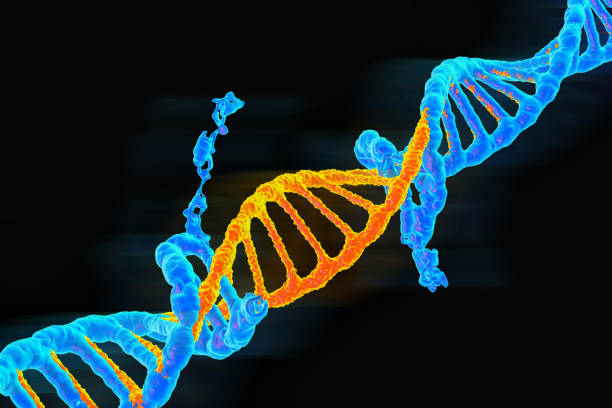
Where Polanyi and Crick truly have the disagreement, then, is in their interpretation of the explanatory power of nature and how DNA is implicated within these frameworks. While Crick views DNA as a chemical agent that proves reducibility, Polanyi argues that the very nature of DNA as an information carrier proves the opposite. For a molecule to function as a code, its sequence cannot be determined by chemical necessity. If chemical laws dictated the arrangement of the DNA molecule, it would be a rigid crystal incapable of conveying complex, variable information. Polanyi writes:
“Thus in an ideal code, all alternative sequences being equally probable, its sequence is unaffected by chemical laws, and is an arithmetical or geometrical design, not explicable in chemical terms.”
By treating DNA as a transmitter of information, Polanyi aligns it with other non-physical forms of communication, such as a book. The physical chemistry of the ink and paper does not explain the content of the text. Similarly, the chemical properties of DNA do not explain the genetic information it carries. Polanyi contends that Crick’s own theory inadvertently supports this non-materialist conclusion:
“The theory of Crick and Watson, that four alternative substituents lining a DNA chain convey an amount of information approximating that of the total number of such possible configurations, amounts to saying that the particular alignment present in a DNA molecule is not determined by chemical forces.”
Therefore, the pattern of the organism, derived from the information in DNA, represents a constraint that physics cannot explain. It is a boundary condition that harnesses matter. Polanyi concludes that the organization of life is a specific, highly improbable configuration that transcends the laws governing its atomic constituents:
“When this structure reappears in an organism, it is a configuration of particles that typifies a living being and serves its functions; at the same time, this configuration is a member of a large group of equally probable (and mostly meaningless) configurations. Such a highly improbable arrangement of particles is not shaped by the forces of physics or chemistry. It constitutes a boundary condition, which as such transcends the laws of physics and chemistry.”
In this way, Polanyi refutes the nominalist materialist perspective by demonstrating that the governing principles of life—its form, function, and information content—are logically distinct from, and irreducible to, the physical laws that govern inanimate matter. Physical laws are, then, merely a piece of the puzzle of the explanation. What’s more, they are insufficient to account for the existence of particular organizations of matter which physical laws and chemistry are not determinative of.