


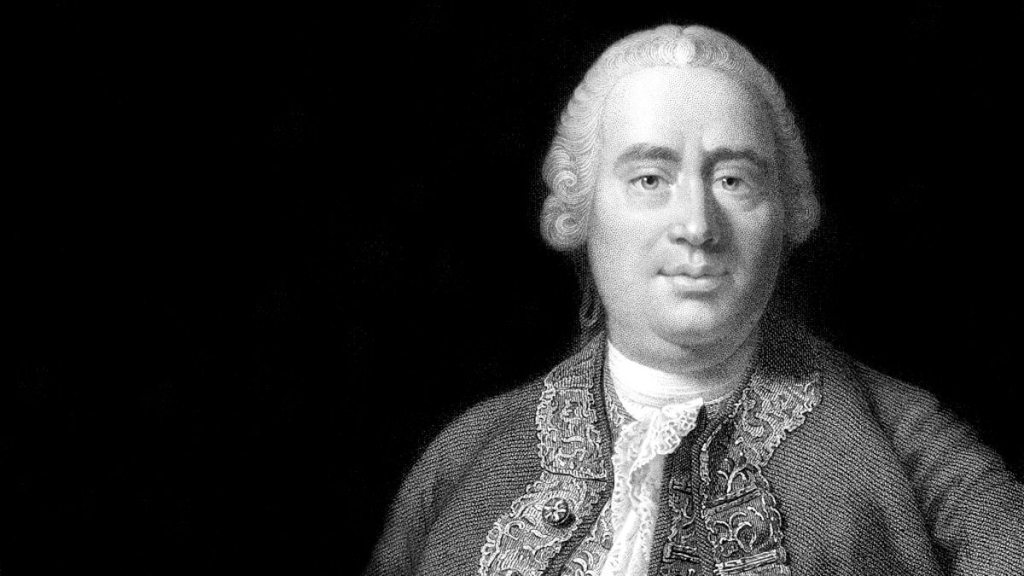
In David Hume’s book A Treatise of Human Nature, he constructs what he calls the science of man. One cannot rightly understand any other species of science before this foundational science. The most radical and paradigm-shifting realization, for Hume, is that if all that exists are impressions and ideas, there are no grounds to truly justify putting any two impressions together causally, no matter how we might be inclined or disposed to do so, either by vulgar habit or through any rational means. This profound insight — that impressions are singular moments of a particular feeling with no relation except that of imagination — forced philosophers (including critics such as Reid) to deeply re-evaluate theories of knowledge acquisition and general epistemic concerns.
Reid says this in his dedication for An Inquiry into the Human Mind, “His reasoning appeared to me to be just: there was therefore a necessity to call in question the principles upon which it was founded, or to admit the conclusions.” However, there are more reasons than the mere founding principles to reject Hume’s rationale. Drawing on a recent and rigorous debate, here are the five major critiques that make me skeptical of Hume’s skeptical conclusions.
1. Circular Reasoning (The Problem of Induction)
Hume uses causal reasoning (observing past regularities and inferring principles about human nature) to undermine the rational basis of causal reasoning. Suppose Hume justifies the separation of cause and correlation from experience, and he uses the distinction to describe and also argue against cause-and-effect as existing outside the mind (outside a relation/idea). In that case, he is making a circular argument. The implications of this circular reasoning are profound, as it challenges the very basis of our understanding of cause and effect. If belief in necessary connection is understood apart from reason, then there is equally no reason to undermine causal reasoning. The basis for an essential connection is reason and logical deduction. Thus, we can infer it from particular impressions, or it is not, and thus we can infer it based on specific impressions. Nothing falls on his skeptical rebuttal. You cannot easily conceive of a cause without an effect, any more than a premise without a conclusion.
2. The Self-Refutation of Assertion and Communication
The fact that Hume is making an argument refutes his point entirely. On what grounds can Hume either 1. make a distinction between kinds of necessity or 2. place either relations or matters of fact squarely into one category? Unthinkable things are equivalent to non-existent things, according to Hume. Therefore, you cannot make claims about external reality with reference to non-existent concepts. Even concepts of the imagination must exist by virtue of real impressions that have newly associated connections. Where are the impressions for a law such as non-contradiction?
Hume believes we cannot know a table exists, so this is not simply descriptive. His outward attempts to convince others, and the fact that he has followers who support his theory, testify against him. Psychological interpretations of reality are false simply because meaning exists apart from the mechanical goings-on of the mind, and that meaning is communicable. The very fact that Hume is articulating his theory indicates such. Even a phenomenological view is better than psychologism.
3. The Ad Hoc Assumption of External Existence
Hume asks for the impression that gives rise to the idea of continuation and external existence separate from our perception, but where does he get the idea of continuation and external existence in the first place? If everything is sense impressions, how is he arguing against anything contrary to sense impressions? This is all very ad hoc. Calling concepts fabrications of the imagination and such. Does he not realize that by doing so, he’s condemning his very principles, which allowed him to condemn continuation and external existence?
4. The Active Nature of Impressions, Not Raw Data
There is also another popular critique of Hume. That is the notion of the tree falling in the woods. The tree falls without making a sound. A sound is something that can only be heard. The point being, Hume’s impressions already imply cause-and-effect before they are even interpreted or registered. Here is another thing. If two people hear a recording of an orchestra, but one of them has finely tuned ears for orchestration while the other does not, then, on first glance, the one with finely tuned ears will hear the counter-melody played on the violin. The one that does not is not surprising. However, Hume would have to acknowledge this as an impression reflected, interpreted by relation (all of which in a near-instant), yet that implies a higher acuity has been granted to the one in the realm of a particular sense. If sense is raw data, and therefore something that you receive and not create, it stands to reason that you should not be able to improve in the tacit reception of raw data. This analogy highlights the inherent contradictions in Hume’s argument, suggesting that our senses are not passive receptors of information but active interpreters that can improve over time.
5. The Flawed Equivalence of Conceivability and Possibility
A rigorous philosophical objection to Hume’s conclusion on necessity centers on his premise that what is conceivable is logically possible. Hume argues that because we can conceive of a cause without its usual effect (e.g., imagining the sun not rising) without contradiction, the necessary connection is not a truth of reason, but of habit. However, this conflates a psychological possibility (what we can imagine) with a metaphysical possibility (what could actually happen in reality). Contemporary critics argue that our inability to conceive of a contradiction in a causal break may reflect our epistemic limitations —our ignorance of deep, non-obvious natural laws —rather than a statement about the world itself. Therefore, the supposed “freedom” of the imagination that underpins his skepticism is merely a function of our ignorance of actual natural necessity, and his argument fails to prove that the necessity is truly absent from the objects themselves.