


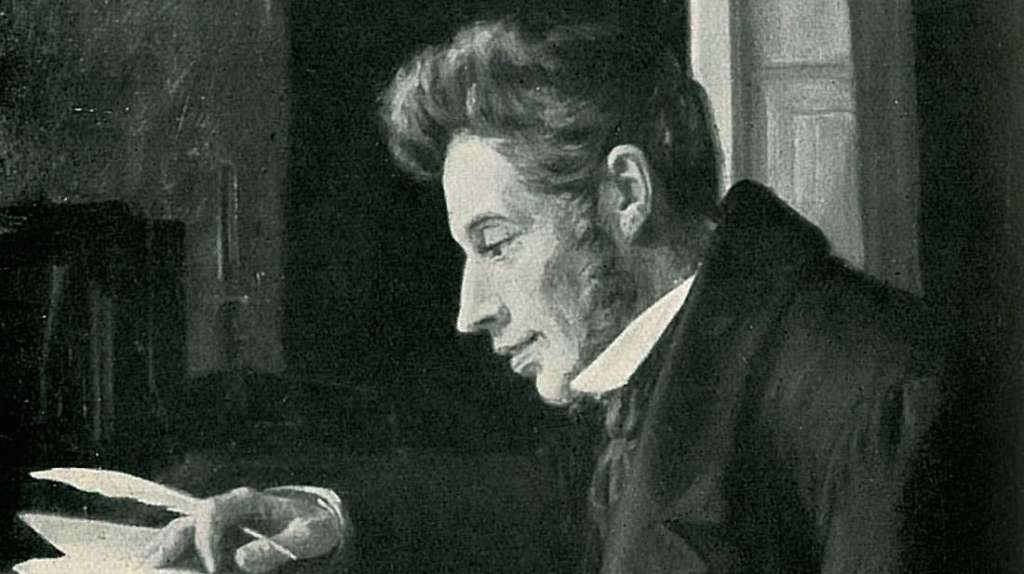
Reading Kierkegaard’s “Concluding Unscientific Postscript,” particularly his exploration of the “leap” of faith, resonates deeply with my own understanding of what it means to embrace a Christian worldview. It’s not merely about intellectual assent to historical or scientific propositions; it’s a profound, personal relationship that transcends the limitations of objective knowledge.
Kierkegaard, through Climacus, articulates the “leap” as a radical discontinuity, a “shifting from one genus to another.” This echoes my own experience in realizing that, although science is fascinating, it is not what we’ll get our final grade on. Just as Climacus argues that historical facts, no matter how compelling, cannot generate faith, I’ve found that scientific evidence, while supportive, doesn’t compel belief on its own. Faith is not a matter of knowing the truth or knowing anything–it’s a leap. This leap is a move from the objective to the subjective, from the realm of empirical observation to the domain of personal commitment.
The “ugly broad ditch” metaphor, about the unbridgeable gap between objective and subjective (relational, personal, i.e., of the subject) truth, illustrates the seemingly insurmountable divide between rational inquiry and the act of faith. No amount of scientific evidence or logical argumentation can bridge this gap. The leap is not a gradual progression but a decisive moment, a qualitative shift that defies rational calculation. It’s not about accumulating evidence until the scale tips; it’s about recognizing the inherent limitations of objective knowledge and choosing to embrace a truth that transcends it.
Climacus’s critique of “earnestness” is particularly helpful. He argues that intellectual striving is “droll enough” in the context of the leap. I’ve encountered many who seek to intellectualize faith, to reduce it to a system of logical propositions. But faith, as Kierkegaard understands it, is not a product of intellectual prowess. It’s a matter of the will, a subjective commitment that transcends the realm of reason. One cannot “earnestly” approach faith; one either makes the leap or one does not. Yet, that is not to undermine neither the objective world nor the subjective relationship.
Climacus’ satirical jab at those who attempt to “grab oneself by the neck a la Münchhausen” (a fictional character known for pulling himself out of a swamp by his own hair) speaks to the absurdity of trying to force faith through intellectual gymnastics. It’s a warning against self-deception, against pretending to have made the leap without truly engaging with its radical, personal nature. This resonates with a perspective which acknowledges the limitations of scientific and theological models and the necessity of a personal encounter with the Creator.
You often here the accusation so and so has “blind faith” or that faith is not based on evidence. For me, the leap of faith is not a blind leap into irrationality. It’s a recognition that objective knowledge, while valuable, is insufficient to grasp the fullness of reality. It’s an acknowledgment that there are truths that transcend empirical observation, truths that can only be apprehended through a subjective act of commitment. In the context of creationism, the leap involves acknowledging the limitations of naturalistic explanations and embracing the possibility of a Creator whose handiwork is evident in the complexity and beauty of the natural world.
This is valuable because we often feel the pressure to demonstrate the historical or the scientific aspect of our worldview as firmly in the historical or scientific. It is not. It is more. It is a leap into a new genus (Aristotelian category) of reality. It is a new domain of experience in addition to and separate from what we experience in religion, science, and the day-to-day.
The leap is a deeply personal decision, one that each individual must make for themselves. It’s a journey that involves wrestling with doubt, questioning assumptions, and ultimately choosing to embrace a truth that resonates with the deepest parts of one’s being. It’s a move from stranglehold the “objective” has on our society into a complementary view which includes the “subjective”, a move that is essential for true faith.
Citation
- Kierkegaard, Søren. Concluding Unscientific Postscript to Philosophical Fragments. Edited and translated by Howard V. Hong and Edna H. Hong, Princeton University Press, 1992.

Leave a comment