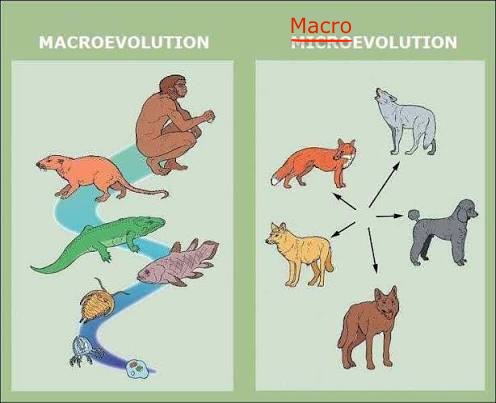
A frequent belief, usually touted as a rebuttal towards creationists, amongst common ancestry proponents is that speciation is macroevolution. Because creationists usually say that they hold to both microevolution and speciation, but not macroevolution, there arises a significant point of confusion from skeptics. Speciation is what happens when organisms have diverged from a lineage population but are separated by niche, geography, habit, or genetics. Macroevolution is a change at or above the species level.
The term macroevolution was coined in 1927 by the Russian entomologist Iuri’i Filipchenko in Variabilität und Variation. He defined it thus*:
“In such a state of affairs, it must be admitted that the decision regarding the question of the factors of the broad features of evolution, i.e., what we call macroevolution, must occur independently of the results of contemporary genetics…” (Page 94)
So macroevolution, according to the original author, does not participate in the class of observable evolutionary processes. Specifically, Filipchenko rejects the notion that macroevolution is speciation:
“…insofar as it is no longer a matter of the ‘origin of species,’ but of characteristics, so to speak, of a higher order, by which we understand characteristics of larger genera, families, orders, classes, etc…” (Page 90)
What Filipchenko is getting at is a notion that microevolutionary processes, simply the processes we observe, are distinct from the kinds which arrive at new body-plans. The changes that he observed could account for variation of parts within their delicate integrated-whole units, but could they account for the origin of novel integrations? Filipchenko argues that any effort in his day to answer that question must be speculative. However, he grants that we may see those events take place and we may accrue evidence which bolsters the hypothesis within the field of genetics.
Yet instead of rising to the challenge to support the macroevolutionary hypothesis, contemporary evolutionary researchers have opted to redefine the term. Macroevolution is speciation. Or at the very least, speciation is the most microcosmic example of this higher macroevolutionary scale.
Their rationale: the modern synthesis has proven that all macroevolution events are just culminations of microevolutionary clusters. There is fundamentally no difference between what goes on in the fossil record and what is going on now.
It stands to reason that if they are satisfied with this redefinition, they must have surely come across some satisfactory evidence that there are no fundamental differences between changes in allele frequencies and changes in higher order structures of the genome. And sure enough, the founders of the MS (Theodosius Dobzhansky, Ernst Mayr, George Gaylord Simpson) did believe they had the evidence to back up their view.
Their evidence came from many lanes, but ultimately it can be boiled down to the simple principle of a nested hierarchy. That there was a consistency of genetic rates of mutations with new taxa in geological history and that there was vast latent diversity within populations to capitalize on new niches quickly. From their perspective, if speciation is the branching point of the nested hierarchy, then speciation is the fundamental unit of macroevolution.
Demonstrating that organisms fit into a nested hierarchy and that gene frequencies shift quickly under selection proves that lineages diverge. But as Filipchenko pointed out in 1927, showing that a system can vary its existing integrated parts across a continuous spectrum is conceptually distinct from demonstrating how a fundamentally new organizational plan is assembled without disrupting the embryonic viability of the organism.
One attempt to further progress in demonstrating this view came from evolutionary development (evo-devo for short). In that area, they appealed to homeotic genes which are genes that facilitate whole organs and structures of the body. These genes are executive genes which can drastically change how an organism is built. A significant factor in its defense is their ubiquity in nature, where large swaths of organismal groups share identical homeotic genes. For example, the Pax-6 gene initiates eye development in insects, mollusks, and vertebrates. All these eyes are vastly different, so perhaps dramatic changes are possible with a base program.
And to credit the modern evolutionary theorists, this work is a valiant attempt. Yet it simply doesn’t justify the semantical shift to Filipchenko’s original thesis. Speciation doesn’t demonstrate changes to fundamental architectures of organisms. Speciation is equally predicted in a world where no large-scale evolutionary epochs exist.
The discovery of shared master switches like Pax-6 offered a compelling glimpse into developmental mechanics, proving that nature can deploy a single executive signal to initiate radically different organ structures—that is not in dispute.
However, this deep homology presents a double-edged blade for the redefined macroevolutionary framework. Because Pax-6 itself is conserved across hundreds of millions of years, the gene cannot be the source of the profound structural differences between an insect’s compound eye and a mammalian camera eye. Those differences reside in the dense, highly integrated downstream Gene Regulatory Networks (GRNs) that process the signal during early embryogenesis. These core regulatory networks operate as tightly coupled developmental hubs; altering their foundational wiring routinely triggers catastrophic embryonic lethality rather than viable structural innovation. Because early developmental pathways are so rigidly canalized, modifying the underlying GRN topology without destroying the viability of the developing organism remains a formidable mechanical hurdle.
Equating speciation with macroevolution addresses the branching of lineages, but it sidesteps the fundamental challenge Filipchenko raised nearly a century ago: how integrated developmental networks can be restructured to yield novel body plans without destroying embryonic viability. Speciation—the divergence of populations through reproductive isolation, geographic drift, or niche specialization—is fully predictable in a framework where structural variation occurs only within established architectural boundaries.
Therefore, it seems a very real possibility that the definition change was a concerted effort to obfuscate where the real clash or debate lies—where the real uncertainty lies in evolutionary theory. If a creationist accepts macroevolution, then the proponent of common ancestry rides off in celebratory parade. If a creationist accepts speciation, then they accept macroevolution, therefore QED. Somewhere along the line of that reasoning, something is being smuggled into the conversation that the creationist did not actually agree to. If that is not the case, the macroevolution is a meaningless phrase. Indeed the evolutionist Dobzhansky, in his book Genetics and the Origin of Species, concluded that one may “reluctantly put an equal sign” between micro- and macro- evolution.
If these terms are rendered useless in this way, then it is only because the evolutionist is begging the question. In order for the evolutionist to say “Speciation is Macroevolution” they must provide evidence that lineage splitting inherently accounts for the origin of novel, integrated developmental architectures. By substituting lineage splitting for structural transformation, modern biological rhetoric may have redefined the term, but the underlying mechanical question remains as vital today as it was in 1927.
*Variabilität und Variation is written in German and the original sentences read as following in order of appearance:
“Bei einer solchen Sachlage muß zugegeben werden, daß die Entscheidung der Frage über die Faktoren der großen Züge der Evolution, d. h. dessen, was wir Makroevolution nennen, unabhängig von den Ergebnissen der gegenwärtigen Genetik geschehen muß…”
“…insofern es sich schon nicht mehr um die ‘Entstehung der Arten’ handelt, sondern der Merkmale sozusagen höherer Ordnung, worunter wir Merkmale der größeren Gattungen, Familien, Ordnungen, Klassen usw. verstehen…”
I︠U︡riĭ Aleksandrovich Filipchenko. (1927). Variabilität und variation von jur. Philiptschenko … Gebrüder Borntraeger.
Nehm, R. H., & Kampourakis, K. (2013). History and philosophy of science and the teaching of macroevolution. International Handbook of Research in History, Philosophy and Science Teaching, 401–421. https://doi.org/10.1007/978-94-007-7654-8_14
Plutynski, A. (n.d.). Speciation and Macroevolution Anya Plutynski Blackwell’s companion. Blackwell’s Companion. Retrieved August 12, 2026, from https://philarchive.org/archive/PLUQAM
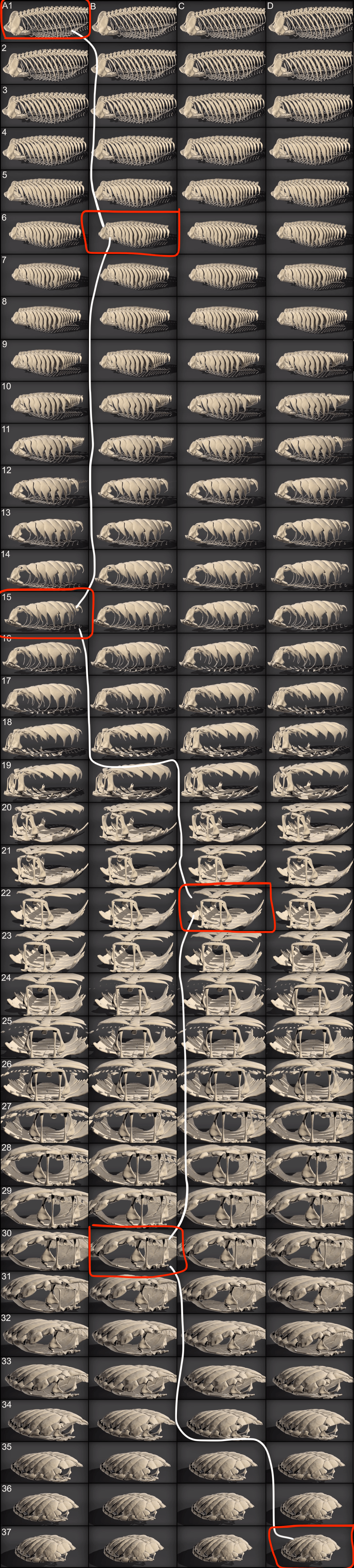
Today I stumbled on an interesting article from 2016 entitled, “Debunking creationism: a visual comparison of “micro” and “macroevolution”“. What initially struck me about the article was a very peculiar picture representing a smooth gradation from ancient lizard ribcage-skeletons to the modern turtle shell. The author notes that, apart from A1, “B6, A15, C22, B30, and D37” are real fossils that “perfectly match the expectations” for transitional forms (Milleretta, Eunotosaurus, Pappochelys, Odontochelys, Chelydra). For reference, I have highlighted those real fossils and drawn a line connecting them as a visual aid.
The main thesis of his argument is that the distinction that creationists draw of macro- vs micro- evolutionary processes is an arbitrary one. He writes,
“this distinction is completely arbitrary and meaningless because the exact same evolutionary mechanisms… In other words, macroevolution is simply the accumulation of microevolutionary steps, and one inherently leads to the other.”
This is such a common idea. One that I feel I have probably harped on before, but a summary could go something like: Micro-evolutionary processes are insufficient to cause Macro-evolutionary advancements because micro-evolutionary processes introduce no novelty into an organism. No new protein family, no new regulatory system, no new addition to gene function. We do see many examples of real functional changes that are predicated by the surrounding informational and structural elements—take epigenetics or evo-devo for example. But we have yet to find an example of a genome either becoming more robust or more diverse.
Modification should at least in part be additive. It’s not necessary that it is all the time, but at least a fair minority of the time it should be. We should observe newness in biology for there to be a coherence to a macro-evolutionary model. In my 2025 article, “Mutation is not Creation”, I formulated an extensive argument for these claims.
My real interest today, like the author of this article, is in exploring the implications of a pictorial challenge. As he states, “I decided to take a different approach for this post and provide a visual explanation.” He credits these photos to Dr. Tyler Lyson’s video, “Evolution of the Turtle Shell“.
You may notice, if you’ve seen these visuals before (in video form or in picture slides), that the version of the presentation I have included is immediately less compelling by nature of simply highlighting which images included are observed. There’s a lot that can be said on the impact that visual story-telling and ad hoc narratives play on our minds, hijacking our rational ability to evaluate the evidence. Evolutionary theory is certainly good at it. Whether we’re looking at the frauds of embryology or the constant barrage of natural selection-laced “this one would survive better” statements.
Setting aside the fact that it is actually not at all obvious that light sensors that are curved ever-so-slightly more inward are an advantage concrete enough for any selection effect, we must acknowledge the elephant (you know, the one that mysteriously vanished from the room?). That is, differential survival means absolutely nothing when you have no mechanisms to reliably build the new iterations. If this fossil transitions sheet tells us anything, it’s that we should expect many more forms in the fossil record.
And what do we do with forms such as Psephochelys polyosteoderma that are identical to modern turtles, but contemporary to Pappochelys found on A15? Before Odontochelys (C22) had time to develop a full shell, Psephochelys had already “converged” on that form, i.e., it already had a turtle shell before turtles existed. Which raises the question: On what basis do we take one pile of bones to be “turtles” and another to be “fakes”, when the very argument of smooth transitions in this article depends on bones, and only bones, to make their arguments? In other words, it raises the question: Are they begging the question?
It seems an awful lot like supporting evolution by looking for evolutionary connections…
Unfortunately the author of this blog, Fallacy Man (which is as apropos of a name as I’ve ever heard), fails to recognize the clear discontinuities and only aims to defend against the weaker argument (but still deadly): the dramatic leaps within the hypothetical diagram. He writes:
“Finally, the argument that this pathway is meaningless because it is partially hypothetical misses the point because it is absolutely fine to use hypotheticals to defeat absolute claims. Creationists claim that macroevolution cannot happen, and this pathway shows that it can happen. In other words, to defeat the claim that macroevolution is impossible, I don’t need to prove that this pathway actually occurred; rather, I simply have to show that a pathway is possible, which it clearly is.”
I just had to laugh when I read this—not at Fallacy Man of course, but at the fallacy. In strict modal logic, proving that something is possible does technically defeat the claim that it is impossible. But Fallacy Man’s argument suffers from a massive epistemic equivocation on the word “possible”. He is conflating visual conceivability with mechanistic biological possibility. Drawing a hypothetical sequence of bones only proves that a structural pathway can be imagined. Demonstrating that a morphological gradient can be mapped out on paper completely fails to refute the claim that the generative biological mechanisms required for macroevolution are actually viable. We need more than a conceptual staircase to prove a biological engine exists to climb it.
He offers the final challenge:
In short, if you are going to insist that macroevolution is impossible, then I want you to look at the evolution of the turtle and tell me which step is impossible (and justify that claim).
And to be fair, there are some transitional forms in the diagram that we do not see today which need to be accounted for. Albeit, there are clear turtle forms before and during those transitions in the fossil record, it’s still true that we have no turtles without hard shell backs today like the Odontochelys… No wait. Even that’s not true. Check out the softshell turtle.
It is a turtle that exists today and has a shell of leathery skin (instead of hard keratin) that could very easily be destroyed when fossilized. That means the skeleton a very similar structure to the Odontochelys and could very feasibly be fossilized without its outer carapace.
So we come to this conundrum: All the transitional forms are still around. They arrive in the fossil record out of order. There are absolutely no clear gradations between them—only self-admitted hypotheticals. So what exactly is this challenge, then?
Because I fail to see any legitimate steps at all.
CHAPTER 2: An Overview of the Source-Particular Model
The Source-Particular model is an attempt to ground empirical and theoretical frameworks within a system that justifies their existence. It is not meant to be revolutionary; rather, it is a method for producing knowledge revolutions. I first built it under the tutelage of my college advisor, Dr. Charley Dewberry, a philosopher and marine ecologist, and it has since grown from a sixty-page undergraduate thesis into more than two hundred pages of model-building. I am deeply grateful to the professors at Gutenberg College, and to Charley especially, for the grounding in the history of philosophy and the great books that made this work possible. Reading thinkers such as Thomas Reid, Michael Polanyi, Alasdair MacIntyre, David Hume, Immanuel Kant, Karl Popper, Aristotle, George Berkeley, and Charles Sanders Peirce — and this is far from an exhaustive list — gave me the raw material for a new synthesis. If that synthesis seems significant, the credit belongs less to any originality on my part than to the excitement of reconciling and extending ideas that have already stood the test of centuries.
I have always been fascinated by science, and a question I keep returning to is this: how should science operate — that is, if it is meant to give us knowledge (justified true belief) about the world? That is the methodological question: what is our scientific method? But that question quickly opens onto a deeper one: what makes a methodology good in the first place? If our scientific method turns out to be nothing more than an arbitrary convention, we are in dangerous territory, because arbitrariness is never a sound foundation for a model of anything.
Consider an example from the history of physics. Albert Einstein criticized Euclidean geometry for the way it abstracts away from any physical embodiment of its figures — Euclid, the Alexandrian mathematician working around 300 BC, produced the ancient world’s definitive book of geometric proofs without a single physical measurement in it (Euclid, Elements). When Einstein discussed Euclid’s Elements, he argued that a genuinely useful model of physical space needs some point of contact with physical evidence, not just internally consistent axioms (Einstein, Geometry and Experience, 1921). I do not want to overcorrect in the other direction and claim that abstract theories are only valid when they are tied directly to a dataset — quite the opposite. I raise Einstein’s critique only because it shows a thinker refusing to let a geometrical system drift into complete arbitrariness, which is a healthy instinct. My concern in this book, however, is with the far more common mistake, which runs the opposite direction: most scientific projects go astray not because they are too tied to physical assumptions, but because researchers discard their own biases and background assumptions at the laboratory door, as though those assumptions were not doing real work in shaping what counts as evidence in the first place.
If science is the foundation for many other fields of empirical, verifiable knowledge, then a poor foundation in science can cause the whole structure built on top of it to collapse. My aim in this book, then, is to provide a clearer foundation that can (1) ground our paradigm, (2) guide our research, (3) help us discover errors, and (4) guide the correction of those errors. Many methodologies fail to offer that fourth piece — a genuine procedure for error correction — even though it is essential to getting back on track in any field once something has gone wrong. Karl Popper’s falsificationism, for example, is an excellent tool for recognizing that some part of a theory is wrong, or that the theory is unfalsifiable and therefore empirically empty (Popper, The Logic of Scientific Discovery, 1934). In brief, falsificationism says that a theory only counts as scientific if it forbids some possible observation — if there is no experiment that could, even in principle, prove it false, then it is not doing scientific work. But Popper’s method, useful as it is, gives us no diagnostic tools for figuring out what specifically has been falsified within a theory, or whether the theory is worth salvaging in modified form, or whether we made a more basic mistake somewhere upstream. That gap was not Popper’s project — he was primarily responding to the logical positivists of his day — but it remains a serious absence in the methodological literature.
This lack of diagnostic capability becomes obvious once we look at real disputes in the history of science. Two examples, which I take up in depth in Chapter 11, are Werner Heisenberg’s rejection of Kantian causality and Albert Einstein’s rejection of Hendrik Lorentz’s ether. Heisenberg believed that quantum indeterminacy could overturn the Kantian assumption that every effect must have a determinate cause (Heisenberg, Physics and Philosophy, 1958). Einstein, for his part, kept Lorentz’s mathematical equations — which had originally been derived on the assumption that light traveled through a physical medium called the “luminiferous ether” — but stripped away the ether and gave the same equations an entirely new interpretation in his theory of special relativity (Einstein, “On the Electrodynamics of Moving Bodies,” 1905). I will develop both cases further later in the book, but the point to note now is that in neither case did the decisive shift turn simply on new observational evidence; something more like a change in background philosophical commitments was doing the work. Beyond this, most methodologies also fail to give the working scientist room to be a skilled craftsman and artist within a specialty — a skill that matters at every stage, from generating theories, to testing them, to evaluating them through peer review. I devote two full chapters to this idea (Chapters 8 and 9).
The inevitable result of trying to build a “method for methodologies” is that we are forced to answer both ontological questions (concerning the real essence of things, both internal and external to the self) and epistemological questions (concerning the theories by which we try to access that ontological reality). Philosophers usually treat ontology and epistemology as two separate specialties that can, in principle, be pursued independently. I do not think that separation holds up. The reason is simple: we cannot learn about what does not exist, and we cannot claim that something exists without some reason for the claim. There may be a degree of circularity built into this — we use our eyes to diagnose the eyes of others, and we use our own rationality to evaluate whether other people are reasoning well — but I think we should accept some circularity here rather than pretend we can escape it. The Source-Particular Model is likewise circular in this sense: we have to use the very tools the model provides in order to evaluate whether those tools are fit for purpose.
That circularity brings us to the heart of the model: an ontological taxonomy, or ranking system with built-in dependencies, that organizes our account of scientific theories. I call it the Source-Particular Model, and the name simply describes the groups of real things I have identified as meaningfully distinct from one another. To visualize the model, picture a three-by-three grid. Reading across, there are three levels, running from most foundational to most contingent: Metaphysical, Physical, and Surphysical.
Reading down, there are three categories that recur within each level: Source, Particulars, and Framework
A quick clarification before the grid itself: levels differ from one another in kind — the metaphysical, physical, and surphysical are different sorts of reality altogether. Categories, by contrast, differ only in aspect within a single level — the Source and the Particulars belonging to a given level are always the same basic kind of reality as each other, just playing different roles. I recognize the terminology is a lot to take in at once, but it becomes intuitive with practice, and three full chapters (3, 4, and 5) are devoted to walking through each level in turn. Here is the grid, with a short gloss of each cell:
Metaphysical
Physical
Surphysical
Source (the container)
Mind
Spacetime
Environment
Particulars (the contained)
Variables
Matter
Complexes
Framework (the emergent metaphor)
Proposition
Motion
Narrative
Levels run left to right, from most foundational (Metaphysical) to most contingent (Surphysical). Categories run top to bottom: Source is the container, Particulars are the contained, and Framework is the new, non-literal thing that emerges when a Source and its Particulars are combined.
Let us build up an intuition for this grid from the “observer’s” point of view, following a path Immanuel Kant helped clear. Kant argued that human thought comes equipped with certain built-in structures — space, time, causality, and so on — that we bring to experience rather than derive from it. He called the world as it actually is, independent of our perceiving it, the noumenon (plural noumena), and he argued that we never have direct access to it. What we do have direct access to is the phenomenon: the world as it appears to us once it has been filtered through the built-in structures of our minds and the raw data of our senses. In Kant’s view, we never encounter objects “in themselves”; we only ever encounter our own interpretation of the effects those objects have on us (Kant, Critique of Pure Reason, 1781). Kant himself was fairly pessimistic about how much this phenomenal picture actually tells us about the noumenal world behind it. I want to push back gently on that pessimism. Drawing on the Scottish philosopher Thomas Reid, I think we have good reason to treat our senses as broadly reliable translators, not just an opaque screen: our senses take what are, at bottom, electrical signals firing in the brain and turn them into meaningful reports about states of affairs in the external world (Reid, Essays on the Intellectual Powers of Man, 1785). We all share this basic translating apparatus and our confidence in it — this is what “common sense,” in Reid’s technical use of the term, actually names. Reid’s translation still runs through the very same mental and sensory machinery Kant describes; the difference between the two thinkers is a difference in how much trust to place in that machinery, not a disagreement about whether it exists. Either way — whether we lean toward Reid’s confidence or Kant’s caution — using our senses at all requires a kind of prior faith, or at least a metaphysical commitment, that they are basically trustworthy. That is why I place our mental properties — the mind and its contents — at the foundation of the whole model, in the Metaphysical level.
This starting point matters enormously. If our metaphysical assumptions shape how we interpret everything we subsequently observe, then flawed metaphysical assumptions will produce a flawed science downstream, no matter how careful the experiments are. Fortunately, metaphysical claims work differently — and, in one sense, more securely — than physical ones. At the metaphysical level we can achieve genuine deductive certainty. To be precise about what I mean: I am not claiming that acquiring rational insight is as mechanical as solving an equation, nor that simply having a metaphysical assumption makes it true. What I am claiming is narrower: metaphysical reasoning is the only kind of reasoning capable of producing strictly deductive arguments — arguments in which true, certain premises guarantee a true conclusion by logical necessity. Only the metaphysical level yields “proofs” in this strong sense. Take a simple case: how certain can we be that 1 + 1 = 2? Totally certain — it follows from the definitions of the terms involved. Or take the law of non-contradiction, that a proposition X cannot be true and false (not-X) at the same time and in the same respect: this is close to true by definition. More elaborate claims, if they are deductively derived step by step from starting-points this basic, inherit the same certainty as their premises.
One useful way to test a metaphysical claim’s certainty is the reductio ad absurdum — showing that denying the claim leads to self-contradiction. Take the claim that our senses are basically trustworthy. Suppose we deny it and say our senses are entirely unreliable. To even assert that claim to someone else, we would need language, memory, and reasoning that are themselves delivered to us via our senses and cognitive faculties — so the very act of arguing against the reliability of our faculties presupposes enough reliability in those faculties to construct and communicate the argument. The claim undercuts itself. Or take a more radical skeptical scenario: perhaps a deceptive demon, or a simulator running our minds like software, manipulates all our beliefs (this scenario is most famously associated with Descartes, but far older versions of it appear even in Augustine’s City of God, Book XI). Suppose we grant, for the sake of argument, that such a deceiver exists. Even so, in order for the deceiver to deceive or manipulate someone, that someone has to exist as a subject capable of being deceived. So even under the worst-case skeptical scenario, we cannot be deceived about the bare fact that we exist. This is the famous Cartesian starting point — “I think, therefore I am” (cogito, ergo sum) — and from that single certain foothold, Descartes tried to build up further certainties one careful step at a time (Descartes, Meditations on First Philosophy, 1641). The Source-Particular Model borrows this same Cartesian starting point as its own metaphysical bedrock.
Before going further, I want to be precise about what I mean by “metaphysics,” since the term gets used in wildly different ways across the history of philosophy. I will use it to mean: whatever exists or holds true prior to experience — that is, whatever is not itself derived from empirical observation. To a committed naturalist, calling something “prior to experience” might sound like a polite way of saying it is second-rate, merely speculative philosophy dressed up as knowledge. I want to resist that inference. Every piece of scientific work is filtered through a subjective interpretive lens before it becomes “data” at all, and that lens itself can only be evaluated using arguments that have no empirical content of their own, even though those arguments are still substantive and rationally binding. The rationalist tradition is correct that our knowledge about evidence — what counts as good evidence, what a fair test looks like, what makes one explanation better than another — exists prior to any particular piece of evidence, whether we recognize that background framework consciously or only implicitly. Even if a rationalist turns out to be wrong about the strict order of events — even if, say, our sense of what counts as good evidence is itself an abstraction built up gradually from accumulated experience rather than something we are born with — it remains true that whatever metaphysical commitments we hold will shape how we read the evidence in front of us. Evidence gets fitted into an interpretive framework that already exists prior to the evidence’s arrival.
Here is a concrete historical illustration. Suppose I hold the geocentric belief that the Earth sits at the center of the universe. When I then observe planets tracing strange, looping paths across the night sky, I do not immediately conclude that my underlying belief is mistaken. Instead, I fit that data into the box marked “things moving around the Earth,” no matter how many extra epicycles — small looping sub-orbits bolted onto the main orbit — I have to add to make the model work. This is, in fact, exactly what happened historically: ancient and medieval astronomers added epicycle upon epicycle to the Ptolemaic (Earth-centered) model to keep it consistent with new observations. The geocentric framework was only seriously questioned once Nicolaus Copernicus argued, on largely aesthetic and metaphysical grounds, that a good and orderly God would more plausibly have arranged the planets in a simpler, more harmonious pattern than the baroque, ever-more-complicated geocentric scheme required (Copernicus, De Revolutionibus Orbium Coelestium, 1543). Notice that the initial case for heliocentrism was not first and foremost a matter of new telescopic data — telescopes did not exist yet — but a metaphysical judgment about beauty, simplicity, and divine orderliness. Beauty, parsimony, coherence, correspondence to a wider theory, and every other quality we use to assign value to a body of data are themselves metaphysical assumptions that precede the evidence they are used to evaluate.
The Cartesian “I think, therefore I am” is, again, the clearest possible example of a purely metaphysical claim. It assumes that there exists a mind — our mind — capable of holding and evaluating variables. By “variables,” I mean placeholders that are capable of later receiving specific empirical content (think of the x, y, and z of an algebraic equation: on their own they carry no empirical content, but real-world observations can subsequently be plugged into the slots they mark out). Variables come logically prior to any actual, concrete phenomena; they are the empty slots waiting to be filled, not the filling itself. If the mind is the container in which these variables reside, then the variables are the things contained within the metaphysical realm. Translating this into the model’s vocabulary: the mind is the Source, and the variables are the Particulars.
The Source-Particular (or, if you prefer more familiar language, container-contained) relationship recurs at every level of the model, as later chapters will show. One caution is worth flagging immediately: the container/contained language is a spatial metaphor standing in for what is really a non-spatial relation of dependency. Do not import literal container-logic — spatial containment, or debates about the curvature of physical space in general relativity — into the metaphysical level; the metaphor is meant to illuminate the dependency relation, not to claim that the mind is a literal box with variables literally rattling around inside it. If the container/contained language still feels confusing, feel free to substitute the more literal terms “prerequisite” and “dependent.” I prefer “Source,” though, because it foregrounds the asymmetry that matters most here: every Particular requires its Source in order to exist at all, but no Source requires any of its Particulars in order to exist — though, as I will explain shortly, a Source does need at least some Particulars in order to have any determinate meaning.
So what happens when the mind gets to work sorting through its variables? We arrive at axioms — the laws of logic, of mathematics, of causality, of sensory awareness, and of personal identity, through which all of our sense-data gets filtered. In the model’s vocabulary, this resulting propositional content is called the Framework, because it is what makes sense of the otherwise unrelated combination of a mind (the Source) and a variable (the Particular). Frameworks are, in Michael Polanyi’s sense, “metaphors”: new meanings that emerge from combining two or more ingredients that do not, taken purely literally, belong together at all (Polanyi, Meaning, 1975). Consider the ordinary sentence “the classroom was a zoo.” Taken completely literally, this sentence is absurd — there are no actual zebras, giraffes, ticket booths, or entry fees anywhere in the classroom. And yet an emergent meaning arises easily out of the cultural association most people share between “zoo” and “chaotic, noisy, and hard to control”: we instantly understand that the classroom was loud and unruly. The metaphor works precisely because it forces together two concepts — “classroom” and “zoo” — that do not literally overlap, generating a third meaning that belongs to neither concept alone. This is exactly the kind of move the Source-Particular Model makes at every level: combining a Source and its Particulars, which are different in kind from one another, to generate a Framework that is different in kind from either.
For the Metaphysical level specifically, “Source-Particular” describes the pairing of mind and variable. The mind, on its own, is not itself particular in any way; it is the general capacity to hold and relate variables. But putting mind and variable together produces new information that neither one supplies on its own — namely, propositions. A proposition, in this technical sense, is the mind’s own self-organization: its ontology, or, as Aristotle would say, its account of being qua being (being simply as being, considered in its own right, apart from any more specific subject matter) (Aristotle, Metaphysics, Book IV). This proposition-level meaning is a metaphor in Polanyi’s sense as well, though with one qualification: for Polanyi, metaphors are strictly statements that cannot be taken literally, not necessarily a pairing of two categories that cannot literally be reconciled with each other. Even so, I think the underlying mechanism is the same: our subsidiary (background, half-noticed) awareness of the parts metaphorically constructs a single focal (foreground, fully attended) awareness of the whole.
Focal awareness is whatever we are directly and consciously attending to at a given moment; it is the meaning that the various parts, taken together, communicate. Consider what it is like to ride a bicycle. Your focal awareness while riding is not the mechanical act of pushing each pedal, nor the constant small shifts of your weight to stay balanced, nor the tiny corrective turns of the handlebars. All of those actions are subsidiary — present, and even necessary, but not directly what you are attending to. Your focal awareness is instead something like “getting down this path” or “not falling over,” the larger purpose that all those unnoticed micro-adjustments are quietly serving. For Polanyi, this means the bicycle functions as a tool: an extension of your own body (Polanyi, Personal Knowledge, 1958). This point generalizes well beyond bicycles. Any tool — a hammer, a pair of glasses, a map, a textbook — is, in this sense, an extension of the body, because it extends the reach of our senses, our physical actions, or our reasoning. Tools change our very relationship to the world by widening the sphere of things we are able to act on or understand. And crucially, our focal awareness is never directed at the tool itself; it is directed at the point where the tool meets the world. When you write with a pen, you attend to the words forming on the page, not to the precise pressure of your fingers on the barrel.
We can also see this dynamic in cases where subsidiary awareness gets wrongly promoted to focal awareness, with poor results. Consider trying to drive a nail with a hammer while consciously fixating on exactly how your fingers are wrapped around the wooden handle. Because your attention is on the grip rather than on the nail, your swing becomes stiff and poorly aimed, and you are far more likely to miss. Once you have practiced enough that the grip becomes properly subsidiary again — something your hand simply “knows” without your having to think about it — your aim on the nail improves immediately. Strengthening our subsidiary skills, in other words, strengthens the focal performance those skills are quietly supporting.
With those three ideas in hand — metaphor, focal awareness, and subsidiary awareness — we can return to the Source-Particular Model itself. Our own everyday focal awareness naturally sits at the highest level and category of the model: the Surphysical Framework of Narrative, where we process our experience in its richest and most meaningful form. This is, experientially, the level closest to lived life. But how we process that experience is quietly governed by the more foundational, more abstract levels beneath it — levels we can only access by deliberately turning our attention away from our ordinary focal awareness and toward the usually-subsidiary machinery underneath. This produces a kind of mirror-image structure in the model: certainty runs from the lower levels up to the higher ones (the Metaphysical level is the most certain, the Surphysical level the least), while focal, lived awareness runs from the higher levels down (we live our lives at the Surphysical level, only rarely attending consciously to the Metaphysical assumptions beneath it).
To round out this set of Polanyian tools, we need one more concept: tacit knowledge, meaning the kind of pre-understanding that lets us do things we cannot fully articulate (Polanyi, Personal Knowledge, 1958). Tacit knowledge explains why we can ride a bicycle without being able to state the physics of gyroscopic stability that keeps us upright, or the precise sequence of muscular corrections our body is making thirty times a second. We might hold only a vague, intuitive picture of what riding involves, or we might be trained mechanical engineers who understand the physics and material science of bicycles in exhaustive technical detail — the metallurgy of the frame, the manufacturing history of the brand, the record times of the best competitive riders, and so on. All of that additional knowledge can enrich our understanding of “riding a bicycle” to varying degrees, but none of it, by itself, constitutes the actual riding. Riding a bicycle is not identical to the physics of the bicycle’s motion, nor to the anatomy of the rider’s muscles. Riding a bicycle, in the vocabulary of this model, is a Narrative — a higher-level Framework that draws on, without being reducible to, everything beneath it.
But is “riding a bicycle” really a metaphor in the relevant sense? After all, what is incoherent or non-literal about the plain sentence “I am riding a bike”? We really are the ones riding it — aren’t we? Here is the twist: what is actually happening, according to the model, is that a mind is interpreting a stream of phenomena as “riding a bike.” The physical matter involved really is arranged into shapes we call a bicycle and a rider. But neither “the bicycle” nor “the rider,” considered as unified, meaningful wholes with a function and a story, exists at the purely metaphysical level (which contains only mind and variables) or at the purely physical level (which contains only spacetime and matter, without any reference to purpose or function). The bicycle-and-rider-as-a-meaningful-unit is therefore a distinctly Surphysical construct. “A biker” implicitly invokes particular complexes (a physical bicycle object, a physical human body) together with a Source that makes those complexes cohere into a single meaningful whole — namely, an environment: the trail, situated within a park, situated within a city, that gives the whole scene its point. Understood this way, “biking” is indeed a metaphor — not the everyday kind that a literal reading of the sentence would obviously flag, but the deeper kind revealed once we notice the ontological gap the sentence is quietly papering over.
This bicycle example reveals something about the model I have not yet stated outright: the Source-Particular structure applies not only within each level, but across the three levels taken together, on a larger scale. Metaphysics, Physics, and Surphysics themselves form a Source, a Particular, and a Framework at the macro-scale of the whole model. Metaphysics provides the container (mind) within which physical things can first be conceived of and related to one another at all. The relating of physical things, in turn, gives rise to environments, complexes, and narratives — the Surphysical Framework layer. I recognize this may be a large claim to absorb this early in the book, and I will return to unpack it more fully in later chapters.
Return once more to the cyclist. Nothing resembling a bicycle or a biker exists at the purely Metaphysical level; that level exists prior to any physical thing being singled out as an object at all. And yet the bicycle example shows that even though our only immediate access is to the Narrative level of our own lived experience, that experience is always quietly informed and constrained by the more foundational levels beneath it. The rider is not focally aware that he is pedaling, yet some form of understanding of pedaling is clearly present and available to further reflection or practice. In the same way, we are not ordinarily, focally aware of our own metaphysical assumptions — but we can bring them into view and examine them through models like this one, which are designed to make visible the usually-hidden subsidiaries beneath our knowledge. This has always been one of philosophy’s central and most valuable roles: not to replace our lived experience, but to clarify, piece by piece, the largely invisible scaffolding that makes that experience possible in the first place.
CHAPTER 3: The Metaphysical Level
No thinker illustrates the Metaphysical level better than Aristotle. Although the title of his treatise Metaphysics arose from a fairly arbitrary bit of ancient library cataloguing — it was simply shelved “after the Physics” (meta ta physika, literally “after the physical things”) — the subject matter turns out to be deeply relevant to physics itself. Aristotle describes this “new science” as the discipline that investigates first principles and causes: the discipline concerned with the attributes of being as such, what he calls ousia, or substance, and what later commentators summarize as the study of “being qua being” (Aristotle, Metaphysics, Book IV, Ch. 1). Aristotle notes, somewhat wryly, that this kind of inquiry tends to flourish historically whenever a society has enough leisure to support philosophers who can pursue it for its own sake rather than for immediate practical need. Early in the Metaphysics, he calls this inquiry into substance the discipline closest to the divine, on the grounds that it is exactly what a god would be occupied with: a god, on Aristotle’s view, is above all the ultimate cause and knower of all things.
Aristotle’s word “science” here should not be confused with our modern, narrower sense of “science” as controlled empirical experimentation. For Aristotle, episteme (often translated “science”) simply means any organized discipline aimed at genuine knowledge, whatever its subject matter. Aristotle explicitly holds that some knowledge is never going to be empirical knowledge at all — that some categories of reality cannot, even in principle, be reduced to matter. His entire Metaphysics is an attempt to work out this non-empirical kind of knowledge in detail. In fact, Aristotle argues that truly knowing something requires more than identifying the matter it is made of: we also need to identify its efficient cause (what brought it about), its formal cause (what shape or structure makes it the kind of thing it is), and its final cause (what it is for). I will unpack all three shortly with a concrete example. Much of the Metaphysics, whether explicitly or implicitly, works out a whole family of a priori concepts — concepts known prior to or independent of experience — including the four causes, the law of non-contradiction, the idea of an uncaused first cause, and criteria like parsimony (preferring simpler explanations), consilience (the way independent lines of evidence converge on the same conclusion), pragmatism, correspondence (truth as matching reality), coherence (truth as fitting together consistently with everything else we hold), the puzzle of infinite regresses, and the basic nature of truth and cognition.
To treat any of these concepts as ultimately reducible to matter, Aristotle argues, is to commit a category error — to mistake one kind of thing for a fundamentally different kind of thing. He makes this point vividly: “wood does not manufacture a bed” (a paraphrase of the reasoning found across Metaphysics, Book VII). Consider a wooden bed built by a craftsman. First, a purely materialist account is missing an efficient cause: what actually moved the wood into the shape of a bed? Wood does not spontaneously assemble itself; some agent — the carpenter — had to act on it. Second, it is missing a formal cause: what, exactly, is “the form of a bed”? That form cannot simply be identified with any one of the bed’s physical constituent parts (the planks, the nails, the fabric), since those same materials could just as easily have been assembled into a chair or a ladder. If matter were truly all there is, then no arrangement of matter would have any privileged claim to be “the shape of a bed” rather than any other shape. Third, it is missing a final cause: there is no built-in purpose, function, or reason for a bed’s existence written into the wood itself. If a random pile of particles happened by pure accident to take on the shape of a bed, it would only count as “a bed” because a mind was there to recognize and use it as one — not because bed-ness is a real property the particles possess independently of anyone’s noticing it. For Aristotle, natural things like an acorn carry their final cause within themselves — an acorn naturally develops into an oak tree, without anyone designing it to do so — whereas artifacts like beds have their final cause located instead in the mind of the person who made them. Whichever kind of case we are dealing with, Aristotle’s broader point stands: a purely materialist account cannot even formulate the question of purpose, let alone answer it, because it has no vocabulary in which purpose could be expressed as a real feature of the world. On this view, matter alone cannot account for change, form, or purpose.
It would therefore be a mistake to assume that empirical, laboratory-style knowledge is automatically more certain or more solid than this kind of philosophical knowledge — that assumption misunderstands what human reasoning is actually doing. We take it for granted, for instance, that a single thing cannot both exist and not exist in the very same respect at the very same time (the law of non-contradiction) — yet this is not itself an empirical discovery made in a lab; no experiment could ever confirm or disconfirm it, because it is presupposed by the very possibility of running and interpreting any experiment at all. We likewise take for granted that composite objects — a human body, a river, a nation — retain a stable identity even as their individual parts are gradually replaced or altered over time. And we take for granted that causes really do produce effects (a point Kant develops with particular care). All of these are metaphysical commitments, quietly operating beneath every empirical inquiry we conduct.
Accepting commitments like these, I want to argue, inevitably implies the existence of a mind as their ultimate source. Within the Source-Particular Model’s three-part structure, the mind functions as the epistemic cause underlying all other causes we might identify: it is the container that makes all other knowledge possible, and in that sense it is the most fundamentally real thing in the system, both ontologically (in terms of what actually exists) and epistemologically (in terms of what we can actually know). One of the broadest points of agreement across the whole history of philosophy — as Georg Wilhelm Friedrich Hegel likewise observed — is simply that there is something rather than nothing, and that philosophical inquiry has to start from whatever is immediately given to us, rather than from some further, more basic starting point (Hegel, Science of Logic, 1812). Exactly who or what “the observing party” ultimately is remains open to debate. But if that observing party is describable as an “I” at all, then that “I” cannot be mistaken about its own existence — that is the one thing it is logically impossible to be deceived about, since being deceived already presupposes a subject there to be deceived. This is not merely deductive certainty (certainty that follows from prior premises); the Source-Particular Model treats it as axiomatic certainty — certainty so basic that it functions as a starting point rather than a conclusion.
And yet, notably, we did not arrive at this truth by reasoning it out in advance of any experience at all. Metaphysics, on my account, studies the ontological conditions that make all other knowledge possible — but we typically arrive at an explicit grasp of those conditions only by reflecting backward from experience we have already had, not by deducing them from nothing beforehand. On Kant’s account, we never have unmediated access to either pure reason on its own or pure raw experience on its own; instead, we receive an already-fused phenomenal synthesis, and it is only by careful philosophical analysis afterward that we can distinguish the contribution of the mind’s own structuring from the contribution of whatever lies “outside.” Even so, for all practical purposes, the resulting phenomenon — the world as it appears to us — is the real substance we actually care about and can meaningfully discuss. It is a common misconception that this Kantian picture is flatly opposed to Reid’s realism. On closer inspection, Reid actually agrees with Kant that we lack any direct access to things exactly as they are “in themselves”; both thinkers hold that, as finite subjects, we have only our own cognition to work with, and that we must extract whatever metaphysical conclusions we can from the accumulated deliverances of experience. The real difference between them is a difference in the degree of trust each is willing to place in that experience as genuinely corresponding to an independent reality. For Reid, our senses and our shared natural language are gifts specifically suited to letting us understand the external world by means of the “signs” our senses present to us; Reid is explicit, in his writings on the philosophy of common sense, that God designed our faculties precisely so that we could correctly interpret the signs of the world beyond our own minds, and this theological confidence is what underwrites Reid’s greater trust in the senses compared to Kant’s more guarded position.
Within the Source-Particular Model, then, “experience” is never merely the isolated mind turned in on itself; it is the entire chain running from mind, to observation, to narrative. We have to postulate that the Physical level — much like Kant’s noumenal world — is genuinely real, even though it is never directly accessible to us in an unmediated way. Whichever picture one ultimately prefers, Reid’s or Kant’s, both end up tracking the very same three-part structure this model proposes. I will not spell out the full mapping in detail quite yet, except to flag it briefly: the Metaphysical level corresponds to the a priori structures of natural language and common sense; the Physical level corresponds to the noumena, the reality that is signified but never directly seen; and the Surphysical level corresponds to the phenomena, the signs through which that reality is indirectly communicated to us.
When we turn to describing the Metaphysical level in the model’s own vocabulary, three categories with their own distinctive qualities come into play — as is true at every level: Source, Particulars, and Framework. Because this is fundamentally a mental realm, the mind plays the crucial role of Source: the space within which the Particulars can exist at all. It plays this role not by creating the Particulars from nothing, the way an author might invent a fictional character, but rather by sustaining them — serving as their ongoing “life-blood,” the condition without which they could not persist. Strictly speaking, we could imagine each of the model’s categories in total isolation from the wider contingency structure, but in practice it becomes very difficult indeed to imagine concepts existing with no mind to hold them, or physics operating outside of any spacetime, or a subject existing with no context at all. The Source is, in this sense, always implicitly assumed by our very language, whether we notice it or not.
Take the word “nothing” as an illustrative case. “Nothing” is meant to describe the absence of either a container or its contents. And yet we cannot construct a linguistically coherent use of “nothing” that makes no reference, even implicitly, to some Source. If I say “nothing is here,” or “nothing happened,” or “nothing happened here,” each of these statements is implicitly framed against a background of spacetime — a “here” or a “when” against which the absence is being measured. Even if I retreat further and try to speak of “nothing” in a purely abstract sense, entirely apart from physical substance, that abstract “nothing” is still occurring as a thought — which is to say, it is still something occurring within a mind. Even the total absence of any thought presupposes a thinker capable of having (or, in this case, not having) that thought, in the same way that the absence of light only makes sense relative to some possible source of light. If this reasoning holds, then not even “nothing” — let alone any particular “thing” — can be conceived apart from some mental context in which it is conceived.
If a mind really exists, and we ask what exactly it is, the most straightforward way to answer is to look at what it does: it senses, remembers, experiences, acts, exercises skill, and so on — in short, it has thoughts. And the crucial feature of a thought, for our purposes, is not merely that it occurs, but that it is about something; philosophers call this feature “intentionality,” or “aboutness.” A thought that is about something is already implicitly a system of variables organized into candidate proofs — proofs that are capable, in principle, of corresponding to real states of affairs, and that are, in a real sense, themselves genuinely existing entities once true. And yet, importantly, at the purely Metaphysical level there is no correspondence relation available to us at all (no way to check a claim directly against an external physical fact) — there is only internal coherence, meaning consistency among the claims themselves. This is precisely why claims at the Metaphysical level are not falsifiable in Popper’s sense: falsifiability requires that some possible empirical observation could count against a claim, but no empirical observation of any kind bears on purely metaphysical claims like the law of non-contradiction.
The only way to test claims that belong exclusively to the mind, then, is to test them against the absurdity of their opposites (the reductio ad absurdum technique introduced earlier) and to build further propositions from them by strict deduction. This procedure can strike many readers as arbitrary or even circular. In fact, I want to argue the opposite: this Metaphysical mode of reasoning yields the most certain and most secure knowledge available at any level of the model.
The Particulars at this level are variables: the smallest indivisible units out of which logic, mathematics, grammar, and reasoning generally are built. They are the most basic, “irreducible” elements available within our mental constructs. On their own, variables signify nothing at all except pure relation — a placeholder standing ready to be related to other placeholders according to some rule. All the metaphysical truths available to us share this same character: they are pure relations, in the sense that they are not yet tied down to any particular external object or physical construct. “Relation” here means holding some determinate value or ordering with respect to other variables. In this sense, the Metaphysical level is specifically the level of value and of the ordering of values. Because values and their orderings can apply equally well, in principle, to any number of different objects, variables themselves never automatically “particularize” into any specific material form; they remain generic until something further fills them in.
Ethics offers an interesting borderline case here. In one sense, ethics genuinely participates in metaphysics: “good” and “bad,” considered purely in the abstract, are themselves a kind of value, and values belong at the Metaphysical level. But there is clearly more to concrete moral judgment than abstract value alone. Moral claims certainly have to conform to basic metaphysical considerations, but they must also correspond to specific actions, carried out by a particular agent, working through a physical medium, within a specific environment and context. Ethics, understood this way, moves beyond the tidy certainties of the Metaphysical level into the messier, richer, and less certain territory of Narrative — which, in this model, belongs to the Surphysical level. Meanwhile, other purely metaphysical items, like numbers or the rules of semantics, seem to have no direct bearing on physical laws or chemical reactions and yet somehow still apply cleanly to them whenever we use them to describe the physical world. In one sense, a variable is applied to some physical or surphysical concept only somewhat arbitrarily, as a matter of notational convenience — and yet, in another sense, real meaning is clearly being communicated when we do this. If that were not so, it would be impossible for two people to genuinely agree or disagree about a mathematical or logical claim concerning the physical world; disagreement itself presupposes shared, meaningful content to disagree about.
This raises an obvious question: what exactly is this abstract realm that can be laid over our empirical findings — organizing them, illuminating them, and helping us judge them true or false — while apparently existing quite separately from the physical world itself? Many mathematicians have puzzled over exactly this question. In his celebrated paper on the subject, the physicist Eugene Wigner argued that the sheer effectiveness of mathematics in describing the physical world is genuinely puzzling — “a wonderful gift which we neither understand nor deserve,” bordering on the mysterious (Wigner, “The Unreasonable Effectiveness of Mathematics in the Natural Sciences,” 1960). In response, others, such as the mathematician Richard Hamming, have suggested that mathematics only looks so effective because we quietly discard whatever mathematics turns out not to correspond well to nature, keeping only the successful cases and thereby creating a kind of survivorship bias (Hamming, “The Unreasonable Effectiveness of Mathematics,” 1980). But this response, I think, only pushes the question back a step: it still has to explain why there is any body of mathematics that corresponds this well to nature in the first place, and to such a strikingly serendipitous degree.
If mathematics really were a completely abstracted discipline, entirely foreign to our material existence, such that its correspondence to nature were simply a coincidence, then that coincidence would indeed be a genuinely inexplicable anomaly. The Source-Particular Model, however, offers a different diagnosis: it denies that abstract mathematical concepts are somehow derived by abstraction from physics and surphysics in the first place. Instead, on this model, the abstract Metaphysical level is precisely the interpretive lens through which we filter and organize our sense experience to begin with — it is not extracted from experience after the fact, but is presupposed by experience from the start. A committed materialist could, in fact, accept a version of this same point: our brains have simply evolved to interpret the world in a way that happens to line up well with how the world actually behaves, so it should be no surprise, on this view, that our mathematical interpretation of the world maps onto the world reasonably well. On this reading, the correspondence between mathematics and nature is close to a tautology, since we use mathematics to organize our experience of nature in the first place, prior to doing any formal natural science with it at all.
This may be part of why Kant himself remained skeptical about our ability to know the noumenal world directly: not only do we lack any unmediated experience of it, but what we do experience turns out to be suspiciously well matched to the very interpretive tools we bring to the table beforehand, which should perhaps make us cautious rather than confident. And yet, paradoxically, this same striking correspondence might instead give comfort to a realist like Reid: if our senses and our intuitions line up with the physical world this well, one very natural explanation is that they were specifically designed to line up that way. Which conclusion one is drawn to — Kantian caution or Reidian confidence — will likely depend on one’s prior views about divine design, and on one’s general willingness to accept an outcome that looks, on its face, highly improbable. At the very least, we can say with confidence that we possess a set of variables that reliably track our analyses of matter and of the higher-level complexes built out of matter.
More specifically, these variables line up with higher-level reality through the alignment of Frameworks across levels. Picture a set of transparent anatomical overlays of the human body — one sheet showing the digestive system, another the nervous system, another the skeleton — that can be layered on top of one another to build up a single, complete picture of the whole body. In much the same way, the different levels of reality in this model line up and overlay one another to produce a fuller, more complete account of reality as a whole.
At this exact juncture, I think, the real limitations of pure naturalism come clearly into view. Whether one chooses to interpret the “unreasonable effectiveness” of mathematics as a tautological by-product of evolutionary history, or instead as a meaningful piece of evidence for cosmic design, depends entirely on the metaphysical commitments one brings to the question beforehand — the raw empirical correlation between mathematics and nature is, by itself, silent about its own ultimate origin. For the naturalist, the alignment is simply a brute material necessity that requires no further explanation; for the teleologist (someone who thinks the universe exhibits genuine purpose, or telos), that same alignment is a significant sign pointing toward design. Our underlying Frameworks inevitably govern how we interpret every individual piece of data we encounter, which shows that we do not simply derive our metaphysical grounding from scientific observation, as a strict empiricist might hope; rather, we conduct our science by means of metaphysical commitments we already hold. If this is correct, then the naturalist, in order to exclude a metaphysical origin for reality, has no choice but to rely on metaphysical commitments of their own to rule that possibility out — which means the naturalist is not actually avoiding metaphysics at all, but only reducing it, by stipulation, to purely material terms. In effect, naturalists cede the genuine ground of metaphysics through what they actually do in practice, even while officially disclaiming metaphysics in their stated doctrines.
At this point it is worth pausing to explain more carefully how Frameworks operate at the Metaphysical level, and in the model generally. First, it is important to be clear that a Framework is not “emergent” in the sense of being built up piece by piece out of its Particulars, the way a wall is built up out of individual bricks. Instead, a Framework is the relationship that holds between two otherwise irreconcilable categories, forming a proper “Source-Particular” pairing: it is a genuinely new, emergent property arising from the interaction between the two prior categories within a single level of reality, rather than something assembled additively from parts. The Framework, in other words, arises from a metaphor, not from mere aggregation. At the Metaphysical level specifically, the mind is categorically distinct from the variables it contains, even though those variables depend on the prior existence of the mind as their Source. The mind is not literally made up of a collection of variables, in the way a wall is made up of bricks; nor are variables literal pieces of the mind, the way a brick is a piece of a wall. And no particular arrangement of mind and variables, however elaborate, can by itself push their relationship into a higher category than the Metaphysical. The laws of logic, for instance, do not depend solely on any particular mind’s actually operating them at a given moment; rather, the operation of minds in general is what makes it possible for categories — that is, stable units and unified groupings — to exist and be used at all. The mind facilitates model-building in general. But without variables — without something for the mind to categorize in the first place — there would be nothing for any Framework to organize, and so no Framework could arise.
Throughout this book I draw on several concepts from Michael Polanyi, especially from his posthumously published work Meaning (1975), which I have not yet fully unpacked. These concepts — metaphor, focal/subsidiary awareness, and tacit knowledge — recur throughout the model, since so much of my own thinking here has been shaped directly by Polanyi’s influence. To restate the definition of metaphor precisely: a metaphor arises when (1) the literal meaning of a statement is absurd or incoherent on its face, prompting the mind to seek out a new, non-literal meaning instead, and (2) that new meaning takes on distinctively subjective, symbolic qualities drawn from shared cultural or experiential context. Returning to our earlier example, “the classroom was a zoo” counts as a metaphor precisely because its literal meaning is absurd (there are, again, no actual zebras or entry fees involved), yet an emergent meaning is readily available from the shared cultural association between “zoo” and “chaotic, noisy, animal-filled place.” A metaphor like this builds directly on our prior, independent understanding of both of its component concepts — “zoo” and “classroom” — fusing them into a single new meaning that neither concept, alone, could supply.
The Metaphysical level’s own “Source-Particular” pairing — mind and variable — is doing a structurally similar kind of work. We are merging two ideas that, taken purely literally, do not belong together: a mind is not itself a variable, and a variable is not itself a piece of mind. And yet their combination generates genuinely new information in our thinking — namely, propositions. Propositions, again, are abstract: they are the mind’s own self-organization, its account of its own being, or, to use Aristotle’s phrase once more, its grasp of “being qua being” — that is, whatever must hold true for anything at all to exist, prior to any further specification of what particular kind of thing it is. This, I am suggesting, is itself a kind of metaphor, though I should flag one difference from Polanyi’s own usage: for Polanyi, metaphors are specifically statements that resist a literal reading, not necessarily any pairing of two categories that cannot be literally reconciled with one another. Still, in a broader sense, I think all of our subsidiary awareness works by metaphorically constructing a single focal awareness out of parts that, considered on their own, do not obviously add up to that focal whole.
Bring this back once more to the model as a whole. Our own immediate, everyday focal awareness sits at the model’s highest level and category — the Surphysical Framework of Narrative — where we process our experience in its richest, most integrated, and most meaningful form. This is, in that sense, the level truest to lived experience. And yet how we process that experience is quietly dictated by the more foundational levels beneath it, levels we can only bring into view by deliberately attending to what is more and more abstract, moving in the opposite direction from our ordinary focal awareness. Even though our everyday awareness sits about as far as possible from the mind considered in its bare, Metaphysical sense, that same bare mind remains the single most certain and most foundational element of the whole model — both epistemically (in terms of what we can be most sure of) and ontologically (in terms of what actually grounds everything else). This produces the mirrored structure I mentioned earlier: certainty increases as we move from the higher levels down toward the Metaphysical level, while immediacy and focal awareness increase as we move from the Metaphysical level up toward the Surphysical.
We have now covered metaphor, focal awareness, and subsidiary awareness. Understanding tacit knowledge is the key to understanding how the Source-Particular Model actually operates in practice. Tacit knowledge is a kind of pre-understanding: it explains why we are able to ride a bicycle without knowing the underlying mechanics or techniques involved, simply by performing the act successfully. We might carry only a fuzzy, intuitive picture of what riding a bicycle involves — or we might be trained engineers, fully versed in the physics and engineering of bicycles and in how a rider’s body ought to move in response. We might even know the specific metals, plastics, and fabrics that go into a given bicycle at the level of chemistry; we might know the various manufacturers who produce them and how; we might know the best and worst competitive riders in the sport’s history, along with the whole array of formal and informal competitions built around cycling, and whatever further trivia one could imagine. All of this additional knowledge can enrich — sometimes considerably — our focal awareness of what it means to ride a bicycle. But none of it, individually or collectively, simply is the riding itself. Riding a bicycle is not reducible even to the complete physics of the bicycle’s motion, or to the complete anatomy of the muscles involved in pedaling and balancing. Riding a bicycle, on this model, is therefore best understood as a kind of Narrative.
But is riding a bicycle really a metaphor at all? How exactly is the plain statement “I’m riding a bike” incoherent, or non-literal, on its face? We really are the ones riding the bike — aren’t we? The answer, on this model, is: not quite, or at least not in the naively literal sense the sentence suggests. What is actually happening is that a mind is undergoing a stream of phenomena that it interprets as “riding a bike.” The physical matter involved really is arranged into the shapes we call a bicycle and a human body. But strictly speaking, neither “the bike” nor “the rider,” understood as unified, meaningful, functioning wholes, exists purely at the Metaphysical level (mind and variables alone) or purely at the Physical level (spacetime and matter alone). What we are calling “a biker,” then, is a genuinely Surphysical construct. “A biker” implies particular complexes — the physical bicycle, the physical rider — together with a Source that makes those complexes cohere into a single meaningful whole: namely, the environment of the trail, situated within the park, situated within the city, that gives the whole activity its point and context. If this analysis is correct, then “biking” really is a metaphor after all — not the everyday, obviously non-literal kind of metaphor a casual reading of the sentence would flag, but a deeper metaphor rooted in the ontological gap between the model’s separate levels, one that ordinary language quietly papers over without our noticing.
In working through this example, I have already shown you something about the Source-Particular Model that I have not yet stated explicitly. There is one further, special layer to the model. The three levels themselves — Metaphysics, Physics, and Surphysics — form their own Source, Particular, and Framework at a larger, macro scale. Metaphysics provides the container within which physical things can first be held and related to one another as objects of thought at all. The relating of those physical things to one another, in turn, gives rise to environments, complexes, and narratives — the full Surphysical layer. I recognize this may feel like getting ahead of ourselves this early in the book; I will return to develop the point more fully in later chapters.
Return once more to the cyclist. Nothing resembling a bicycle, or a biker, exists at the purely Metaphysical level — that level exists prior to any physical thing’s being singled out as a determinate object at all. And yet the bicycle example shows that even though our only truly immediate access is to the Narrative level of our own lived experience, that experience is always quietly informed by the more foundational levels beneath it. The rider need not be focally aware that he is pedaling in order for some understanding of pedaling to be genuinely present, available for further reflection or refinement through practice. In the same way, we are not ordinarily, focally aware of our own metaphysical assumptions — yet we can bring them into explicit view through models like this one, which are built precisely to surface the ordinarily hidden subsidiaries beneath our knowledge. By acquiring a fuller and more accurate picture of these subsidiaries, we put ourselves in a position to build better diagnostic tools for correcting our errors and navigating toward truth. This has been philosophy’s central and most valuable role since its very beginning.
CHAPTER 4: The Physical Level
The Physical level is, in one sense, the most obvious and intuitive of the three, and in another sense the most controversial. Even though this level (along with, occasionally, the Surphysical) is often the only level of reality a strict materialist is willing to accept as real at all, there is nonetheless real hesitation, even among materialists, about how exactly to divide this level into its own Source, Particular, and Framework. What is the ultimate substratum of physics? Is it quantum fields? Is it spacetime itself? Is it some more abstract mathematical vector space? Is matter best understood as the curvature of spacetime, in the manner of general relativity, or as the excitation of underlying quantum fields? And what, at bottom, is physics itself — is it something fundamental that exists prior to the universe, or is it, like some naturalists claim about logic and mathematics, merely a convenient after-the-fact abstraction, built up to fit the patterns of observation the philosopher David Hume described as mere habit or custom? These are serious questions that any genuinely ontological model has to confront directly rather than sidestep.
We can say a few things at the outset about how the Physical level differs from the Metaphysical level already discussed. Two differences stand out in particular: (1) the Physical realm is finite, where the Metaphysical realm (of pure logical and mathematical relation) is not, and (2) the Physical realm proceeds by induction — drawing general conclusions from a limited set of specific observations, always open to revision by future evidence — rather than by the strict deduction available at the Metaphysical level. This means that whatever we identify as the Physical level’s Source, Particular, and Framework, physical reality as a whole must exhibit finitude, and therefore changeability, and therefore falsifiability — which, recall from Chapter 2, is the gold standard for any genuinely empirical, inferential body of knowledge.
With those two constraints in view, we can ask what the Physical Source actually is. We are looking for something finite that is nonetheless capable of holding finite particulars within it. The best candidate is spacetime. A pure mathematical vector space will not do, because vector spaces are typically infinite in extent, whereas we need something bounded. Quantum fields will not do either, because fields themselves already presuppose some more basic physical setting they operate within and depend on — they are too narrow a candidate to serve as the ultimate container. Spacetime, by contrast, satisfies both requirements: both space and time, as we ordinarily conceive them, are finite dimensions. You cannot meaningfully describe two particulars as separated by an infinite distance or an infinite duration within an ordinary spacetime framework the way you could within a purely abstract, infinite mathematical space. Spacetime also differs from the Metaphysical level in another important respect: it is not itself intrinsically changeable, even though things within spacetime change constantly. Within any given physical Framework, the specific arrangement of spacetime is altered by the events occurring within it, but the underlying nature of spacetime itself — as the finite, four-dimensional stage on which those events occur — remains constant across all such changes.
Having now discussed the two most fundamental Sources in the model — mind at the Metaphysical level, spacetime at the Physical level — we can test an interesting structural prediction. If mind really is more certain than even its own Particulars, as the Cartesian and Augustinian argument from Chapter 3 concludes, then we should expect a similar pattern of relative certainty to recur at every level: in each case, the Source of a level should turn out to be more fundamental — and, in an important sense, more certain — than the level’s other categories. And indeed, this rhyming pattern does appear to hold: spacetime, being less bound to any one specific physical configuration and more universal than any of the particular material objects it contains, turns out to be more certain and more fundamental than those objects. If the model is correct, we should expect this same rhyming structure to recur across every level’s set of three categories.
Let us test the rhyme again, this time at the level of Particulars. A variable, the Metaphysical Particular, represents a consistent placeholder value running throughout a given logical or mathematical proposition; it carries a distinctive kind of universality, in that any specific, “accidental” content can be substituted into it without changing the overall logical structure of the framework it belongs to (think again of x in an equation — you can substitute any specific number for x, and the equation’s underlying form remains exactly the same). In an analogous way, matter, the Physical Particular, remains consistent as the basic substrate running throughout any physical system — which is exactly why material reductionism (the view that complex physical phenomena can, at least in principle, be fully explained in terms of their smaller material constituents) is a coherent project to pursue in the first place. Matter can certainly be described using a vast range of competing theoretical frameworks over time — Newtonian corpuscles, quantum fields, string-theoretic vibrating strings, and so on — but my goal in this chapter is not to adjudicate between these physical theories about what matter’s ultimate nature turns out to be; that question belongs to physics proper, not to this philosophical Framework for organizing physics. Indeed, some physicists themselves have advanced broadly idealist views, on which the entire physical world is ultimately some kind of emergent mental phenomenon rather than genuinely mind-independent stuff.
That idealist possibility, interestingly, would fit quite comfortably within the Source-Particular Model’s overall structure, though the model by no means requires it. Instead, for the purposes of this chapter, we can simply take “matter” to mean whatever general, indivisible physical unit or units end up occupying physical spacetime, whatever their ultimate nature turns out to be. Yes, matter counts here as an ontological category in its own right — but note carefully that this is a claim only about the category itself, not a specific claim about what matter, in its final physical description, actually consists of. Working out that further, more specific question is squarely the job of physicists, not philosophers, and the philosopher can happily wait for the physicist’s verdict. What the philosopher can say with confidence in advance, however, is that matter’s ultimate nature can, in principle, be discovered by physical science — because otherwise we would be left with genuinely “floating,” unmoored laws of physics and chemistry that have no underlying substance to which they actually apply. And because, on this model, our metaphysical commitments come logically prior to our physical investigations, we can also say with confidence that our physical sciences, properly pursued, should not lead us into outright logical absurdities…
Paul Garner’s The New Creationism (2009) is, in its own right, a competent book. Coming to it from within a young-earth creationist framework, I don’t think it’s dishonest or lazy. Garner sets out a defined and modest goal: to demonstrate that plausible scientific models exist which map on to the conclusions entailed by a creationist reading of Genesis. He is not attempting philosophy; there’s no questioning the assumptions of modern science. He is not interrogating his own interpretive assumptions about Scripture; he doesn’t do an explicit run-down justifying his exegetical framework. He takes a run-of-the-mill YEC hermeneutical framework as is and asks, simply, whether science and it can be made to wed. On those terms, he largely succeeds at least for the models available to him in the late nineties and early two-thousands.
And yet the book is, for my purposes, radically unhelpful. This is not entirely Garner’s fault. On one hand, the evidence and models are out-of-date and the rhetorical style is too summary-driven to build genuine conviction in the reader. On the other hand, he is immersed in a cultural environment which takes many things for granted. But the deeper problem is one the book never acknowledges and, in certain ways, actively compounds. Garner operates within an essentially naturalistic and objectivist model of inquiry. He tacitly embraces the notion that knowledge is an enterprise of neutral evidence-gathering and model-fitting. This makes him hardly different from any other creationists doing science. It’s extraordinarily rare to see anyone asking whether their framework is coherent (or whether they’re uncritically taking on their opponents framework).
And within the model he operates, Garner provides data but sidesteps important issues. For example he dismisses radiometric dating on grounds of evidence which could easily be construed as anomalous (at best). He presents plausible stories but gives the reader no tools for weighing them. And finally, his seeming implicit suspicion of those who would question his conclusions, a kind of shy posture of his presentation, makes it very difficult for any genuine skeptic, non-YEC christians included, to engage without feeling pre-judged.
This points to the real problem, which is not the book’s particular arguments but the epistemological framework it silently assumes and shares with many of its critics.
Providing good data or a good alternative story is insufficient if the underlying theory of knowledge is broken. Garner’s models, even the best of them, cannot move a reader whose priors are organized differently and he does nothing to address those priors. This is the Bayesian heart of the matter. If I am a committed naturalist, the prior probability I assign to any divine act in history is, by stipulation, effectively zero. No amount of geological evidence for a global flood will alter my conclusions, because the flood’s supernatural cause is ruled out before the first piece of evidence is evaluated. Conversely, if I accept the flood on theological grounds, the rock record opens up in ways that compress geological time dramatically, and evolutionary timescales collapse accordingly. These are not just disagreements about data. Granted there is data involved, but we are using essentially different models to parse it. If it was just data, we could all go do some field work and resolve it relatively simply.
The trouble is that neither party is typically honest (to themselves) about this. The naturalist often presents their epistemology as though it were simply “ the science.” That is, a neutral view-from-nowhere method that anyone reasonable would adopt. But naturalism is itself a prior, not a conclusion. It is a decision, made before the evidence is examined, about what kinds of causes are admissible. And all our beliefs are this way—they are decisions we commit to prior to evidence or reason. The creationist who dismisses radiometric dating on theological grounds is doing something structurally similar, but at least is usually more explicit about it. They follow “what the Bible says” and filter evidence that way. These are both problematic, of course.
But what’s more pernicious is the skeptical posture that is invisible to itself. You see, if one assumes that one’s own epistemic tools are simply “rational inquiry” while the opponent’s (the rest of the world) are “faith” or “bias.” The skeptic’s lens changes what they see, but the lens itself goes unexamined. This is the foundational error, and it is not unique to any one side of this debate. In fact, we all do this. I am guilty of this too, no question.
This epistemological failure has a name when it becomes habitual: suspicion. And suspicion, when it hardens into a hermeneutic, destroys not just arguments but people.
The suspicious mind does not engage with what its opponent actually says. It looks for what the opponent must really mean. It asks: what’s the hidden motive, the tribal allegiance, the bad faith lurking beneath the surface of the stated position? When someone challenges a cherished belief, the suspicious interpreter does not ask: what is the most charitable reading of this challenge? Instead, they identify the person as either part of their group or not, and use that as a basis for ascribing their reasons and motivations. And having psychoanalyzed the questioner, they feel free to dismiss the question without answering it. This is often called well-poisoning and it comes from the suspicious mind.
This is a type of hermeneutic of suspicion in its most socially destructive form. It does not show up only in academia, where it has a respectable pedigree. It shows up at the dinner table. It shows up in the conversation between a parent and a child who has started to doubt.
The pattern is familiar to anyone who has spent time in strongly evangelical or young-earth creationist communities, though it is by no means limited to them (as I have heard of the direct reverse of this example too). A child raises a question. Perhaps about evolution, or about a passage of Scripture that doesn’t sit right, or about the age of the universe. And the question is not answered. It is adjudicated. The parent decides, often unconsciously, that the question is not a genuine inquiry but a symptom of bad influences, of pride, of the first steps away from faith. The question is treated as a threat rather than an invitation. And the child, sensing that their intellectual honesty is being read as betrayal, learns either to stop asking or to stop sharing. Or worse than that, sometimes the child is ostracized, losing that relationship permanently.
This is a catastrophic failure, and it cannot be fixed by better arguments. The problem is not that the parent lacks a good answer to the question about radiometric dating or archaeological records. The problem is that they have pre-judged the questioner’s intent and, in doing so, have abdicated the most basic responsibility of love: to understand the other person on their own terms before responding.
And yet, and this needs to be said plainly, the skeptical child is not innocent either. Questions can be genuine, or they can be rhetorical. It is entirely possible to ask a question you already believe you know the answer to, not because you seek understanding but because you want to establish your own position without exposing it to scrutiny. It is possible to use doubt as a crutch, i.e., a way of staying comfortable in uncertainty without doing the hard work of actually following the argument wherever it leads. It is possible to use questions as a tool to demonstrate intellectual superiority, because of the same genus of suspicion the parents may have held. Therefore, neither party in these conversations is automatically the victim. Yet, clearly a parent’s role is quite different, based on their natural responsibilities.
Moving to another political question in the US, the Governor Spencer Cox situation is a useful illustration of how quickly this breaks down in public life. In the aftermath of Charlie Kirk’s assassination, Cox made a statement that he had prayed the killer would not be a Utah resident. Several media outlets and commentators interpreted this as an expression of xenophobia. They took it as a wish to scapegoat a foreigner. One framing put it that Cox had “hoped to blame the killing on an immigrant.”
It is perfectly plausible—in fact, considerably more plausible—that Cox simply meant what he said: he had hoped the shooter wasn’t from his own state. No xenophobia or racism needed. But when a person has been categorized as part of an ill-intending elite, suddenly charitable exegesis cannot even be considered. The suspicious reader does not offer the generous interpretation to then reject it. They usually never consider it at all. The conclusion comes first, and the reading is constructed to confirm it.
This is the same error the excommunicating parent makes, and the same error the dismissive skeptic makes. It is a one-and-the-same error of deciding, in advance, that the person you disagree with is not rational enough, or honest enough, or good-faith enough, to be taken at their word.
There is no logic or facts-based fix for this. You cannot reason someone out of a posture they did not reason themselves into. But there is a solution, and it begins with a simple commitment: empathy.
This means resisting the first interpretation that comes to mind when someone challenges your worldview, and asking whether there is a more generous reading. It means treating the person across from you as someone who arrived at their position through some combination of experience, reasoning, and honest conviction—how would you be able to tell otherwise, anyway? It means being willing to say “I don’t know” without treating that admission as a defeat and being willing to accept that some will treat it as victory. It means recognizing that your own epistemic tools are not neutral, that your priors are not simply reason, and that the discomfort of examining them is the price of intellectual honesty.
For Christians and creationists in particular, though again, this applies broadly, there is something theologically incoherent about treating people who ask hard questions as enemies. If you believe that truth is not threatened by honest inquiry, then honest inquiry should not threaten you. If you believe that love is the first obligation, then the person asking the question is the first obligation—not the question.
Ken Ham has no difficulty identifying who is wrong and explaining why. That is easy. What is harder, and what matters infinitely more, is how you treat the person who is wrong (or who you believe is wrong). How you treat people in the moment of their doubt is not a secondary concern, it is the real work. The only work that can actually open a conversation rather than close one.
So how do we have an open conversation? How do we have an empathetic mind? We need to be able to step back and ask: “Why are you asking that question? What’s behind it?” Asking that first protects you from falling into the trap of holding suspicion. The alternative is a world of building walls. We need to step back from the approach to conversation-as-war. It’s not. So many of us act like it is, and the damage matters here. It makes the cost of even asking questions too high a barrier for entry.
Openness is, as it happens, the only epistemic strategy that can actually get you to the truth. Not the indifferent agnostic openness, but active, deliberate, uncomfortable practice of checking your own worst interpretations against the most generous alternative. When you catch yourself saying that someone is lying, stop. When you find yourself assuming that what a person plainly says must really mean something more sinister, stop. These are not signs of rigor or a critical mind. They are signs that you have prioritized the security of your own position and a suspicious mind over the person standing in front of you. Therefore, we should trade our suspicious mind with an empathetic mind which strives for humility, generosity, and grace in interpretation.
Citations:
Balta, Hugo. “Governor Cox’s Prayer Wasn’t Just Misguided—It Was Dangerous.” The Fulcrum, 14 Sept. 2025.
Garner, Paul. The New Creationism. EP BOOKS, 2009.
As I have been promoting the Kalam cosmological argument, I’ve been thinking deeply about its particular criticisms. To be clear, most criticisms of Craig’s Kalam fail, however some are fascinating and get you thinking about the particulars such as what existence means and whether ex nihilo (out of nothing) is an ontologically distinct kind of creation which we don’t observe.
On one hand, most proponents of the Kalam are perfectly willing to grant that we don’t observe ex nihilo creation and redirect the skeptic to the metaphysical entailments of creation (usually from the principle of sufficient reason), suggesting that the universe, and all things which have ontology in and of themselves, do need efficient causes. Yet, I really don’t think we need to cede ground here. As I’ve meditated on this, I’ve come to the conclusion that we do in fact observe ex nihilo creations—from our minds.
What do I mean by this? Well, take any concept of a “thing”, let’s say a wooden chair (it’s the favorite of philosophers), and ask ourselves how it is that this thing exists in the “real” world. When we examine a chair carefully, we discover something remarkable: the chair as a unified object—as a chair—does not exist in the physical substrate at all. What exists physically are atoms arranged in a particular configuration. The “chairness” of this arrangement, the ontological unity that makes these atoms one thing rather than billions of separate things, is something imposed by mind. In this sense, we observe minds creating genuine ontological categories ex nihilo—not creating the matter itself, but creating the very thingness that makes a collection of particles into a unified object.
This realization leads to a profound philosophical argument that I believe has been insufficiently explored in contemporary philosophy of religion.
The Nature of Composite Objects
We land on a few interesting features when we examine any purported “thing” in the material world. For one, a thing is instantiated in the world separate from its physical parts. This chair, for instance, may be made of wood, but many metals, plastics, and fabrics can be substituted and the identity of a thing within a category (or genus) is not changed. There is something higher than just mere components which brings the composition into a unified whole.
But what is this “something higher”? The materialist wants to say it’s just the arrangement of particles. But this raises immediate problems. Consider: when exactly does a collection of wood atoms become a chair? When the carpenter has assembled 50% of the pieces? 75%? 90%? What if one leg is broken—is it still a chair, or merely chair-shaped atoms? What if the leg is cracked but still functional? The materialist has no principled answer to these questions because “chairness” is not a property that can be reduced to particle arrangements.
The problem becomes even clearer when we consider boundaries. A chair has clear boundaries to us—we know where the chair ends and the floor begins. But at the atomic level, there are no such boundaries. Atoms are constantly exchanging electrons, being shed and replaced. Air molecules intermingle with the chair’s molecules at the surface. There is no physical demarcation that says “here the chair ends.” The boundaries we perceive (form) are imposed by our minds based on function and purpose.
This leads to several different possible conclusions about where a “thing” must be sustained. We are asking where something really exists, ontologically speaking. To be precise, there are three exhaustive options: (1) the thing is sustained in a domain of itself (like Platonic Forms), (2) the thing is sustained in the material domain (by physics and chemistry alone), (3) the thing is sustained in the mental domain (by a mind). I offer the reader to consider alternate hypotheses and notice that these choices really do cover the gamut.
The Trilemma of Ontology
Let us examine each option in turn to see which can bear the weight of explanation.
Option 1: Material Sustenance (Reductionist Materialism)
For the materialist position, we run into the logical contradiction of unified-composite objects. The materialist must assume that composite objects, like a rock, have no inherent boundaries. Physical things are mere indifferentiable clusters of atoms. From here, the materialist has two options. They can either accept a form of object nihilism, where no composite objects actually exist, or they can turn to a nominalistic approach.
In regards to nominalism, we must ask: what is the reason we would call a rock “rock” if separate from its ontology or it actually being a rock? If things, like a rock, exist in name only, then they do not really exist within distinct categories or kinds. This renders their definitions completely meaningless, because a good definition requires classification within the context of genus-species relationships. If things really exist as distinct objects, it is only because we have determined some aspect of their ontology over and above what reductionism or materialism can explain. So in reality, there is no sustainable nominalist approach for the materialist: one is either an object nihilist, or one must accept that real things are established some other way.
It seems to me that something like a rock is a perfect example of what would be impossible to be established as ontologically distinct without a mind. Is a pebble a rock? Is a handful of sand many small pebbles? Why do we call a variant quantity of small rocks a singular category? Why do we delineate between singular grains of sand and groups of pebbles? Is it not an arbitrary size distinction relative to our observational abilities and purposes?
For another example, consider why people groups such as Inuit tribes, who live in snowy environments, have many particular names for snow, whereas those tribes who live near the equator do not. It is because words are conventions within social groups to establish meaningful concepts. To someone who may see snow one day of the year, different textures and variations of snow are not meaningfully distinct. All composite objects that exist—including the very words that I am writing—are things minds have established as meaningful and bounded.
Therefore, a rock is meaningfully different from a pebble and a group of pebbles from sand only insofar as our use or intent dictates. Our experience of snow presupposes our naming conventions of snow. If you learn a language with seven words for snow, but you have always lived in a desert, you will not suddenly understand snow differently—you need to experience snow differently first.
But the materialist might object: “Even if our labels are arbitrary, the physical arrangements are real. When I sit in a chair, something physical holds me up.” This is true, but it misses the point. Yes, atoms arranged in a certain configuration will bear weight. But those atoms bearing weight is not the same as a chair existing. The chair, as a unified object with identity over time, with the capacity to be the same chair even if we replace parts, with clear boundaries—this is not present in the physical substrate. It is a mental construct imposed on that substrate.
Consider the philosophical puzzle of the Ship of Theseus. If we replace every plank of a ship, one by one, is it the same ship? The puzzle has no answer in purely physical terms because the ship’s identity is not a physical property. Identity over time, unity, and boundaries are all features imposed by minds, not discovered in matter.
If you accept Object Nihilism for composite objects and argue for a fundamental realist view where only quarks and leptons (or quantum fields) exist, then you face equally severe problems. What is your evidence that you exist ontologically? An entity which doesn’t exist as a unified object cannot consistently argue that some things do exist as unified objects. Moreover, what is your basis for assuming you know the “stuff” which is fundamental to reality? Even the quantum field is not necessarily the bottom line. Who can say what energy ultimately is? What’s to say that what’s fundamental isn’t also mind-contingent? That it isn’t mathematical in nature—which would itself require mental grounding?
This view has made a distinction where everything composite is nominal except for something that has never been directly observed as a truly fundamental “thing.” How does one justify this distinction in the first place? It seems to me a contradiction in reasoning to deny mind-dependent categories for composite objects while affirming mind-independent categories for fundamental particles. Both require the same kind of ontological boundary-drawing that only minds can provide.
Option 2: Self-Sustaining Forms (Platonism)
From here, a skeptic might say, “Okay, the chair or rock isn’t purely material. But maybe it’s just a Platonic Form. It sustains itself in an abstract realm. Why do we need a Mind?”
This is a more sophisticated response, but it ultimately fails for several reasons.
First, abstract objects have no causal power. A Platonic Form of “chairness” cannot reach down into the physical world and organize atoms into a chair configuration. It cannot explain why this particular collection of atoms instantiates the form rather than some other collection. The relationship between abstract forms and concrete particulars remains deeply mysterious in Platonic metaphysics—so mysterious that even Plato himself struggled with it in dialogues like the Parmenides.
Second, and more fundamentally, it is unintelligible to think of abstract objects like propositions, mathematical truths, or forms existing without a mind to think them. As Alvin Plantinga has argued, propositions are the contents of thoughts. They are the sort of thing that exists in minds. To say they exist “on their own” in some abstract realm is to commit a category error—it’s like saying colors exist independently of anything colored, or that motion exists independently of anything moving.
Consider what a Platonic Form would have to be: a truth, a concept, a logical structure. But these are precisely the kinds of things that exist as thoughts. A thought cannot exist without a thinker any more than a dance can exist without a dancer. The Platonist wants to affirm that 2+2=4 exists eternally and necessarily, and I agree. But this truth exists as an eternal thought in an eternal mind, not as a free-floating abstraction.
Third, many Platonic forms presuppose relationships, which themselves presuppose minds. Take the concept of justice. Justice involves right relations between persons. But “right relations” is an inherently normative concept that makes no sense without minds capable of recognizing and valuing those relations. Or consider mathematical sets. A set is defined by a rule of membership—a mental act of grouping things together according to a criterion. Sets don’t group themselves.
Therefore, if the “Blueprint” of the universe is real—if there truly are eternal structures, categories, and forms that ground the intelligibility of reality—these cannot be free-floating abstract objects. They must be Divine Thoughts, eternally sustained in a Divine Mind.
Option 3: Mental Sustenance (Idealism)
This leaves us with the third option: composite objects exist insofar as they are sustained by minds. This may sound counterintuitive at first, but it’s the only option that avoids the contradictions of the previous two.
When a carpenter builds a chair, he doesn’t merely arrange atoms—he imposes a conceptual unity on those atoms. He creates boundaries where there were none. He establishes identity conditions (this is one chair, not four separate legs plus a seat plus a back). He determines a function and purpose that gives meaning to the configuration. All of these acts are mental, not physical.
But here’s the crucial question: once the carpenter stops thinking about the chair, does it cease to exist? In one sense, yes—the carpenter’s mind is no longer actively sustaining it. But in another sense, no—the chair continues to be recognized as a chair by other minds. As long as someone conceptualizes those atoms as a unified object called “chair,” it exists as such.
This actually goes back to Bishop George Berkeley’s famous argument: “If a tree falls in the woods and no one is there to hear it, does it make a sound?” In a sense, if we stipulate that there is no wildlife and trees lack the ability to register sound frequencies, the fall really does not make a sound. This is because sound is a perception, a mental phenomenon. There are pressure waves in the air, certainly, but “sound” as we experience it requires a mind to interpret those waves.
However, Berkeley went further than this, and so must we. Berkeley argued that material objects continue to exist when no human observes them because God’s mind perpetually perceives them. I want to make a similar but distinct claim: composite objects, categories, and the conceptual structure that makes reality intelligible all require perpetual mental sustenance. Not just observation, but active ontological grounding.
An analogy may help: consider an author writing a novel. The characters in the novel have a kind of existence—they’re not nothing. But their existence is entirely dependent on the author’s creative act and the mind of any reader engaging with them. If every copy of the book were destroyed and everyone forgot the story, the characters would cease to exist in any meaningful sense. They have no “existential inertia” apart from minds sustaining them.
I propose that composite objects in our world are similar. The atoms may have mind-independent existence (though even this is debatable), but the chairness—the unified object with boundaries, identity, and purpose—exists only in minds. And since these objects continue to exist even when finite human minds aren’t thinking about them, they must be sustained by an infinite, omnipresent Mind.
The Formal Argument
All this contemplation leads me to the first formulation of a new kind of contingency argument which I call the Argument from Ontological Sustenance (or Idealist Argument from Contingency):
Premise 1: All composite objects require a mind to sustain their ontology.
Premise 2: The universe is a composite object.
Conclusion: Therefore, the universe requires a mind to sustain its ontology.
This is a logically valid argument, meaning if the premises are true, the conclusion must be as well.
The first premise has been defended at length above. The key insight is that composite objects—things made of parts organized into a unity—have no ontological status in the physical substrate alone. Their unity, boundaries, and identity exist only as mental constructs.
The second premise should be relatively uncontroversial. The universe is composed of parts (galaxies, stars, planets, particles) organized into a whole. It has boundaries (even if those boundaries are the limits of spacetime itself). It has an identity that persists through time. All of these features require the same kind of mental grounding that chairs and rocks require.
Therefore, the universe itself must be sustained in its existence as a unified, bounded entity by a mind. And since the universe contains all finite minds, this sustaining mind must be transcendent—beyond the universe, not part of it.
Why Not Pantheism?
An obvious objection arises: couldn’t the universe itself be the Mind that sustains all these categories? This would be a pantheistic solution—identifying God with the universe itself rather than positing a transcendent deity.
This fails for several reasons:
Step 1: A mind is a container for concepts. It is the sort of thing that has thoughts, holds ideas, and maintains logical relationships between propositions.
Step 2: Necessary truths (logic, mathematics, metaphysics) exist outside our finite minds. We discover them; we don’t invent them. This implies a Greater Mind contains them.
Step 3: Could this Greater Mind be the Universe itself?
Refutation: No. A “Universe Mind” would be composed of parts (galaxies, energy fields, quantum states) and subject to entropy (time, change, decay). But anything composed of parts is contingent—dependent on those parts and their organization. Anything subject to entropy requires external sustenance or an explanation for why it continues to exist through change.
Moreover, the universe is precisely the kind of composite object that needs mental grounding. To say the universe grounds its own categories is circular—it’s like saying a novel writes itself, or a dance choreographs itself.
Conclusion: The Ultimate Sustainer cannot be the Universe. It must be Transcendent (distinct from creation) and Non-Contingent (self-existent, not dependent on anything external to itself).
The Divine Attributes
Once we establish that a Transcendent, Non-Contingent Mind sustains all reality, we can derive further attributes through the classical logic of Act and Potency (pure actuality).
Premise: A Non-Contingent Mind has no external cause, and therefore no external limitations or deficiencies. It is “Pure Act”—fully realized, with no unrealized potential.
Omnipotence
To possess “some” power but not “all” power is to have a limitation—an unrealized potential to do more. But a Non-Contingent Being has no unrealized potentials by definition. Nothing external limits what it can do. Therefore, it possesses all power—omnipotence.
Omniscience
Ignorance is a lack, a privation of knowledge. A Fully Realized Mind has no lacks or privations. Moreover, if this Mind sustains all reality through its thoughts, it must know everything it sustains—otherwise, how could it sustain it? Therefore, it knows all things—omniscience.
Omnibenevolence
Evil, in the classical metaphysical tradition, is a privation—a lack of goodness or being. It is not a positive reality but an absence, like cold is the absence of heat or darkness the absence of light. Since this Mind is Fully Realized Being with no privations, it contains no evil. It is Pure Goodness—omnibenevolence.
Eternity and Immutability
Change implies potentiality—the ability to become something one is not yet. But a Non-Contingent Being has no potentiality. Therefore, it does not change. It exists eternally in a timeless present, not subject to temporal succession.
Personhood
This Mind thinks, knows, and creates categories. These are the activities of a person, not an impersonal force. Moreover, the categories it sustains include moral values, relational properties, and purposes—all of which presuppose personhood. Therefore, this Being is personal.
The Christian Specificity
We have now established the existence of a Transcendent, Omnipotent, Omniscient, Omnibenevolent, Eternal, Personal Mind that sustains all reality. This is recognizably the God of classical theism. But can we go further and identify this God with the specific God of Christianity?
The Argument from Relational Necessity
Premise 1: A God who is Personal, Truthful, and Loving is inherently Relational. Love seeks connection; truth seeks to be known; personhood seeks communion.
Premise 2: To be fully known and to establish a perfect relationship with finite creatures, this Infinite God must bridge the ontological gap. He cannot remain purely transcendent and abstract.
Consider: if God is perfectly loving, His love must be expressed, not merely potential. If God is truth, He must reveal Himself, not remain hidden. If God is personal, He must enter into relationship with persons He has created. But finite creatures cannot reach up to an infinite God—the ontological distance is too vast. Therefore, God must reach down to us.
The Filter
With this criterion, we can evaluate the world’s major religious traditions:
Deism/Pantheism: These fail immediately because they offer no relationship. Deism presents a God who creates and withdraws. Pantheism identifies God with the universe, making genuine relationship impossible.
Unitarian Monotheism (Islam/Judaism): These traditions affirm God’s transcendence and offer prophetic revelation—books and laws sent from on high. But God remains fundamentally separate. He sends messages but does not cross the boundary to unite with creation. The relationship is external, mediated through texts and commandments, never achieving full intimacy or union.
Christianity: This succeeds as the only worldview where the Sustainer becomes the Sustained. In the doctrine of the Incarnation, God doesn’t merely send a message about Himself—He enters history as a human being. The Infinite becomes finite. The Creator becomes a creature. The Mind that sustains all reality subjects Himself to the very categories He created.
This is not merely unique—it’s philosophically necessary. If God is to bridge the ontological gap between infinite and finite, between Creator and creature, He must do so by becoming both. The Incarnation is the only way for perfect relationship to be achieved.
Verification Through Human Experience
The Christian worldview also uniquely and truthfully describes the human condition. We experience ourselves as simultaneously possessing great dignity (made in God’s image, capable of reason and love) and great depravity (prone to selfishness, cruelty, and irrationality). We long for meaning, purpose, and redemption, yet find ourselves unable to achieve these on our own.
Christianity explains this through the doctrine of the Fall and offers a solution through Redemption—not by our own efforts, but by God’s gracious action in Christ. This narrative aligns with both our philosophical conclusions about God’s nature and our existential experience of ourselves.
Conclusion
The Mind that sustains the rock, the chair, and every composite object in reality is the same Mind that entered the world as Jesus of Nazareth. From the seemingly simple question “What makes a chair a chair?” we have traced a path to the central truth of Christianity: God is not distant or abstract, but intimately involved in every aspect of reality, from the smallest pebble to the vast cosmos, from the categories that make thought possible to the incarnate life that makes redemption possible.
This is the Argument from Ontological Sustenance. Like all philosophical arguments, it invites scrutiny, challenges, and further refinement. But I believe it opens a fruitful path for natural theology—one that begins not with cosmological speculation about the universe’s beginning, but with careful attention to the ontological structure of everyday objects and the categories that make them intelligible.
Every time we recognize a chair as a chair, a rock as a rock, or the universe as a cosmos, we are implicitly acknowledging the work of the Divine Mind that makes such recognition possible.
In his paper “Life Transcending Physics and Chemistry,” Michael Polanyi examines biological machines in a way that illuminates the explanatory failures of materialism. The prevailing materialist paradigm that life can be fully explained by the laws of inanimate nature fails to account for higher ordered realities which have operations and structures that involve non-material judgements and interpretations. He specifically addresses the views of scientists such as Francis Crick, who, along with James Watson, argued for a total reductionist and nominalist view based on their discovery of DNA. For Polanyi, there is a life-transcending nature that all biological organisms have which is akin to machines and their transcendent properties. His central argument is based on the concept of “boundary control,” which argues the notion that there are laws that govern physical reactions (as Crick would accept) yet there are particular laws of form and function which are unique and separate from those lower-level laws.
There is a real clash between Polanyi’s position and the reductionist/nominalist position which is commonly held by molecular biologists. To start to broach this divergence he explains how the contemporaneous discovery of the genetic function of DNA was interpreted as the final blow to vitalist thought within sciences. He writes:
“The discovery by Watson and Crick of the genetic function of DNA (deoxyribonucleic acid), combined with the evidence these scientists provided for the self-duplication of DNA, is widely held to prove that living beings can be interpreted, at least in principles, by the laws of physics and chemistry.”
Polanyi explicitly rejects Crick’s interpretation; that position is of the mainstream and popular level academia. Crick states that his principle “has so far been accepted by few biologists and has been sharply rejected by Francis Crick, who is convinced that all life can be ultimately accounted for by the laws of inanimate nature.” This same sentiment can indeed be found in Crick’s book “Molecules and Man.” Crick writes the following:
“Thus eventually one may hope to have the whole of biology “explained” in terms of the level below it, and so on right down to the atomic level.”
To dismantle the materialist argument, Polanyi utilizes the analogy of a machine. A machine cannot be defined or understood solely through the physical and chemical properties of its materials. Take a watch and put it into a machine that can read a detailed atomic map of the device: can even the best chemist give any coherent reason as to whether the watch is functioning or not? Worse—can one even tell you what a watch is, if all that exists is matter in motion for no particular reason? Polanyi writes it best:
“A complete physical-chemical topography of my watch—even though the topography included the changes caused by the movements in the watch—would not tell us what this object is. On the other hand, if we know watches, we would recognize an object as a watch by a description of it which says that it tells the time of the day… We know watches and can describe one only in terms like ‘telling the time,’ ‘hands,’ ‘face,’ ‘marked,’ which are all incapable of being expressed by the variables of physics, length, mass, and time.”
Once you see this distinction, you are invariably led (as Polanyi was) to two unique substratum of explanation; what he calls the concept of dual control. Obviously, there are physical laws which dictate constraints and operations of all material and all material things can be explained by these very laws. However, those laws are only meaningfully called constraints when there is some notion of intention or design to be constrained. The shape of any machine, man-made or biological, is not determined by natural laws. Not only is it not determined by them, it cannot be determined by them in any way. Polanyi elaborates on this relationship:
“The machine is a machine by having been built and being then controlled according to principles of engineering. The laws of physics and chemistry are indifferent to these principles; they would go on working in the fragments of the machine if it were smashed. But they serve the machine while it lasts; machines rely for their operations always on the laws of physics and chemistry.”
As I hinted at before, Polanyi also applies this logic to biological systems, arguing that morphology is a boundary condition in the same way that a design of a machine is a boundary condition. Biology cannot be reduced to physics because the structure that defines a living being is not the result of physical-chemical equilibration. Physical laws do not intend to create nor do they care that anything functions. Instead, “biological principles are seen then to control the boundary conditions within which the forces of physics and chemistry carry on the business of life.”
Where Polanyi and Crick truly have the disagreement, then, is in their interpretation of the explanatory power of nature and how DNA is implicated within these frameworks. While Crick views DNA as a chemical agent that proves reducibility, Polanyi argues that the very nature of DNA as an information carrier proves the opposite. For a molecule to function as a code, its sequence cannot be determined by chemical necessity. If chemical laws dictated the arrangement of the DNA molecule, it would be a rigid crystal incapable of conveying complex, variable information. Polanyi writes:
“Thus in an ideal code, all alternative sequences being equally probable, its sequence is unaffected by chemical laws, and is an arithmetical or geometrical design, not explicable in chemical terms.”
By treating DNA as a transmitter of information, Polanyi aligns it with other non-physical forms of communication, such as a book. The physical chemistry of the ink and paper does not explain the content of the text. Similarly, the chemical properties of DNA do not explain the genetic information it carries. Polanyi contends that Crick’s own theory inadvertently supports this non-materialist conclusion:
“The theory of Crick and Watson, that four alternative substituents lining a DNA chain convey an amount of information approximating that of the total number of such possible configurations, amounts to saying that the particular alignment present in a DNA molecule is not determined by chemical forces.”
Therefore, the pattern of the organism, derived from the information in DNA, represents a constraint that physics cannot explain. It is a boundary condition that harnesses matter. Polanyi concludes that the organization of life is a specific, highly improbable configuration that transcends the laws governing its atomic constituents:
“When this structure reappears in an organism, it is a configuration of particles that typifies a living being and serves its functions; at the same time, this configuration is a member of a large group of equally probable (and mostly meaningless) configurations. Such a highly improbable arrangement of particles is not shaped by the forces of physics or chemistry. It constitutes a boundary condition, which as such transcends the laws of physics and chemistry.”
In this way, Polanyi refutes the nominalist materialist perspective by demonstrating that the governing principles of life—its form, function, and information content—are logically distinct from, and irreducible to, the physical laws that govern inanimate matter. Physical laws are, then, merely a piece of the puzzle of the explanation. What’s more, they are insufficient to account for the existence of particular organizations of matter which physical laws and chemistry are not determinative of.
Is the human eye poorly designed? Or is it optimal?
If you ask most proponents of modern evolutionary theory, you will often hear that the eye is a pinnacle of unfortunate evolutionary history and dysteleology.
There are three major arguments that are used in defending this view:
The human eye:
is inverted (retina) and wired backwards
has a blind spot due to nerve exit
Is fragile due to retinal detachment
#1 THE HUMAN EYE IS INVERTED
The single most famous critique is, of course, the backward wiring of the retina. An optimal sensor should use its entire surface area for data collection, right? The vertebrate eye requires obstruction of the eye-path by axons and capillaries before it hits the photoreceptors.
Take the cephalopod eye: it has an everted retina, the photo receptors face the light and the nerves are behind them meaning there is no need for a blind spot. The human reversed wiring represents a mere local (rather than global) maximum where the eye could only optimize so far due to its evolutionary history.
Yet, this argument misses non-negotiable constraints. There is a metabolic necessity for the human eye which doesn’t exist in the squid or octopus.
Photoreceptors (the rods and cones) have the highest metabolic rate of any cell in the body. They generate extreme heat and oxygen levels and undergo constant repair from constant reaction from photons. The energy demand is massive. This is an issue of thermoregulation, not just optics.
The reason this is important is because the vertebrate eye is structured with an inverted retina precisely for the survival and longevity of these high-energy photoreceptors. These cells require massive, continuous nutrient and oxygen delivery, and rapid waste removal.
The current inverted orientation is the only geometric configuration that allows the photoreceptors to be placed in direct contact with the Retinal Pigment Epithelium (RPE) and the choroid. The choroid, a vascular layer, serves as the cooling system and high-volume nutrient source, similar to a cooling unit directly attached to a high-performance processor.
If the retina were wired forward, the neural cabling would form a barrier, blocking the connection between the photoreceptors and the choroid. This would inevitably lead to nutrient starvation and thermal damage. Not only that, but human photoreceptors constantly shed toxic outer segments due to damage, which must be removed via phagocytosis by the RPE. The eye needs the tips of the photoreceptors to be physically embedded in the RPE.
If the nerve fibers were placed in front they would form a barrier, preventing waste removal. This specific geometry is a geometric imperative for long-term molecular recycling and allows for eyes that last for 80+ years on the regular.
Critics often insist however that even given the neural and capillary layers being necessary for metabolism, it is still a poor design because they block or scatter incoming light.
Yet, research has demonstrated that Müller glial cells span the thickness of the retina and act as essentially living fiber-optic cables. These cells possess a higher refractive index than the surrounding tissue, which gives them the capability to channel light directly to the cones with minimal scattering.
So this criticism actually goes from being a poor design choice into an awesome low-pass filter which improves the signal-to-noise ratio and visual acuity of the human eye.
But wait, there’s more! The neural layers contain yellow pigments (lutein and zeaxanthin) which absorb excess blue and ultraviolet light that is highly phototoxic! This layer is basically a forcefield against harmful rays (photo-oxidative damage) which extends the lifespan of these super delicate sensors.
#2 THE HUMAN EYE HAS A BLIND SPOT
However, the skeptics will still push back (which leads to point number 2): But surely a good design would not include a blind spot where the optic nerve runs through! And indeed this point is a fairly powerful one at a glance. But on further inspection, we see that this exit point, where literally millions of nerve fibers bundle together to pass the photoreceptors, is an example of optimized routing and not a critical flaw of any kind.
This is true for many reasons. For one, by having the nerves bundle into this reinforced exit point, in this way, maximized the structural robustness of the remaining retina. Basically, if it were not this way, and the nerve fibers exited individually or even in small clusters across the retina, it would radically lower the integrity of the whole design. It would make the retina prone to tearing during rapid eye movements (saccades). In other words, we wouldn’t be getting much REM sleep! That, but also, we’d be missing out on most looking around of any kind.
I’d say, even if that was the only advantage, the loss of a tiny fraction of our visual field is worth the trade-off.
Second, and this is important, the blind spot is functionally irrelevant. What do I mean by that? I mean that humans were designed with two eyes for the purpose of seeing depth-of-field, i.e., understanding where things are in space. You can’t do that with one eye, so that’s not an option. With two eyes, the functional retina of the left eye covers the blind spot of the right eye, and vice versa. There is no problem in this design if both the vision is covered and depth-of-field are covered 100% accurately: which they are.
Third, the optic disc is also used for integrated signal processing, containing melanopsin-driven cells that calibrate brightness perception for the entire eye, using the exit cable as a sensor probe. That means that the nerves also detect brightness and run the logistics in a localized region which is incredibly efficient.
#3 THE HUMAN EYE IS VULNERABLE
That is, the vulnerability specifically refers to retinal detachment. That is when the neural retina separates from the RPE. Why does this happen? It is a consequence of the retina being held loosely against the choroid, largely by hydrostatic pressure. Critics call this a failure point. Wouldn’t a good design be one where the RPE is solidly in place, especially if it needs to be connected to the retina? Well… no, not remotely.
The RPE must actively transport massive amounts of fluid (approximately 10 liters per day) out of the subretinal space to the choroid to prevent edema (swelling) and maintain clear vision. A mechanically fused retina would impede this rapid fluid transport and waste exchange. Basically, the critics offer a solution which is really a non-solution. There is no possible way the eye could function at all by the means they suggest as the alternative “superior” version.
So, what have we learned?
The human eye is not a collection of accidents, but a masterpiece of constrained optimization. When the entire system (eye and brain) is evaluated, the result is astonishing performance. The eye achieves resolution at the diffraction limit (the theoretical physical limit imposed by the wave nature of light!) at the fovea, meaning it is hitting the maximum acuity possible for an aperture of its size.
The arguments that the eye is “sub-optimal” often rely on comparing it to the structurally simpler cephalopod eye. Yet, cephalopod eyes lack trichromatic vision (they don’t see color like we do), have lower acuity (on the scale of hundreds of times worse clarity), and only function for a lifespan of 1–2 years (whereas the human eye must self-repair and maintain high performance for eight decades). The eye’s complexity—the Müller cells, the foveal pit, and the inverted architecture—are the necessary subsystems required to achieve this maximal performance within the constraints of vertebrate biology and physics.
That’s not even getting to things like mitochondrial microlens in our cells which are essential for processing light. Recent research suggests that mitochondria in cone photoreceptors may actually function as micro-lenses to concentrate light, adding another layer of optical optimization. Optimization which would need to be there, perhaps a lot earlier than even the reversed lens structure.
The fact that the eye is so optimal still remains, despite the critics best attempts at thwarting it. Therefore, the question remains, how could something so optimized evolve by random chance mutation, as well as so early and often in the history of biota?
In The Origin of Species, Darwin outlines evidence against the contemporary notion of species fixity, i.e., the idea that species represent immovable boundaries. He first uses the concepts of variations alongside his introduced mechanism of natural selection to create a plausible case for not merely variations, breeds, or races of organisms, but indeed species as commonly descended. Then, in chapter 4, after introducing a taxonomic tree as a picture of biota diversification, he writes,
“I see no reason to limit the process of modification, as now explained, to the formation of genera alone.”
This sentence encapsulates the theoretical move that introduced the concept of universal common ancestry as a permissible and presently accepted scientific model. There is much to discuss regarding the arguments and warrants of the modern debate; however, let us take Darwin on his own terms. In those premier paragraphs of his seminal work, was Darwin’s extrapolation merited? Do the mechanisms and the evidence put forth for them bring us to this inevitable conclusion, or perhaps is the argument yet inconclusive? In this essay, we will argue that, while Darwin’s analogical reasoning was ingenious, his reliance on uniformitarianism and nominalism may render his extrapolation less secure than it first appears.
In order to explain this, one must first understand the logical progression Darwin must follow. There are apparently three major assumptions—or premises. These are (1) analogism–artificial selection is analogous to natural selection, (2) uniformitarianism–variation is a mostly consistent and uniform process through biological time, and (3) nominalism–all variations and, therefore, all forms, vary by degree only and not kind. Here, we use ‘nominalism’ in the sense that species categories reflect human classification rather than intrinsic natural divisions, a position Darwin implicitly adopts.
Of his three assumptions, one shows itself to be particularly strong—that of analogism. He spends most of the first four chapters defending this premise from multiple angles. He goes into detail on the powers of artificial selection in chapter one. His detail helps us identify which particular aspect of artificial selection leads to the observed robustness and fitness within its newly delineated populations. For this, he highlights mild selection over a long time. While one can see a drastic change in quick selection, this type of selection is less sustainable. It offers a narrower range of variable options (as variations take time to emerge).
However, even with this carefully developed premise, let us not overlook its flaws. Notice that the evidence for the power of long-term selection is said to show that it brings about more robust or larger changes within some organisms in at least some environments. However, what evidence does Darwin present to demonstrate this case?
Darwin does not provide a formal, quantifiable, long-term experiment to demonstrate the superiority of mild, long-term selection. Instead, he relies on descriptive, historical examples from breeders’ practices and then uses a logical argument based on the nature of variation. Thus, Darwin’s appeal demonstrates plausibility, not proof. This is an important distinction if one is to treat natural selection as a mechanism of universal transformation rather than limited adaptation.
Even still, the extrapolation of differential selection and the environment’s role in that is not egregiously contentious or strange. Moreover, perhaps surprisingly, the assumption of analogism seems to be the most mutable extrapolation. The processes which stand in more doubt are Uniformitarianism and Nominalism (which will be the issue of the rest of this essay). The assumptions of uniformitarianism and nominalism undergird Darwin’s broader inference. When formalized, they resemble the following abductive arguments:
Argument from Persistent Variation and Selection:
Premise 1: If the mechanisms of variation and natural selection are persistent through time, then we can infer universal common descent.
Premise 2: The mechanisms of variation and natural selection are persistent through time.
Conclusion: Therefore, we can infer universal common descent.
Argument from Difference in Degree:
Premise 1: If all life differs only by degree and not kind, then we can infer that variation is a sufficient process to create all modern forms of life.
Premise 2: All life differs only by degree and not kind,
Conclusion: Therefore, we infer that variation is a sufficient process to create all modern forms of life.
From these inferential conclusions, we see the importance of the two final assumptions as a fountainhead of the stream of Darwinian theory.
Before moving on, a few disclaimers are in order. It is worth noting that both arguments are contingent on the assumption that biology has existed throughout long geological time scales, but that is to be put aside for now. Notice we are now implicitly granting the assumption of analogism, and this imported doctrine is, likewise, essential to any common descent arguments. Finally, it is also worth clarifying that Darwin’s repeated insistence that ‘no line of demarcation can be drawn’ between varieties and species exemplifies the nominalist premise on which this argument from degree depends.
To test these assumptions and determine whether they are as plausible as Darwin takes them to be, we first need to examine their constituent evidence and whether they provide empirical or logical support for Darwin’s thesis.
The uniformitarian view can be presented in several ways. For Darwin, the view was the lens through which he saw biology, based on the Principles of Geology as articulated by Charles Lyell. Overall, it is not a poor inferential standard by any means. There are, however, certain caveats that limit its relevance in any science. Essentially, the mechanism in question must be precisely known, in that what X can do is never extrapolated into what X cannot do as part of its explanatory power.
How Darwin frames the matter is to say, “I observe X happening at small scales, therefore X can accumulate indefinitely.” This is not inherently incorrect or poor science in and of itself. However, one might ask: if one does not know the specific mechanisms involved in this variation process, is it really plausible to extrapolate these unknown variables far into the past or the future? Without knowing how variation actually works (no Mendelian genetics, no understanding of heredity’s material basis), Darwin is in a conundrum. He cannot justify the assumption that variation is unlimited if he cannot explain what it would even mean for that proposition to be true across deep time. It is like measuring the Mississippi’s sediment deposition rate, as was done for over 170 years, and extrapolating it back in time, when the river spanned the Gulf of Mexico. Alternatively, it is like measuring the processes of water erosion along the White Cliffs of Dover and extrapolating back in time until it reaches the European continent. In the first case, there is an apparent flaw in assuming constant deposition rates. In the second case, it is evident that water alone could not have caused the original break between England and France.
It is the latter issue that is of deep concern here. There are too many unknowns in this equation to make it remotely scientific. It is not true that observing a phenomenon consistently requires understanding its mechanisms to extrapolate. However, Darwin’s theory is historical in a way that gravity, disease, or early mechanistic explanations were not. It cannot be immediately tested. Darwin, at best, leaves us to do the bulk of the grunt work after indulging in what can only be called guesswork.
Darwin’s second line of reasoning to reach the universal common ancestry thesis relies heavily on a philosophical view of reality: nominalism. For nominalism to be correct, all traits and features would need to be quantitatively different (longer/shorter, harder/softer, heavier/lighter, rougher/smoother) without any that are qualitatively different (light/dark, solid/liquid/gas, color/sound, circle/square). In order to determine whether biology contains quality distinctions, we must understand how and in what way kinds become differentiable.
The best polemical examples of discrete things, which differ more than just in degree, are colors. Colors could be hard to pin down on occasion. Darwin would have an easy time, as he did with species and variation taxonomical discourse, pointing out the divisive groups of thought in the classification of colors. Intuitively, there is a straightforward flow of some red to some blue. Even if they are mostly distinguishable, is not that cloud or wash of in-betweens enough to question the whole enterprise of genuine or authentic categories?
However, moving from blue to yellow is not just an increase or decrease in something; it is a change to an entirely new color identity. It is a new form. The perceptual experience of blue is qualitatively different from the perceptual experience of yellow. Meaning they affect the viewer in particular and different ways. Hues, specifically, are indeed highly differentiated and are clear species within the genus of color. An artist mixing blue and yellow to create green does not thereby prove that blue and yellow are not real, distinct colors—only that intermediates are possible. Likewise, it is no business of the taxonomer, which calls some species and others variations, to negate the realness of any of these separate groups and count them as arbitrary and nominal. If colors—which exist on a continuous spectrum of wavelengths—still exhibit qualitative differences, then Darwin’s assumption that ALL biological features exist only on quantitative gradients becomes questionable.
However, Darwin has done this very thing, representing different kinds of structures with different developmental origins and functional architectures as a mere spectrum with no distinct affections or purposes. Darwin needs variation to be infinitely plastic, but what does he say to real biological constraints? Is it ever hard to tell the difference between a plant and an animal? A beak from fangs? A feather from fur? A nail from a claw? A leaf from a pine needle? What if body plans have inherent organizational logic that resists certain transformations? He is treating organisms like clay that can be molded into any form, but what if they are more like architectural structures with load-bearing walls? Darwin is missing good answers to these concerns. All of which need answers in order to call the Argument from Difference in Degree sound or convincing.
This critique does not diminish Darwin’s achievement in proposing a naturalistic mechanism for adaptation. Instead, it highlights the philosophical assumptions embedded in his leap from observable variation to universal common descent. Assumptions that, in 1859, lacked the mechanistic grounding that would make such extrapolation scientifically secure.
In David Hume’s book A Treatise of Human Nature, he constructs what he calls the science of man. One cannot rightly understand any other species of science before this foundational science. The most radical and paradigm-shifting realization, for Hume, is that if all that exists are impressions and ideas, there are no grounds to truly justify putting any two impressions together causally, no matter how we might be inclined or disposed to do so, either by vulgar habit or through any rational means. This profound insight — that impressions are singular moments of a particular feeling with no relation except that of imagination — forced philosophers (including critics such as Reid) to deeply re-evaluate theories of knowledge acquisition and general epistemic concerns.
Reid says this in his dedication for An Inquiry into the Human Mind, “His reasoning appeared to me to be just: there was therefore a necessity to call in question the principles upon which it was founded, or to admit the conclusions.” However, there are more reasons than the mere founding principles to reject Hume’s rationale. Drawing on a recent and rigorous debate, here are the five major critiques that make me skeptical of Hume’s skeptical conclusions.
1. Circular Reasoning (The Problem of Induction)
Hume uses causal reasoning (observing past regularities and inferring principles about human nature) to undermine the rational basis of causal reasoning. Suppose Hume justifies the separation of cause and correlation from experience, and he uses the distinction to describe and also argue against cause-and-effect as existing outside the mind (outside a relation/idea). In that case, he is making a circular argument. The implications of this circular reasoning are profound, as it challenges the very basis of our understanding of cause and effect. If belief in necessary connection is understood apart from reason, then there is equally no reason to undermine causal reasoning. The basis for an essential connection is reason and logical deduction. Thus, we can infer it from particular impressions, or it is not, and thus we can infer it based on specific impressions. Nothing falls on his skeptical rebuttal. You cannot easily conceive of a cause without an effect, any more than a premise without a conclusion.
2. The Self-Refutation of Assertion and Communication
The fact that Hume is making an argument refutes his point entirely. On what grounds can Hume either 1. make a distinction between kinds of necessity or 2. place either relations or matters of fact squarely into one category? Unthinkable things are equivalent to non-existent things, according to Hume. Therefore, you cannot make claims about external reality with reference to non-existent concepts. Even concepts of the imagination must exist by virtue of real impressions that have newly associated connections. Where are the impressions for a law such as non-contradiction?
Hume believes we cannot know a table exists, so this is not simply descriptive. His outward attempts to convince others, and the fact that he has followers who support his theory, testify against him. Psychological interpretations of reality are false simply because meaning exists apart from the mechanical goings-on of the mind, and that meaning is communicable. The very fact that Hume is articulating his theory indicates such. Even a phenomenological view is better than psychologism.
3. The Ad Hoc Assumption of External Existence
Hume asks for the impression that gives rise to the idea of continuation and external existence separate from our perception, but where does he get the idea of continuation and external existence in the first place? If everything is sense impressions, how is he arguing against anything contrary to sense impressions? This is all very ad hoc. Calling concepts fabrications of the imagination and such. Does he not realize that by doing so, he’s condemning his very principles, which allowed him to condemn continuation and external existence?
4. The Active Nature of Impressions, Not Raw Data
There is also another popular critique of Hume. That is the notion of the tree falling in the woods. The tree falls without making a sound. A sound is something that can only be heard. The point being, Hume’s impressions already imply cause-and-effect before they are even interpreted or registered. Here is another thing. If two people hear a recording of an orchestra, but one of them has finely tuned ears for orchestration while the other does not, then, on first glance, the one with finely tuned ears will hear the counter-melody played on the violin. The one that does not is not surprising. However, Hume would have to acknowledge this as an impression reflected, interpreted by relation (all of which in a near-instant), yet that implies a higher acuity has been granted to the one in the realm of a particular sense. If sense is raw data, and therefore something that you receive and not create, it stands to reason that you should not be able to improve in the tacit reception of raw data. This analogy highlights the inherent contradictions in Hume’s argument, suggesting that our senses are not passive receptors of information but active interpreters that can improve over time.
5. The Flawed Equivalence of Conceivability and Possibility
A rigorous philosophical objection to Hume’s conclusion on necessity centers on his premise that what is conceivable is logically possible. Hume argues that because we can conceive of a cause without its usual effect (e.g., imagining the sun not rising) without contradiction, the necessary connection is not a truth of reason, but of habit. However, this conflates a psychological possibility (what we can imagine) with a metaphysical possibility (what could actually happen in reality). Contemporary critics argue that our inability to conceive of a contradiction in a causal break may reflect our epistemic limitations —our ignorance of deep, non-obvious natural laws —rather than a statement about the world itself. Therefore, the supposed “freedom” of the imagination that underpins his skepticism is merely a function of our ignorance of actual natural necessity, and his argument fails to prove that the necessity is truly absent from the objects themselves.
The evidence typically presented as definitive proof for the theory of common descent, the nested hierarchy of life and genetic/trait similarities, is fundamentally agnostic. This is because evolutionary theory, in its broad explanatory power, can be adapted to account for virtually any observed biological pattern post-hoc, thereby undermining the claim that these patterns represent unique or strong predictions of common descent over alternative models, such as common design.
I. The Problematic Nature of “Prediction” in Evolutionary Biology
Strict Definition of Scientific Prediction: A true scientific prediction involves foretelling a specific, unobserved phenomenon before its discovery. It is not merely explaining an existing observation or broadly expecting a general outcome.
Absence of Specific Molecular Predictions:
Prior to the molecular biology revolution (pre-1950s/1960s), no scientist explicitly predicted the specific molecular similarity of DNA sequences across diverse organisms, the precise double-helix structure, or the near-universal genetic code. These were empirical discoveries, not pre-existing predictions.
Evolutionary explanations for these molecular phenomena (e.g., the “frozen accident” hypothesis for the universal genetic code) were formulated after the observations were made, rendering them post-hoc explanations rather than predictive triumphs.
Interpreting broad conceptual statements from earlier evolutionary thinkers (like Darwin’s “one primordial form”) as specific molecular predictions is an act of “eisegesis”—reading meaning into the text—rather than drawing direct, testable predictions from it. A primordial form does not necessitate universal code, universal protein sequences, universal logic, or universal similarity.
II. The Agnosticism of the Nested Hierarchy
The Nested Hierarchy as an Abstract Pattern: The observation that life can be organized into a nested hierarchy (groups within groups, e.g., species within genera, genera within families) is an abstract pattern of classification. This pattern existed and was recognized (e.g., by Linnaeus) long before Darwin’s theory of common descent.
Compatibility with Common Design: A designer could, for various good reasons (e.g., efficiency, aesthetic coherence, reusability of components, comprehensibility), choose to create life forms that naturally fall into a nested hierarchical arrangement. Therefore, the mere existence of this abstract pattern does not uniquely or preferentially support common descent over a common design model.
Irrelevance of Molecular “Details” for this Specific Point: While specific molecular “details” (such as shared pseudogenes, endogenous retroviruses, or chromosomal fusions) are often cited as evidence for common descent, these are arguments about the mechanisms or specific content of the nested hierarchy. These are not agnostic and can be debated fruitfully. However, they do not negate the fundamental point that the abstract pattern of nestedness itself remains agnostic, as it could be produced by either common descent or common design.
III. Evolutionary Theory’s Excessive Explanatory Flexibility (Post-Hoc Rationalization)
Fallacy of Affirming the Consequent: The logical structure “If evolutionary theory (Y) is true, then observation (X) is expected” does not logically imply “If observation (X) is true, then evolutionary theory (Y) must be true,” especially if the theory is so flexible that it can explain almost any X.
Capacity to Account for Contradictory or Diverse Outcomes:
Genetic Similarity: Evolutionary theory could equally well account for a model with no significant genetic similarity between organisms (e.g., if different biochemical pathways or environmental solutions were randomly achieved, or if genetic signals blurred too quickly over time). For example, a world with extreme porportions of horizontal gene transfer (as seen in prokaryotic and rare eukaryotic cells)
Phylogenetic Branching: The theory is flexible enough to account for virtually any observed phylogenetic branching pattern. If, for instance, humans were found to be more genetically aligned with pigs than with chimpanzees, evolutionary theory would simply construct a different tree and provide a new narrative of common ancestry. This flexability puts a wedge in any measure of predictability claimed by the theory.
“Noise” in Data: If genetic data were truly “noise” (random and unpatterned), evolutionary theory could still rationalize this by asserting that “no creator would design that way, and randomness fully accounts for it,” thus always providing an explanation regardless of the pattern. In fact, a noise pattern is perhaps one of the few patterns better explained by random physical processes. Why would a designer, who has intentionality, create in such a slapdash way?
Convergence vs. Divergence: The theory’s ability to explain both convergent evolution (morphological similarity without close genetic relatedness) and divergent evolution (genetic differences leading to distinct forms) should imediately signal red-flags, as this is a telltale sign of a post-hoc fitting of observations rather than a result of specific prediction.
To illustrate this point, Let’s imagine we have seven distinct traits (A, B, C, D, E, F, G) and five hypothetical populations of creatures (P1-P5), each possessing a unique combination of these traits. For example, P1 has {A, B, C}, P2 has {A, D, E}, P3 has {A, F, G}, P4 has {B, D, F}, and P5 has {E, G}. When examining this distribution, we can construct a plausible “evolutionary story.” Trait ‘A’, present in P1, P2, and P3, could be identified as a broadly ancestral trait. P1 might be an early branch retaining traits B and C, while P2 and P3 diversified by gaining D/E and F/G respectively.
However, the pattern becomes more complex with populations like P4 and P5. P4’s mix of traits {B, D, F} suggests it shares B with P1, D with P2, and F with P3. An evolutionary narrative would then employ concepts like trait loss (e.g., B being lost in P2/P3/P5’s lineage), convergent evolution (e.g., F evolving independently in P4 and P3), or complex branching patterns. Similarly, P5’s {E, G} would be explained by inheriting E from P2 and G from P3, while also undergoing significant trait loss (A, B, C, D, F).
And this is the crux of the argument, given any observed distribution of traits, evolutionary theory’s flexible set of explanatory mechanisms—including common ancestry, trait gain, trait loss, and convergence—can always construct a coherent historical narrative. This ability to fit diverse patterns post-hoc renders the mere existence of a nested hierarchy, disconnected from specific underlying molecular details, as agnostic evidence for common descent over other models like common design.
IV. Challenges to Specific Evolutionary Explanations and Assumptions
Conservation of the Genetic Code:
The claim that the genetic code must remain highly conserved post-LUCA due to “catastrophic fitness consequences” of change is an unsubstantiated assumption. Granted, it could be true, but one can imagine plausible scenarios which could demonstrate exceptions.
Further, evolutionary theory already postulates radical changes, including the very emergence of complex systems “from scratch” during abiogenesis. If such fundamental transformations are possible, then the notion that a “new style of codon” is impossible over billions of years, even via incremental “patches and updates,” appears inconsistent.
Laboratory experiments that successfully engineer organisms to incorporate unnatural amino acids demonstrate the inherent malleability of the genetic code. Yet no experiment has demonstrate abiogenesis, a much more implausible event with less evolutionary time to play with. Why limit the permissible improbable things arbitrarily?
There is no inherent evolutionary reason to expect a single, highly conserved “language” for the genetic code; if information can be created through evolutionary processes, then multiple distinct solutions should be the rule.
Functionality of “Junk” DNA and Shared Imperfections:
The assertion that elements like pseudogenes and endogenous retroviruses (ERVs) are “non-functional” or “mistakes” is often an “argument from ignorance” or an “anti-God/atheism-of-the-gaps” fallacy. Much of the genome’s function is still unknown, and many supposedly “non-functional” elements are increasingly found to have regulatory or other biological roles. For instance, see my last article on the DDX11L2 “pseudo” gene which operates as a regulatory element including as a secondary promoter.
If these elements are functional, their homologous locations are easily explained by a common design model, where a designer reuses functional components across different creations.
The “functionality” of ERVs, for instance, is often downplayed in arguments for common descent, despite their known roles in embryonic development, antiviral defense, and regulation, thereby subtly shifting the goalposts of the argument.
Probabilities of Gene Duplication and Fusion:
The probability assigned to beneficial gene duplications and fusions (which are crucial for creating new genetic information and structures) seems inconsistently high when compared to the low probability assigned to the evolution of new codon styles. If random copying errors can create functional whole genes or fusions, then the “impossibility” of a new codon style seems a little arbitrary.
Conclusion:
The overarching argument is that while common descent can certainly explain the observed patterns in biology, its explanatory power often relies on post-hoc rationalization and a flexibility that allows it to account for almost any outcome. This diminishes the distinctiveness and predictive strength of the evidence, leaving it ultimately agnostic when compared to alternative models that can also account for the same observations through different underlying mechanisms.