



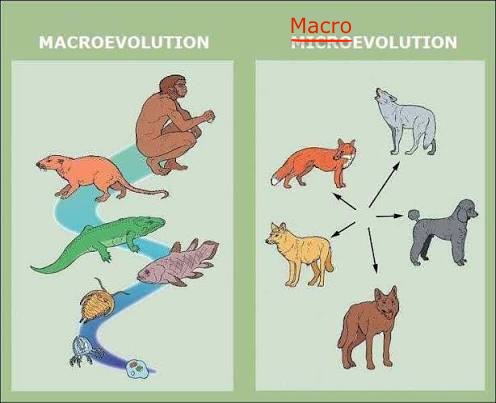
A frequent belief, usually touted as a rebuttal towards creationists, amongst common ancestry proponents is that speciation is macroevolution. Because creationists usually say that they hold to both microevolution and speciation, but not macroevolution, there arises a significant point of confusion from skeptics. Speciation is what happens when organisms have diverged from a lineage population but are separated by niche, geography, habit, or genetics. Macroevolution is a change at or above the species level.
The term macroevolution was coined in 1927 by the Russian entomologist Iuri’i Filipchenko in Variabilität und Variation. He defined it thus*:
“In such a state of affairs, it must be admitted that the decision regarding the question of the factors of the broad features of evolution, i.e., what we call macroevolution, must occur independently of the results of contemporary genetics…” (Page 94)
So macroevolution, according to the original author, does not participate in the class of observable evolutionary processes. Specifically, Filipchenko rejects the notion that macroevolution is speciation:
“…insofar as it is no longer a matter of the ‘origin of species,’ but of characteristics, so to speak, of a higher order, by which we understand characteristics of larger genera, families, orders, classes, etc…” (Page 90)
What Filipchenko is getting at is a notion that microevolutionary processes, simply the processes we observe, are distinct from the kinds which arrive at new body-plans. The changes that he observed could account for variation of parts within their delicate integrated-whole units, but could they account for the origin of novel integrations? Filipchenko argues that any effort in his day to answer that question must be speculative. However, he grants that we may see those events take place and we may accrue evidence which bolsters the hypothesis within the field of genetics.
Yet instead of rising to the challenge to support the macroevolutionary hypothesis, contemporary evolutionary researchers have opted to redefine the term. Macroevolution is speciation. Or at the very least, speciation is the most microcosmic example of this higher macroevolutionary scale.
Their rationale: the modern synthesis has proven that all macroevolution events are just culminations of microevolutionary clusters. There is fundamentally no difference between what goes on in the fossil record and what is going on now.
It stands to reason that if they are satisfied with this redefinition, they must have surely come across some satisfactory evidence that there are no fundamental differences between changes in allele frequencies and changes in higher order structures of the genome. And sure enough, the founders of the MS (Theodosius Dobzhansky, Ernst Mayr, George Gaylord Simpson) did believe they had the evidence to back up their view.
Their evidence came from many lanes, but ultimately it can be boiled down to the simple principle of a nested hierarchy. That there was a consistency of genetic rates of mutations with new taxa in geological history and that there was vast latent diversity within populations to capitalize on new niches quickly. From their perspective, if speciation is the branching point of the nested hierarchy, then speciation is the fundamental unit of macroevolution.
Demonstrating that organisms fit into a nested hierarchy and that gene frequencies shift quickly under selection proves that lineages diverge. But as Filipchenko pointed out in 1927, showing that a system can vary its existing integrated parts across a continuous spectrum is conceptually distinct from demonstrating how a fundamentally new organizational plan is assembled without disrupting the embryonic viability of the organism.
One attempt to further progress in demonstrating this view came from evolutionary development (evo-devo for short). In that area, they appealed to homeotic genes which are genes that facilitate whole organs and structures of the body. These genes are executive genes which can drastically change how an organism is built. A significant factor in its defense is their ubiquity in nature, where large swaths of organismal groups share identical homeotic genes. For example, the Pax-6 gene initiates eye development in insects, mollusks, and vertebrates. All these eyes are vastly different, so perhaps dramatic changes are possible with a base program.
And to credit the modern evolutionary theorists, this work is a valiant attempt. Yet it simply doesn’t justify the semantical shift to Filipchenko’s original thesis. Speciation doesn’t demonstrate changes to fundamental architectures of organisms. Speciation is equally predicted in a world where no large-scale evolutionary epochs exist.
The discovery of shared master switches like Pax-6 offered a compelling glimpse into developmental mechanics, proving that nature can deploy a single executive signal to initiate radically different organ structures—that is not in dispute.
However, this deep homology presents a double-edged blade for the redefined macroevolutionary framework. Because Pax-6 itself is conserved across hundreds of millions of years, the gene cannot be the source of the profound structural differences between an insect’s compound eye and a mammalian camera eye. Those differences reside in the dense, highly integrated downstream Gene Regulatory Networks (GRNs) that process the signal during early embryogenesis. These core regulatory networks operate as tightly coupled developmental hubs; altering their foundational wiring routinely triggers catastrophic embryonic lethality rather than viable structural innovation. Because early developmental pathways are so rigidly canalized, modifying the underlying GRN topology without destroying the viability of the developing organism remains a formidable mechanical hurdle.
Equating speciation with macroevolution addresses the branching of lineages, but it sidesteps the fundamental challenge Filipchenko raised nearly a century ago: how integrated developmental networks can be restructured to yield novel body plans without destroying embryonic viability. Speciation—the divergence of populations through reproductive isolation, geographic drift, or niche specialization—is fully predictable in a framework where structural variation occurs only within established architectural boundaries.
Therefore, it seems a very real possibility that the definition change was a concerted effort to obfuscate where the real clash or debate lies—where the real uncertainty lies in evolutionary theory. If a creationist accepts macroevolution, then the proponent of common ancestry rides off in celebratory parade. If a creationist accepts speciation, then they accept macroevolution, therefore QED. Somewhere along the line of that reasoning, something is being smuggled into the conversation that the creationist did not actually agree to. If that is not the case, the macroevolution is a meaningless phrase. Indeed the evolutionist Dobzhansky, in his book Genetics and the Origin of Species, concluded that one may “reluctantly put an equal sign” between micro- and macro- evolution.
If these terms are rendered useless in this way, then it is only because the evolutionist is begging the question. In order for the evolutionist to say “Speciation is Macroevolution” they must provide evidence that lineage splitting inherently accounts for the origin of novel, integrated developmental architectures. By substituting lineage splitting for structural transformation, modern biological rhetoric may have redefined the term, but the underlying mechanical question remains as vital today as it was in 1927.
*Variabilität und Variation is written in German and the original sentences read as following in order of appearance:
“Bei einer solchen Sachlage muß zugegeben werden, daß die Entscheidung der Frage über die Faktoren der großen Züge der Evolution, d. h. dessen, was wir Makroevolution nennen, unabhängig von den Ergebnissen der gegenwärtigen Genetik geschehen muß…”
“…insofern es sich schon nicht mehr um die ‘Entstehung der Arten’ handelt, sondern der Merkmale sozusagen höherer Ordnung, worunter wir Merkmale der größeren Gattungen, Familien, Ordnungen, Klassen usw. verstehen…”
References
Hautmann, M. (2019). What is macroevolution? Palaeontology, 63(1), 1–11. https://doi.org/10.1111/pala.12465
I︠U︡riĭ Aleksandrovich Filipchenko. (1927). Variabilität und variation von jur. Philiptschenko … Gebrüder Borntraeger.
Nehm, R. H., & Kampourakis, K. (2013). History and philosophy of science and the teaching of macroevolution. International Handbook of Research in History, Philosophy and Science Teaching, 401–421. https://doi.org/10.1007/978-94-007-7654-8_14
Plutynski, A. (n.d.). Speciation and Macroevolution Anya Plutynski Blackwell’s companion. Blackwell’s Companion. Retrieved August 12, 2026, from https://philarchive.org/archive/PLUQAM

Leave a Reply