


The question of free will has perplexed theologians and philosophers for centuries. For one concerned with a proper exegesis of the Bible, the concept of free will is crucial for understanding human responsibility, divine justice, and the nature of God’s relationship with humanity.
The Bible consistently presents humans as moral agents capable of making choices. Several passages highlight this:
- Deuteronomy 30:19: “I call heaven and earth to witness against you today, that I have set before you life and death, blessing and curse. Therefore choose life, that you and your offspring may live.”
- Joshua 24:15: “And if it is evil in your eyes to serve the Lord, choose this day whom you will serve, whether the gods your fathers served in the region beyond the River, or the gods of the Amorites in whose land you dwell. But as for me and my house, we will serve the Lord.”
- Revelation 3:20: “Behold, I stand at the door and knock. If anyone hears my voice and opens the door, I will come in to him and eat with him, and he with me.”
- 2 Peter 3:9: “The Lord is not slow to fulfill his promise as some count slowness, but is patient toward you, not wishing that any should perish, but that all should reach repentance.”
These verses establish that God has instilled in his image-bearing creation an ability to make moral choices. God has made these choices available to us and we are culpable for our sin in disobedience. This is, at the very least, a strong indication that mankind is accountable to God. Therefore, ruling out any form of determinism that denies human accountability.
Theological Considerations
The tension between God’s sovereignty and human free will is a central theological challenge. There is not a simple yes or no that we can give to the question of free will, because it exists in the particular. While God is omniscient and omnipotent, the Bible also affirms human accountability. Further, God can intercede in human activity, even moral activity.
A common example of this is God’s hardening of the Pharaoh’s heart in Exodus. God foreknew Pharaoh’s hardened heart, but Pharaoh’s initial choices were what led to divine hardening. God’s foreknowledge does not negate Pharaoh’s agency. This is what’s called prescience. God knowing the future, but did not cause the future.
God is in total control of how he behaves and interacts with his creation. That does not mean he has to necessarily micromanage every aspect such that this world then becomes, “the greatest of all possible worlds.” If you take the view that God plays a direct role in every particular, you will run into a few problems.
Take the popular analogy of God as an author and humans as characters. This is often used to argue against free will. It goes like this: imagine all of humankind and the universe, itself, are figures of the imagination of God. Sure, in the narrative a certain character may act in this or that way based on their motivations and choices, yet these motivations and choices were all designed by the author. The author can write the characters in whatever way is pleasing.
However, this analogy breaks down when considering God’s desire for genuine relationship. This view results in the rather absurd conclusion that God must have created us solely for the entertainment value. If humans are merely puppets, their love for God is not authentic. True love requires reciprocal choice which requires free will. Therefore, a world without free will results in a parasitic phantasy in the mind of God.
There are two counters to this perspective that I encounter often. They have to do with the power of God and the will of God. I will address, first, the will of God.
It is indeed the case that nothing can happen apart from God’s will. So when this criticism gets brought up the framing is such that it appears, therefore, God wills for all the choices which you have made in your life to have happened and in the manner in which they happened. However, there is a hidden assumption. Does God actually will that, or is what God values a more nuances proposition. I argue that God’s will can be to permit free agency. This is suggested heavily in scripture any time that God calls for a response from his creation. When God says “sin no more,” he is calling man to action. Why is it necessary for God to say this, if God is the only active agent in the process of who sins and who does not? Does it make sense for me to say to my bicycle, “stop pedaling.” According to some, it is not the bike doing the pedaling and, likewise, it is not the man doing the sinning (although the bike is moving and the man is acting they are not casually powerful).
So does man having free will to choose actions that move away from God’s set path make God less powerful? This claim is often made against those who endorse a free-will-agency view. It is suggested that, if man can act apart from God’s purpose for their life (even if it’s not against God’s will) there still arises a problem in which God could plausibly create a world where every freewill agent he created would freely choose him. God can rig the game in his favor, so to speak. Apart from the fact that if this counterexample is true, it has graver consequence on the validity of a reformed view, there is a logical error in this understanding of the nature of free will.
If God were to guarantee a specific outcome, such as every human freely choosing him, then the choice would no longer be truly free. It would be a predetermined response, a mere illusion of choice. True free will necessitates the genuine possibility of choosing otherwise, including the potential for rejection. To remove this possibility is to remove the essence of free will itself, rendering it meaningless. Therefore, to argue that God’s power is diminished by allowing genuine free will is to misunderstand that genuine free will requires the possibility of choosing against God.
Three Main Arguments For Free Will:
- If God ordains every human action, including evil ones, then God becomes the author of evil. For the young earth creationist there is a clear perspective which attributes evil to the misuse of free will, consistent with the Genesis narrative of the Fall. God allows evil, but he does not create it.
- As Dr. Michael S. Heiser argues, humans are created in God’s image, which includes attributes like intelligence, emotion, and creativity. It is consistent that free will is also a component of this image. To deny free will is to diminish human dignity and responsibility. It is also rather arbitrary to leave out a significant part of man’s God-image for no apparent reason.
- The sacrifice of Jesus Christ is presented as sufficient for all humanity. If salvation is not universally applied, it is due to individual rejection, not divine limitation. God’s desire that none shall perish, is a strong argument for free will.
Conclusion
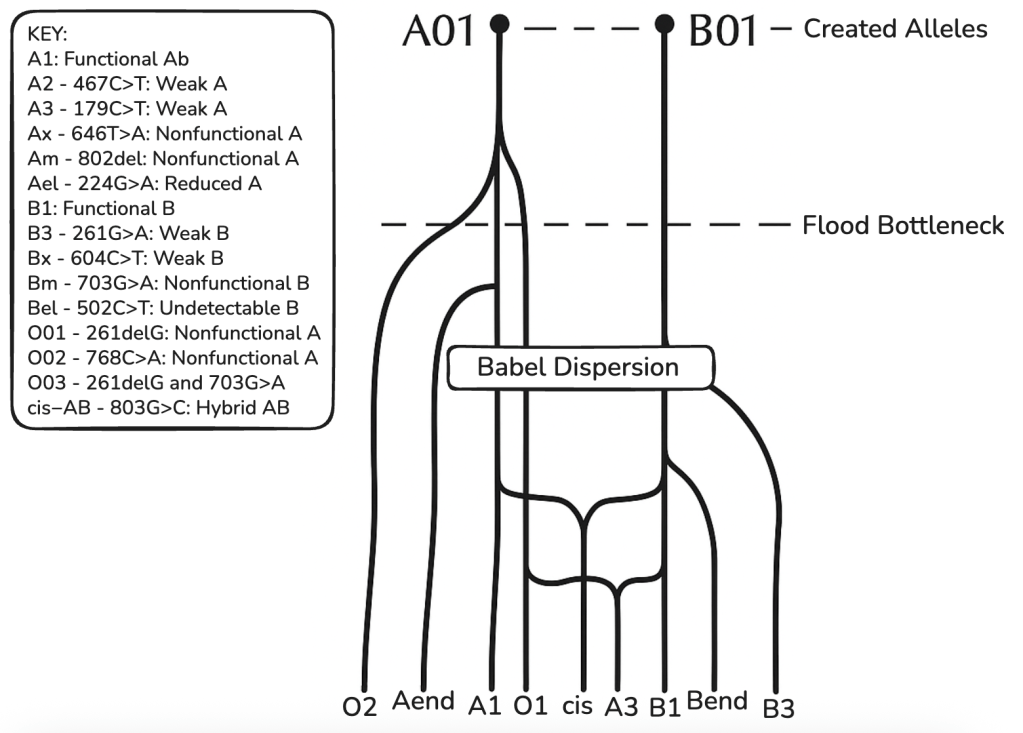
In conclusion, the biblical narrative, particularly the passages emphasizing human choice and accountability, strongly supports the concept of free will. While the tension between divine sovereignty and human agency presents a complex theological challenge, the young-Earth creationist perspective offers a coherent framework for understanding this relationship. By recognizing God’s permissive will, acknowledging the importance of genuine relationship, and affirming the image of God in humanity, we can reconcile these seemingly contradictory truths. The rejection of a deterministic worldview, which reduces humans to mere puppets, underscores the significance of free will in the context of divine justice and love. Potentially, the concept of created heterozygosity and information theory can provide a scientific framework and biological basis for understanding the inherent capacity for diverse moral choices within the created order (although this is speculation). Ultimately, the existence of free will, while a mystery in some respects, is essential for understanding human responsibility, the nature of God’s relationship with humanity, and the very essence of love itself.

Leave a comment