

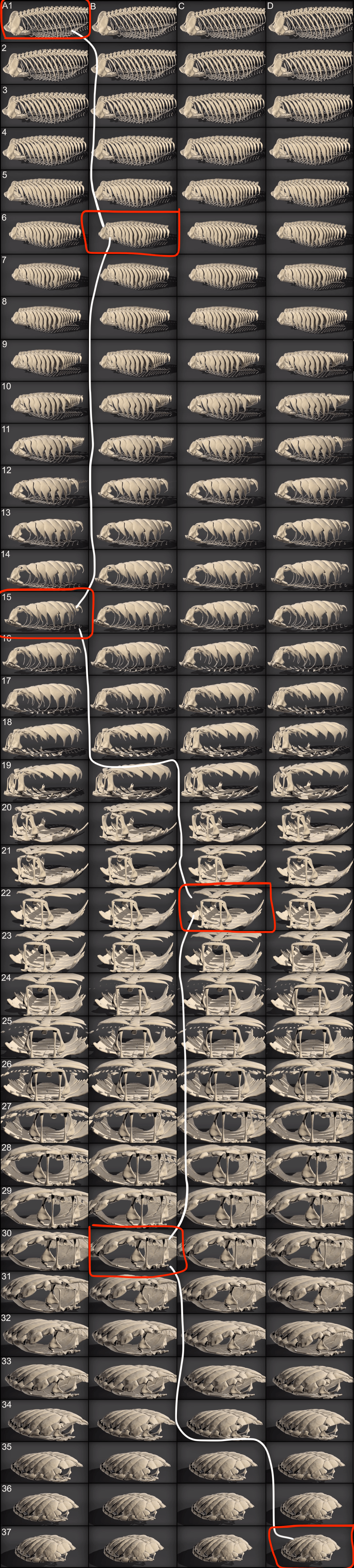
Today I stumbled on an interesting article from 2016 entitled, “Debunking creationism: a visual comparison of “micro” and “macroevolution”“. What initially struck me about the article was a very peculiar picture representing a smooth gradation from ancient lizard ribcage-skeletons to the modern turtle shell. The author notes that, apart from A1, “B6, A15, C22, B30, and D37” are real fossils that “perfectly match the expectations” for transitional forms (Milleretta, Eunotosaurus, Pappochelys, Odontochelys, Chelydra). For reference, I have highlighted those real fossils and drawn a line connecting them as a visual aid.

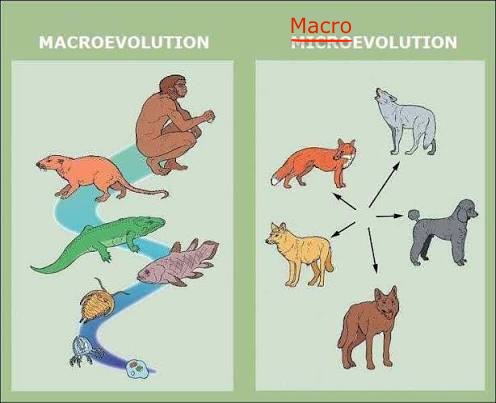
The main thesis of his argument is that the distinction that creationists draw of macro- vs micro- evolutionary processes is an arbitrary one. He writes,
“this distinction is completely arbitrary and meaningless because the exact same evolutionary mechanisms… In other words, macroevolution is simply the accumulation of microevolutionary steps, and one inherently leads to the other.”
This is such a common idea. One that I feel I have probably harped on before, but a summary could go something like: Micro-evolutionary processes are insufficient to cause Macro-evolutionary advancements because micro-evolutionary processes introduce no novelty into an organism. No new protein family, no new regulatory system, no new addition to gene function. We do see many examples of real functional changes that are predicated by the surrounding informational and structural elements—take epigenetics or evo-devo for example. But we have yet to find an example of a genome either becoming more robust or more diverse.
Modification should at least in part be additive. It’s not necessary that it is all the time, but at least a fair minority of the time it should be. We should observe newness in biology for there to be a coherence to a macro-evolutionary model. In my 2025 article, “Mutation is not Creation”, I formulated an extensive argument for these claims.
My real interest today, like the author of this article, is in exploring the implications of a pictorial challenge. As he states, “I decided to take a different approach for this post and provide a visual explanation.” He credits these photos to Dr. Tyler Lyson’s video, “Evolution of the Turtle Shell“.
You may notice, if you’ve seen these visuals before (in video form or in picture slides), that the version of the presentation I have included is immediately less compelling by nature of simply highlighting which images included are observed. There’s a lot that can be said on the impact that visual story-telling and ad hoc narratives play on our minds, hijacking our rational ability to evaluate the evidence. Evolutionary theory is certainly good at it. Whether we’re looking at the frauds of embryology or the constant barrage of natural selection-laced “this one would survive better” statements.
Setting aside the fact that it is actually not at all obvious that light sensors that are curved ever-so-slightly more inward are an advantage concrete enough for any selection effect, we must acknowledge the elephant (you know, the one that mysteriously vanished from the room?). That is, differential survival means absolutely nothing when you have no mechanisms to reliably build the new iterations. If this fossil transitions sheet tells us anything, it’s that we should expect many more forms in the fossil record.
And what do we do with forms such as Psephochelys polyosteoderma that are identical to modern turtles, but contemporary to Pappochelys found on A15? Before Odontochelys (C22) had time to develop a full shell, Psephochelys had already “converged” on that form, i.e., it already had a turtle shell before turtles existed. Which raises the question: On what basis do we take one pile of bones to be “turtles” and another to be “fakes”, when the very argument of smooth transitions in this article depends on bones, and only bones, to make their arguments? In other words, it raises the question: Are they begging the question?
It seems an awful lot like supporting evolution by looking for evolutionary connections…
Unfortunately the author of this blog, Fallacy Man (which is as apropos of a name as I’ve ever heard), fails to recognize the clear discontinuities and only aims to defend against the weaker argument (but still deadly): the dramatic leaps within the hypothetical diagram. He writes:
“Finally, the argument that this pathway is meaningless because it is partially hypothetical misses the point because it is absolutely fine to use hypotheticals to defeat absolute claims. Creationists claim that macroevolution cannot happen, and this pathway shows that it can happen. In other words, to defeat the claim that macroevolution is impossible, I don’t need to prove that this pathway actually occurred; rather, I simply have to show that a pathway is possible, which it clearly is.”
I just had to laugh when I read this—not at Fallacy Man of course, but at the fallacy. In strict modal logic, proving that something is possible does technically defeat the claim that it is impossible. But Fallacy Man’s argument suffers from a massive epistemic equivocation on the word “possible”. He is conflating visual conceivability with mechanistic biological possibility. Drawing a hypothetical sequence of bones only proves that a structural pathway can be imagined. Demonstrating that a morphological gradient can be mapped out on paper completely fails to refute the claim that the generative biological mechanisms required for macroevolution are actually viable. We need more than a conceptual staircase to prove a biological engine exists to climb it.
He offers the final challenge:
In short, if you are going to insist that macroevolution is impossible, then I want you to look at the evolution of the turtle and tell me which step is impossible (and justify that claim).
And to be fair, there are some transitional forms in the diagram that we do not see today which need to be accounted for. Albeit, there are clear turtle forms before and during those transitions in the fossil record, it’s still true that we have no turtles without hard shell backs today like the Odontochelys… No wait. Even that’s not true. Check out the softshell turtle.
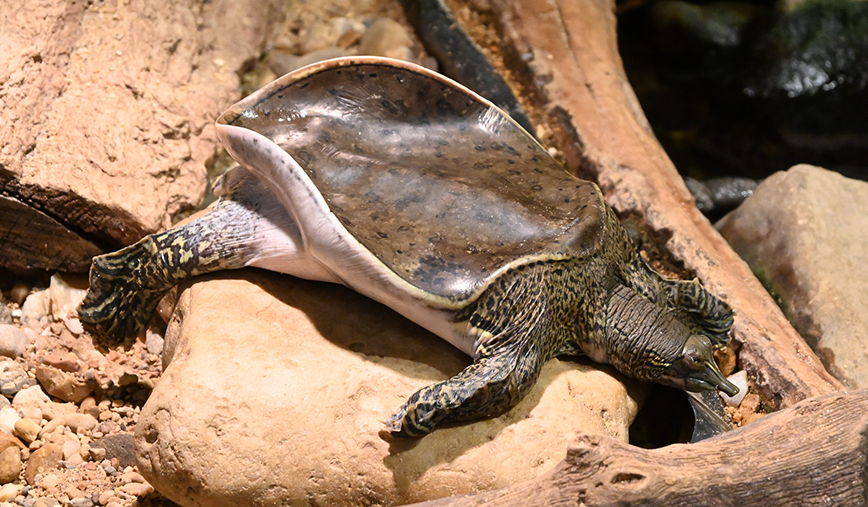
It is a turtle that exists today and has a shell of leathery skin (instead of hard keratin) that could very easily be destroyed when fossilized. That means the skeleton a very similar structure to the Odontochelys and could very feasibly be fossilized without its outer carapace.
So we come to this conundrum: All the transitional forms are still around. They arrive in the fossil record out of order. There are absolutely no clear gradations between them—only self-admitted hypotheticals. So what exactly is this challenge, then?
Because I fail to see any legitimate steps at all.
Citations
Coleman, W. (2025, November 7). Mutation is not Creation. Creation Questions. https://creationquestions.blog/2025/11/07/mutation-is-not-creation/
Fallacy Man. (2016, September 6). Debunking creationism: a visual comparison of “micro” and “macroevolution”. The Logic of Science. https://thelogicofscience.com/2016/09/06/debunking-creationism-a-visual-comparison-of-micro-and-macroevolution/
Lyson, T. (2013, May 30). Evolution of the Turtle Shell (Illustrated) [Video]. YouTube. https://www.youtube.com/watch?v=NphNApmSZ0U


Leave a comment